August 7, 2026, (Inside AI) — Scientists at Stanford University and the Arc Institute have used artificial intelligence to design fully functional viruses from scratch, a first in synthetic biology. The team created 16 novel bacteriophages—viruses that infect bacteria—using a generative AI model trained on millions of natural genomes.
The breakthrough, reported in the journal Science under the title “Generative Design of Bacteriophages with Genome Language Models,” marks a significant leap in the ability to engineer biological entities with precision. The AI-generated phages successfully infected E. coli C bacteria in laboratory tests, with some designs proving more effective than their natural counterparts at killing antibiotic-resistant strains.
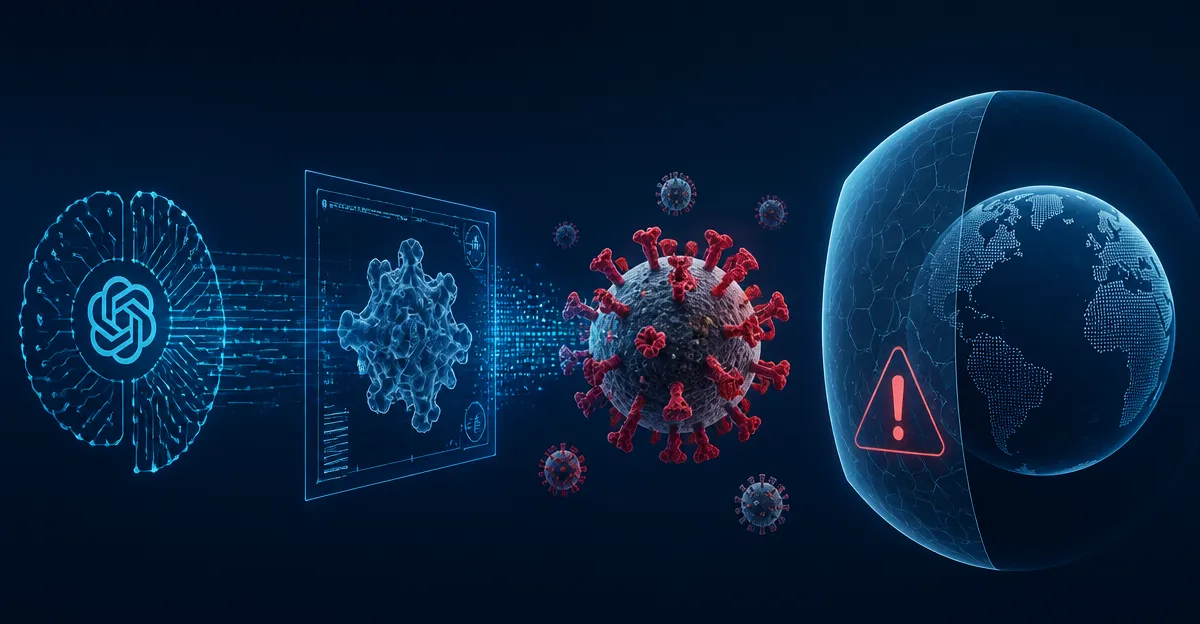
The study’s approach mirrors how large language models like ChatGPT generate text. Researchers fed the model genetic sequences from viruses, bacteria, plants, and humans, allowing it to learn recurring DNA patterns. It then produced entirely new viral genomes with no direct template in nature. From around 300 AI-designed genomes synthesized chemically, 16 yielded viable phages.
“The generated phages were different from any known natural phages, exhibiting de novo mutations, divergent genes and regulatory elements, and variable genome lengths,” the paper stated.
Read: OpenAI Launches Permanent Bio Bounty Program, Doubles Reward to $50,000
A key finding: a cocktail of AI-designed phages rapidly killed antibiotic-resistant bacteria, while a comparable mix of natural phages failed. This suggests the technology could accelerate phage therapy, a long-studied alternative to antibiotics that has struggled with the time-consuming process of isolating effective viruses from nature.
The research underscores a broader shift toward using AI to decode and manipulate biology’s fundamental language. Genome language models, trained on vast repositories like the NCBI GenBank, can now predict functional elements and generate novel sequences. This study went further by proving those sequences can be built into living, replicating organisms.
When Viral Design Outpaces Natural Evolution
Bacteriophages are the most abundant biological entities on Earth, yet only a fraction have been characterized. Traditional phage discovery involves environmental sampling and laborious screening. The AI method bypasses these limits, creating tailored viruses in weeks rather than months. The Stanford-Arc team’s model, uses a transformer architecture adapted to genomic data, treating DNA bases like words in a sentence.
This efficiency raises both promise and peril. On one hand, engineered phages could target crop diseases, foodborne pathogens, or industrial biofouling. On the other, the same techniques might be repurposed to design pathogens that infect humans. The study’s authors acknowledged the dual-use dilemma, noting that while their work focused on bacteria-specific viruses, the underlying AI models are agnostic to host range.
Biosecurity experts have long warned that generative AI could lower barriers to creating dangerous biological agents. A 2023 report from the National Academies of Sciences, Engineering, and Medicine emphasized that language models trained on genomic data could enable the synthesis of pandemic-capable viruses if safeguards are absent. The current study did not involve human-infecting viruses, and the phages used are closely related to the well-studied Phi X-174, which poses no threat to people.
Did AI Cross a Biosecurity Red Line?
Despite assurances, the experiment pushes against existing governance frameworks. Current U.S. policies on dual-use research of concern (DURC) focus on a short list of select agents and specific experiments, such as enhancing pathogen transmissibility. AI-designed viruses fall into a regulatory gray area because the design process itself is digital and can be distributed as code. The International Gene Synthesis Consortium screens orders for dangerous sequences, but AI models can generate designs that evade such checks if not properly monitored.
Read: Duke’s Raygun AI Shrinks Proteins to Unlock Gene Therapy
“The technology is moving faster than the policy,” said Dr. Sarah Carter, a biosecurity analyst at the Center for International Security and Cooperation, in an interview with Inside AI. “We need binding standards for AI models that can design biological agents, not just voluntary guidelines.”
The study’s authors have not publicly detailed the specific training data or model architecture, citing safety concerns. However, they stressed that the phage genomes were synthesized and tested in a biosafety level 2 laboratory, standard for work with non-hazardous organisms. No human-infecting viruses were created, and the phages are incapable of infecting mammalian cells.
Looking ahead, the team plans to explore AI-designed phages for treating infections in animal models, a step toward clinical applications. The work also opens the door to designing custom viruses for gene therapy, vaccine development, and environmental remediation. But the dual-use shadow looms large, and the scientific community is now grappling with how to publish such research without enabling misuse.
The World Health Organization has begun consultations on AI and biological threats, and the Biological Weapons Convention meeting in 2027 is expected to address AI-generated pathogens. For now, the Stanford-Arc study stands as both a marvel of engineering and a cautionary tale, proving that AI can write the code of life itself.