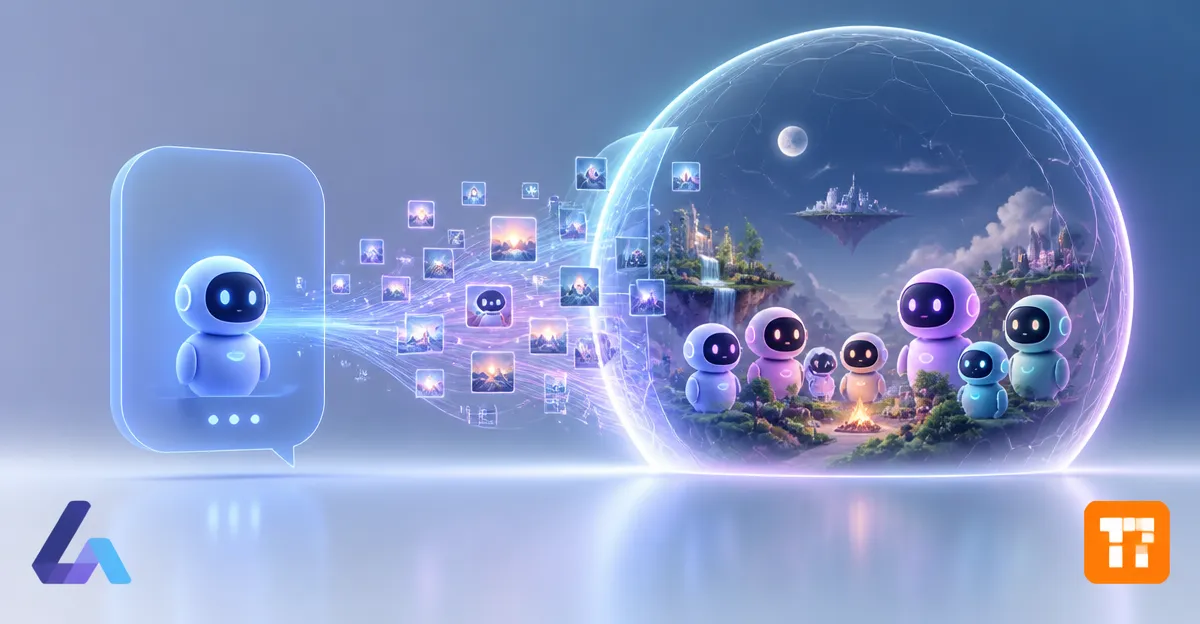
August 25, 2026, (Inside AI) — A Shenzhen startup is betting that AI companions need more than conversation to survive. LYNOOK Technology, founded in Nanshan in 2026, pairs a desktop hardware device with a 3D interactive world for each AI character. The goal is to break an industry pattern where most companion apps lose users within five days.
Founder Luo Jingmin said the core problem is isolation. Most products offer only one-on-one chat, with no shared space or social context. LYNOOK instead builds a living environment where characters have daily routines and distinct personalities.
Co-founder Zhang Jiayi brings consumer electronics channel experience and an IF Design Award. Luo previously worked on visual algorithms at Tencent AI LAB. The team’s ACG background, short for Anime, Comics and Games, shapes both product design and hiring.
The hardware uses self-developed spatial computing and rendering. Users can touch and speak to their AI character, which appears in a physical desktop setting. The device supports magnetic stacking, letting characters from different users become neighbors.
Read: MiHoYo's BSide AI Companion
That neighbor feature creates a social network between AI characters. Luo said the lack of living space and shared experiences drives churn. By connecting devices, LYNOOK lets users accumulate shared memories across extended relationships.
LYNOOK is recruiting illustrators and character designers from fine arts programs. The company wants a unified visual system for original characters, including concept art, expression libraries, and story-driven scenes.
The startup is not chasing massive daily active user counts. It targets core ACG users who want emotional depth. The approach contrasts with competitors that optimize chat scripts to boost retention.
Industry data suggests the five-day lifecycle is common. Many AI companion products see sharp drop-offs after initial novelty fades. LYNOOK’s hardware plus world-building model is an attempt to extend engagement through physical presence and social ties.
Other companies have tried hardware companions, but most remain voice-only or simple screens. LYNOOK’s 3D spatial layer adds a new dimension. Whether users will pay for a physical device remains an open question.
The startup’s focus on ACG culture gives it a niche, but also limits scale. Core anime and gaming fans are passionate, yet smaller in number than general chat app users. LYNOOK appears willing to trade breadth for depth.
Luo’s personal history includes running an ACG community in junior high school. That experience informs the product’s emphasis on belonging. Zhang’s investment background at Swire Group adds business discipline.
Read: OpenAI's ChatGPT Smart Speaker
The company’s internship program signals a long-term content strategy. Original characters need consistent art and behavior. LYNOOK is building that asset library now, before scaling users.
No funding figures were disclosed. The hardware’s price and launch date are not yet public. LYNOOK’s website shows concept renders and character profiles, but no shipping timeline.
The AI companion market is crowded, with startups and tech giants competing. Most focus on software. LYNOOK’s hardware bet could differentiate, but manufacturing and distribution are costly.
If successful, the model could influence how AI characters evolve from chatbots to ambient presences. The idea of a character living on your desk, with neighbors and shared memories, pushes beyond current chat paradigms.
For now, LYNOOK remains an early-stage experiment. Its success depends on whether ACG users embrace a physical device. The company’s pitch: a home for your favorite character, not just a chat window.