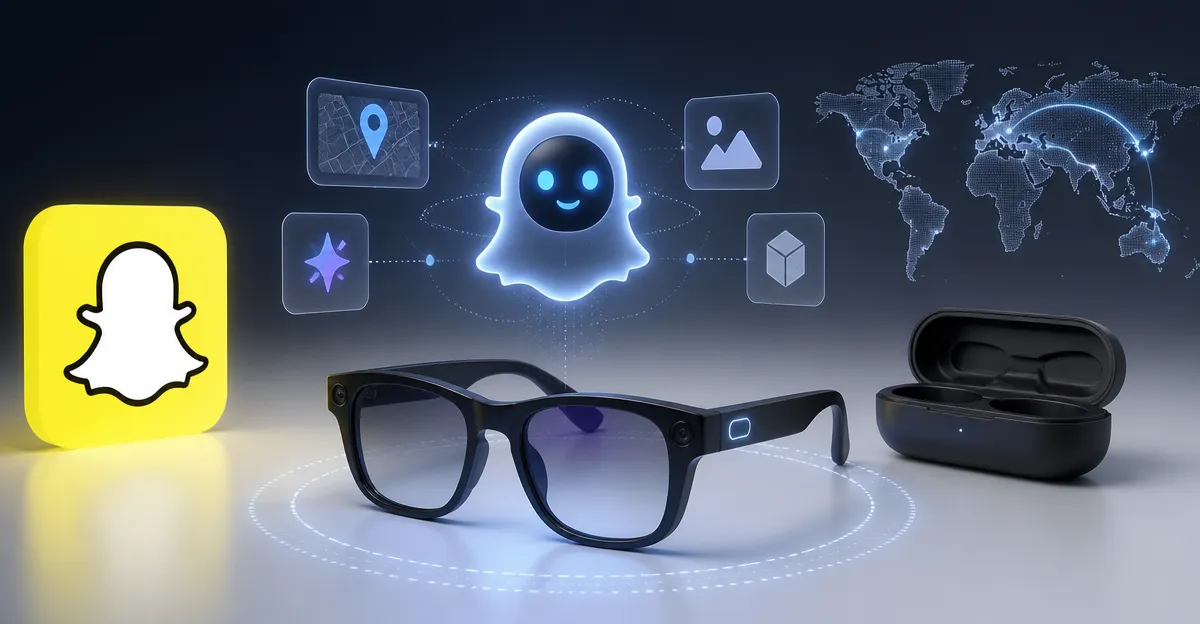
September 17, 2026, (Inside AI) — Snap will launch its first augmented reality glasses, Specs, this fall at $2,195, betting that a new anticipatory AI assistant can justify a price that stunned early observers. The company unveiled the full feature set on Wednesday, including Specs Intelligence, an AI service that connects to Gmail, Slack and other accounts to surface work tasks, travel plans and meeting preparation directly into the wearer's field of view.
Early buyers can get the glasses at a pop-up in Los Angeles in October 2026. The device ships with two lens sizes, 47mm and 52mm, and runs on Snap's Snap OS. Specs Intelligence is available on iOS in preview starting today, with a waitlist for a Mac version.
The launch represents Snap's second attempt to sell the public on face-worn computing. The first reveal earlier this year drew criticism over the price and the bulky black frame, which is noticeably heavier than Meta's Ray-Ban smart glasses. Wednesday's announcements aim to answer the obvious question: what does the device actually do that a phone cannot?
Specs Intelligence Trades Privacy for Personal Context
Snap describes Specs Intelligence as an "anticipatory AI service" that helps users manage daily attention and longer-term goals. Users connect the apps and tools of their choosing, allowing the assistant to ground its outputs in personal context. A user preparing for a meeting can ask for likely questions. A traveler can request flight, hotel and dinner plans while the assistant flags a work deadline during the trip.
Read: Meta AI Launches Dedicated Mac App
The system runs on a proprietary mix of open-source models hosted in the United States alongside local large language models. Snap says it cannot view or access personal content fed to Specs Intelligence. The company also says connected account data will not train or fine-tune its AI models, nor serve personalized ads.
That privacy architecture matters because the assistant's value depends on deep access to email, calendars and messaging. Snap is asking users to hand over sensitive context to a company whose core business is advertising. The pledge not to use that data for ad targeting is a direct response to that tension, though it remains a policy promise rather than a technical guarantee.
Positioning Specs as a more human-centric computer, CEO and co-founder Evan Spiegel framed the launch against industry narratives about AI replacing workers and virtual worlds replacing reality.
"I will say it's an interesting time to be launching a new computer because things in tech are pretty weird right now," Evan Spiegel, CEO and co-founder of Snap, said. "We're being told that AI will take our jobs, that virtual worlds will replace the real one. Well, no, thank you. We do not accept that future. Making people irrelevant is not progress, and computers should make us more important, not less."
Spiegel's remarks echo a broader shift among hardware makers who now sell AI as an amplifier of human attention rather than a replacement for it. Whether buyers accept that framing at $2,195 is the central commercial test.
Enterprise, Entertainment and a Cellular Bet
Snap also introduced Specs for Enterprise, a program that integrates the glasses into corporate workflows through partnerships with Amazon, Salesforce, Nvidia and other firms. A demo showed an IT technician repairing hardware with remote guidance through the glasses. The program signals that Snap sees working professionals as an initial market, not just consumers.
On the entertainment side, Specs will play content from HBO Max and Spotify. Snap partnered with the NBA and WNBA on an AR basketball training experience that lets wearers practice and improve their shot. A connectivity package with Verizon adds a charging case with built-in cellular, priced at $10 a month for Verizon customers and $20 a month for others.
Read: Anthropic Merges Claude Cowork and Chat into One Unified Experience
The enterprise push and the Verizon bundle address two adoption barriers: usefulness at work and dependence on WiFi. Both moves follow a pattern set by enterprise AR vendors like Microsoft and Magic Leap, which found early revenue in industrial and medical training before consumer markets matured. Snap is attempting to run both playbooks at once.
Snap has also leaned on Indian developers to build AR experiences for its app and glasses, a detail that points to where the company expects creator supply to come from. The strategy mirrors how Meta seeded its Quest store with external studios before scaling first-party content.
What remains unproven is whether an anticipatory assistant can overcome the physical and financial friction of wearing a computer on your face. The glasses are heavier than rivals, the price is roughly triple a high-end phone, and the AI features depend on integrations Snap does not control. The October pop-up will offer the first real signal of whether early adopters see a computer that makes them more important, or an expensive accessory searching for a reason to exist.