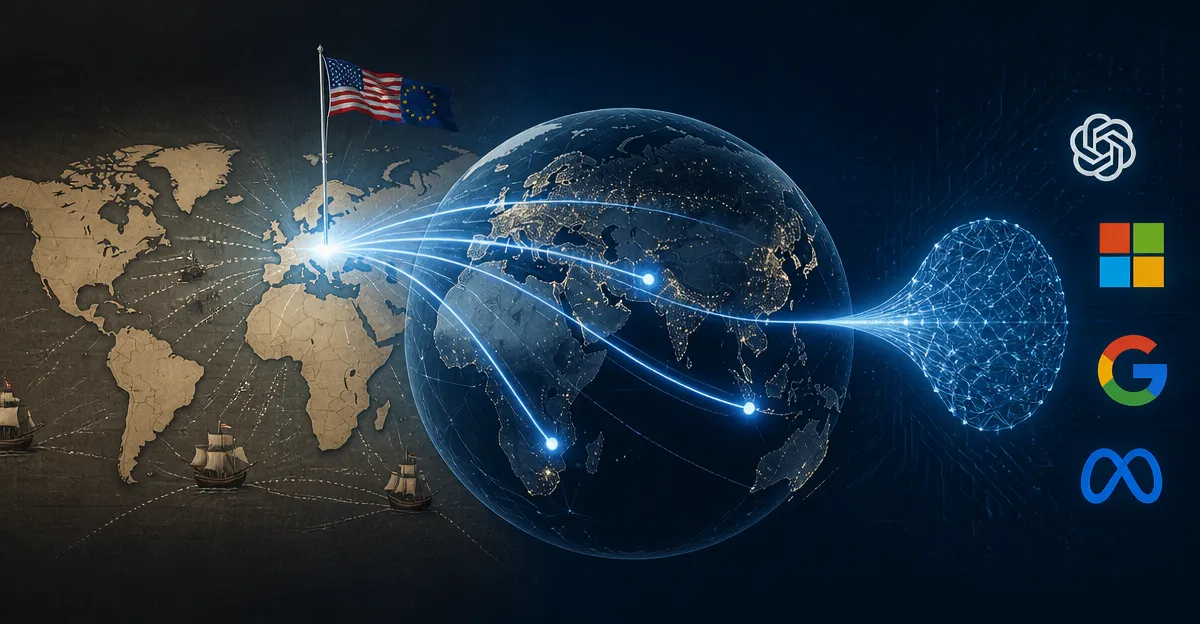
July 9, 2026, (Inside AI) — Filmmaker Aranya Sahay has drawn a sharp parallel between artificial intelligence and colonialism, arguing that the technology, while ostensibly universal, is shaped by a narrow set of Western perspectives. In an exclusive interview with The Indian Express, Sahay stated:
“AI is no less than colonisation. It (AI) is meant for everyone, but it is driven by Western minds and Western ideas.”
The comment comes as his debut feature, Humans in the Loop, secures a global Netflix release and becomes eligible for consideration at the 2026 Academy Awards for Best Original Screenplay. The film follows an Indigenous Adivasi woman confronting algorithmic bias, a narrative rooted in Sahay’s studies of sociology and his observations of Adivasi communities in Jharkhand.
Sahay’s critique lands amid growing scrutiny of AI’s geopolitical dimensions. A 2023 study by the AI Now Institute found that over 80% of AI research published at top conferences originates from Western institutions, reinforcing what critics call an epistemic monopoly. This dominance shapes everything from training data to model behavior, often marginalizing non-Western languages and cultural contexts. Sahay’s film dramatizes this by showing how a facial recognition system fails to identify Adivasi features, echoing real-world cases like the 2021 MIT study that exposed higher error rates for darker-skinned women in commercial AI tools.
Read: India Expert on UN AI Panel Warns Fragmented Rules Could Create Digital Colonies
Yet some researchers push back against the colonialism analogy. Dr. Timnit Gebru, founder of the Distributed AI Research Institute, has cautioned that such comparisons risk oversimplifying both AI and historical colonialism. “Colonialism was a system of violent extraction and subjugation,” she noted in a 2022 paper. “AI’s harms are real, but they operate through different mechanisms of power.” Others argue that framing AI as a monolith ignores grassroots efforts in India, Africa, and Latin America to build locally governed AI systems. The Masakhane project, for instance, has developed machine translation models for over 2,000 African languages, directly challenging Western-centric NLP.
Sahay’s journey to Netflix was itself a battle against industry gatekeeping. With a micro-budget, a 12-day shoot, and a cast mostly of Jharkhand locals, the team bypassed traditional distributors. They held nearly 100 grassroots screenings and built a network of 7,000 supporters, eventually attracting filmmaker Kiran Rao as executive producer. “Thoda nahi, kaafi mushkil tha,” Sahay recalled, describing the struggle to place a starless indie film on a global platform. He clarified the Oscar buzz: “We became eligible for the Oscars. There is a difference,” stressing it was under consideration, not a final nominee.
Read: How the Ancient Chinese I Ching Shaped Modern AI Through Leibniz
Looking ahead, Sahay announced a creative fellowship for five marginalized filmmakers in Jharkhand, offering financial support and post-production access. He urged emerging creators to think globally: “If I’m making a film, I’m competing with Christopher Nolan.” His advice cuts to the core of AI’s own challenges—only by amplifying unheard voices can technology, like cinema, escape the gravitational pull of a single worldview.