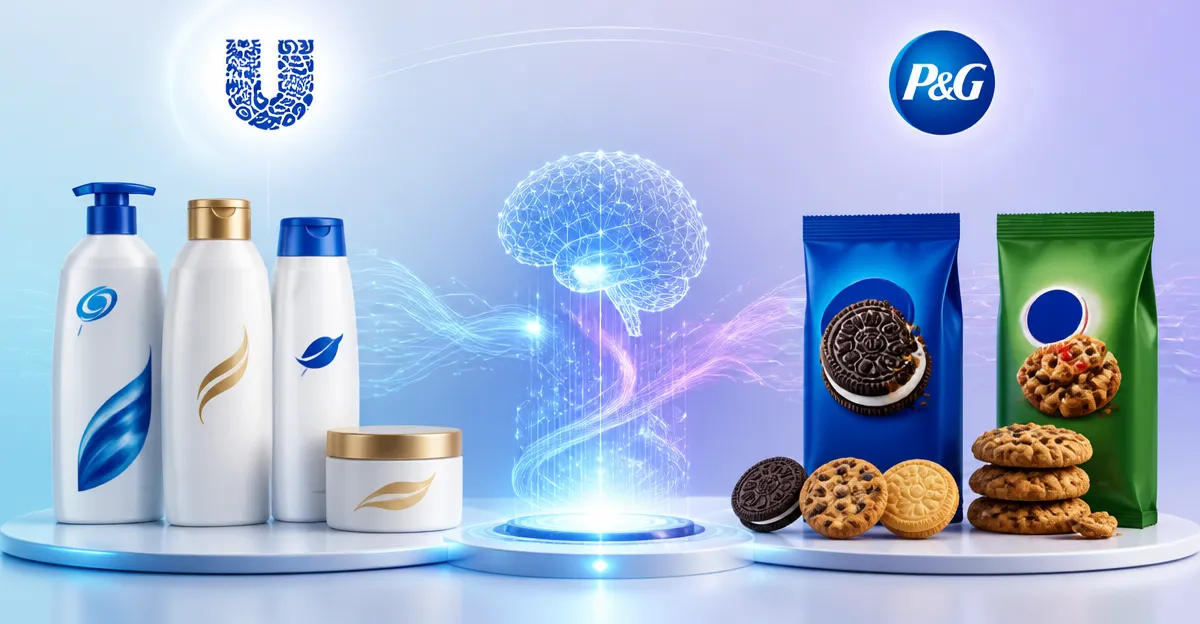
July 6, 2026, (Inside AI) — Consumer goods giants are racing to infuse artificial intelligence into product development, compressing innovation cycles from years to months. L’Oréal, Nestlé, Haleon, and Mondelez are among the firms leveraging AI to reformulate shampoos, cookies, and more—with executives calling the shift a game-changer for speed and cost.
At the Consumer Goods Forum’s Global Summit in Vienna in late June, L’Oréal revealed it now creates products four times faster by using AI to predict molecular effects on skin and hair. Fabrice Megarbane, president of its consumer products unit, said the company repurposed skincare molecules for a new collagen-infused shampoo that adds lift and fullness.
“You can really go much faster by imagining … new associations of molecules and new benefits of molecules,” Megarbane told Reuters.
The push comes as consumer tastes fragment and companies face margin pressure. L’Oréal CEO Nicolas Hieronimus launched a “beauty stimulus plan” last year after the firm posted its slowest group sales growth in years. AI is now central to that plan, identifying new molecules and accelerating lab work that began four years ago.
Read: Bristol Myers Squibb Buys Nvidia’s Latest AI Supercomputer for Drug Research
At Mondelez, maker of Cadbury and Toblerone, AI is rewriting recipes. Chief Information and Digital Officer Filippo Catalano said the technology generated “out-of-the-box” ideas for its Gluten Free Golden Oreo cookies and a refreshed Chips Ahoy recipe. The firm’s AI tool cut sample counts and delivered better nutrition, sustainability, and cost metrics in 60% of biscuit recipes.
“You can optimise how you develop your recipes,” Catalano said, noting AI reduces dependency on single-source ingredients and adapts formulas to shifting demand. “(AI capabilities are) accelerating things you could do already, but compressing the time from months to weeks or years to months.”
Nestlé and Haleon are also deploying AI for ingredient testing and supply chain resilience, though details remain sparse. The trend mirrors a broader industry pivot: AI is moving from back-office automation to core R&D, where even small efficiency gains can yield blockbuster products.
Yet the transformation is not without friction. AI-generated recipes still require human validation to ensure safety and taste. Mondelez’s Catalano stressed that experts assess every AI output. Similarly, L’Oréal’s molecular predictions must pass rigorous lab and consumer tests before reaching shelves.
Historically, consumer goods R&D relied on trial-and-error and lengthy focus groups. The AI shift echoes the pharmaceutical industry’s adoption of computational chemistry in the 1990s, which slashed drug discovery timelines. Now, shampoo and cookie makers are catching up, using similar predictive models to mine existing ingredient databases for new uses.
What’s missing from the current narrative is hard data on cost savings or revenue impact. Neither L’Oréal nor Mondelez disclosed specific ROI figures. Skeptics may question whether AI-driven innovation truly creates differentiated products or merely optimizes existing formulas. Moreover, the environmental footprint of training large AI models could undercut sustainability claims.
Read: AI-Referred Shoppers Spend 53% More Per Visit, Adobe Data Shows
Regulatory hurdles also loom. The European Union’s AI Act and evolving FDA guidelines on AI in consumer products could slow deployment. Companies must prove that AI-generated formulations meet safety standards—a process still undefined for many categories.
Despite these unknowns, the momentum is clear. AI is becoming a competitive differentiator in an industry where speed to market can make or break a brand. As Catalano noted, the technology is not doing the impossible—it is doing the possible, faster. For consumers, that could mean more personalized, sustainable, and novel products hitting shelves sooner than ever before.