July 8, 2026, (Inside AI) — China is weighing restrictions on foreign access to its most advanced AI models, a move that could isolate its leading startups and trigger a global tech fragmentation. The discussions, led by the Ministry of Commerce, involve top firms like Alibaba, ByteDance, and Knowledge Atlas, and aim to limit both the use and funding of cutting-edge systems by overseas entities.
The proposed curbs mirror recent U.S. actions. In June, Washington restricted foreign nationals from accessing Anthropic’s most advanced Fable and Mythos models, though Fable’s controls were later eased. China’s potential rules could confine homegrown giants like the $92 billion Zhipu and Moonshot to local markets, slowing their progress and pushing other nations to build costly alternatives.
The closed-door meetings, held over the past month, signal Beijing’s intent to shield its AI sovereignty. According to a Reuters report on July 7, participants explored capping access to even open-source versions of advanced models and tightening rules on who can invest in domestic AI startups. None of the companies responded to queries.
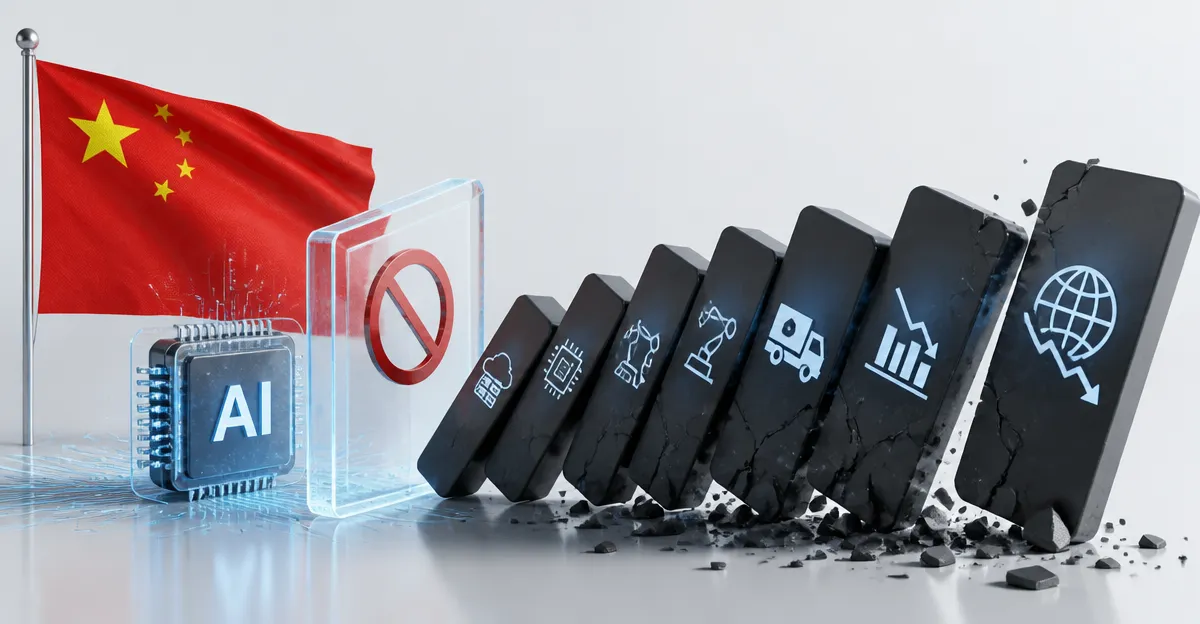
This tit-for-tat escalation risks balkanizing the global AI landscape. By cordoning off its most powerful models, China would not only stifle cross-border collaboration but also incentivize other countries to develop independent AI stacks, duplicating efforts and raising costs. The economic ripple effects could be profound, as AI becomes a core infrastructure for industries worldwide.
The Cascade of Isolation
Restricting foreign access would hit China’s AI unicorns hard. Zhipu, valued at $92 billion, and Moonshot rely on global user data and capital to refine their models. Cutting them off would slow iteration cycles and reduce competitiveness against Western counterparts like OpenAI and Google DeepMind. It would also deter international investors, drying up vital funding streams.
Historical parallels are instructive. The U.S.-China tech decoupling over 5G and semiconductors fragmented supply chains and inflated costs. AI, however, is more pervasive, embedded in everything from healthcare to defense. A divided AI ecosystem could lead to incompatible standards, security risks, and a loss of the collaborative research that has driven breakthroughs.
Smaller nations face a stark choice: align with one bloc or build from scratch. The latter is prohibitively expensive. Training a single large language model can cost hundreds of millions of dollars, not to mention the talent and infrastructure needed. This could widen the AI gap, leaving developing countries dependent on foreign tech that may be restricted or untrustworthy.
Mirroring Moves and Missing Pieces
The U.S. set a precedent with its Anthropic order. The Mythos model, designed for cybersecurity pros, remains locked to “trusted” U.S. organizations only. China’s discussions suggest a similar playbook, but with broader scope—potentially covering all frontier models, including those yet to be released. The Ministry of Commerce’s involvement hints at export control-style mechanisms.
Yet, critical details are absent. Which specific model capabilities would trigger restrictions? How would open-source releases be policed? And what about joint ventures between Chinese and foreign firms? Without clarity, companies face a compliance minefield. The lack of public comment from Alibaba and ByteDance underscores the sensitivity.
Una Galani, Asia Editor of Reuters Breakingviews, notes that confining these firms would slow their progress and push other countries to build their own tech. The full analysis will be published shortly on Breakingviews. Meanwhile, the global AI community watches nervously as the two superpowers draw new battle lines.
In the broader context, this move aligns with China’s push for technological self-reliance. But it also reflects a defensive posture against U.S. containment. As AI becomes a geopolitical weapon, the risk of a fragmented, less innovative future grows. The next steps from Beijing will be closely parsed for signals on how far this decoupling will go.