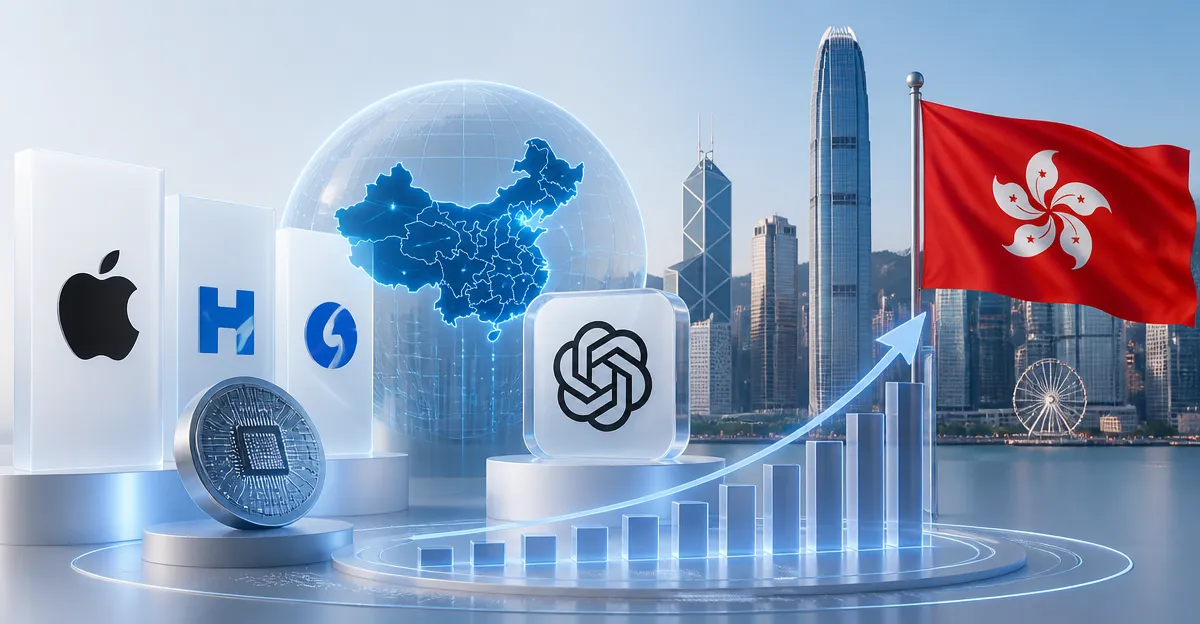
July 9, 2026, (Inside AI) — Chinese technology companies have raised a combined HK$136.23 billion ($17.38 billion) in Hong Kong equity markets this year, as firms from battery giants to AI model developers tap soaring investor demand to fund expansion in artificial intelligence, semiconductors, and advanced manufacturing.
The wave of listings and share sales underscores Hong Kong’s role as a critical capital hub for China’s tech sector, even as geopolitical tensions and export controls complicate access to Western markets. The deals span electric vehicle supply chains, AI infrastructure, and chip design, reflecting Beijing’s push for self-sufficiency in strategic technologies.
Among the largest transactions, CATL, the world’s leading EV battery maker, raised approximately HK$39.2 billion in an April share sale, just months after its blockbuster Hong Kong debut. The company priced 62.4 million new H shares at HK$628.20 each, capitalizing on its dominant market position with customers including Tesla, BMW, and Volkswagen.
AI-focused firms have been particularly aggressive. Zhipu AI, a prominent large language model developer seen as a rival to OpenAI, launched a HK$31.41 billion share sale. MiniMax Group, founded in 2022 by former SenseTime executive Yan Junjie, raised HK$4.82 billion after pricing shares at the top of its range. The company develops multimodal AI models generating text, audio, images, video, and music.
In the autonomous driving space, Momenta Global, backed by Mercedes-Benz, raised about HK$5.89 billion despite a flat trading debut. Founded in 2016 by former Microsoft researcher Cao Xudong, Momenta supplies assisted-driving solutions to automakers like Toyota and BYD.
Semiconductor firms also featured prominently. Shanghai Biren Technology, an AI chip startup, raised HK$5.58 billion in a December listing, with most proceeds earmarked for R&D. Co-founded by former SenseTime president Zhang Wen and ex-Huawei and Qualcomm executive Jiao Guofang, Biren aims to commercialize its designs amid U.S. chip restrictions.
Montage Technology, a semiconductor designer founded in 2004, raised HK$7.04 billion in February. Its offering attracted 17 cornerstone investors, including JPMorgan Asset Management and UBS Asset Management. The company designs integrated circuits that accelerate data movement in servers and data centers.
Other notable deals include Lingyi iTech, an Apple supplier, which priced its IPO to raise about HK$8.3 billion, partly to expand AI capacity. Founded in 2006 by billionaire Zeng Fangqin, the company also supplies Huawei and Samsung. Meanwhile, OmniVision Integrated Circuits, the world’s third-largest digital image sensor provider with a 13.7% market share, raised HK$4.80 billion and plans to allocate 70% to R&D.
The Hong Kong listings come as Chinese authorities encourage domestic capital formation to counter U.S. export controls on advanced chips and AI technologies. By listing in Hong Kong, firms gain access to international investors while staying within China’s regulatory orbit. The city’s exchange has relaxed rules for pre-revenue tech companies, fueling the IPO pipeline.
However, some debuts have been mixed. Momenta’s flat performance and caution around AI stocks reflect lingering concerns over valuations and geopolitical risks. Still, the sheer volume of deals—from GigaDevice Semiconductor’s HK$4.68 billion listing to Nexchip Semiconductor’s HK$6.98 billion offering—signals robust appetite for China’s tech champions.
Analysts note that the fundraising aligns with Beijing’s “new quality productive forces” strategy, prioritizing AI, green energy, and advanced manufacturing. Whether these companies can deliver returns amid intense competition and regulatory uncertainty remains an open question.