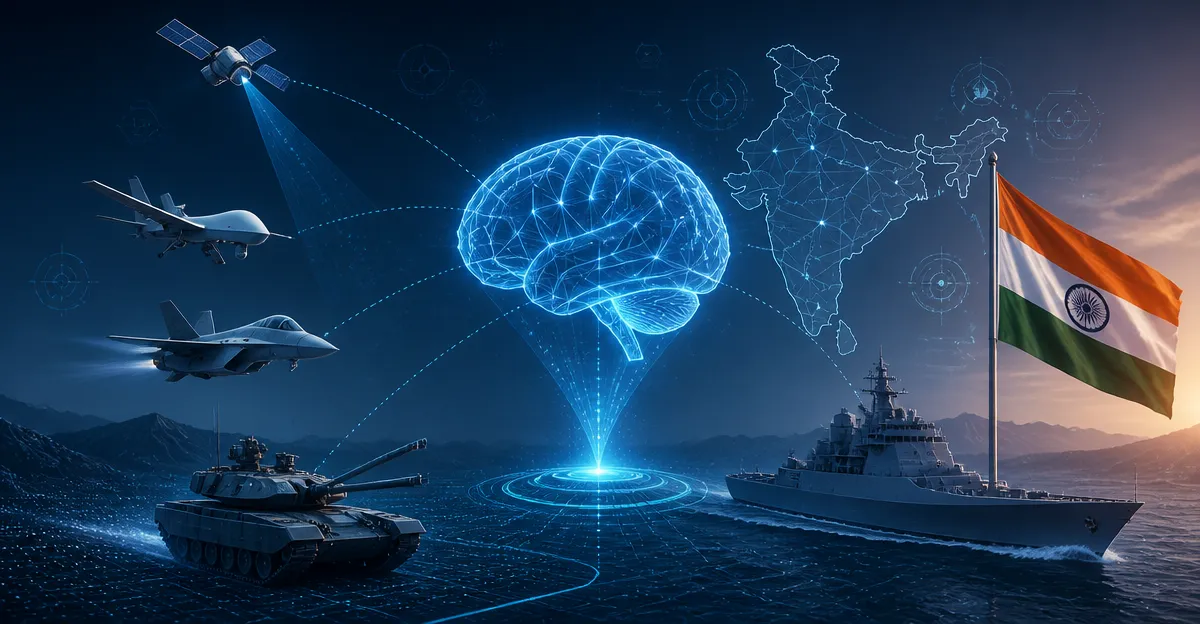
July 6, 2026, (Inside AI) — Artificial intelligence is fundamentally altering the character of modern warfare, pushing military strategy into an era where algorithms dictate the speed and precision of combat. The fusion of AI, military autonomy, and algorithmic warfare is not a distant prospect but a present reality, already reshaping battlefields from Eastern Europe to the Middle East.
Lieutenant General (Retd.) Raj Shukla, former Army Commander of India’s Army Training Command, warns that this convergence represents a ‘Manhattan Project’ moment for combat. He argues that India must urgently adapt or risk strategic obsolescence. His analysis, rooted in recent conflicts, outlines how software-driven kill chains are compressing decision cycles and redefining deterrence.
The Algorithmic Battlefield: Lessons from Ukraine, Venezuela, and Iran
The Russia-Ukraine war has become a live laboratory for AI-enabled warfare. Ukraine’s Delta platform exemplifies this shift. It fuses radar imagery, social media feeds, and other intelligence into a single stream, creating a digital ‘kill web’ that reduces engagement times from detection to neutralisation to just minutes. A 35-km corridor along the frontier, nicknamed the “death zone,” sees artillery pushed back, tanks immobilized, and infantry targeted by FPV drones within moments of being spotted.
This year, Ukraine plans to procure eight million drones, surpassing its artillery ammunition expenditure from last year. These unmanned systems offer commanders options from close air support at 25 km to strategic strikes at 2,500 km. The shift from remote human control to algorithmic autonomy is accelerating. In the naval domain, autonomous software is increasingly captaining vessels, while in the air, startups like Anduril are testing the YFQ-44A Fury, an AI-powered autonomous fighter jet.
Read: US Weaponizes AI Access, Forcing India to Confront a Permanent Strategic Gap
Beyond Ukraine, AI’s role in covert operations is growing. In Venezuela, the United States reportedly used Anthropic’s Claude to track ousted president Nicolás Maduro, anticipate his movements, and synchronize electronic attacks with a Delta Force assault. In Iran, machine-speed targeting packages enabled strikes that eliminated nearly the entire Iranian leadership on the morning of February 28. These cases underscore a brutal truth: AI is compressing the kill chain to machine timescales, leaving human decision-makers struggling to keep pace.
India’s Strategic Imperative: A Sovereign AI Pathway
For India, the implications are stark. The country faces a two-front threat from Pakistan and China, both investing heavily in AI-driven military capabilities. Chinese innovations like DeepSeek and Huawei’s Tau’s Law of Scaling—aiming for 1.4 nanometre transistor density by 2031—signal a race to surpass current Nvidia Blackwell chips at 4 nanometres. Meanwhile, software updates in combat theatres now occur every three weeks, outpacing hardware cycles of three months.
Lt. Gen. Shukla proposes a sovereign roadmap. First, India must urgently develop an AI-enabled data analytics platform akin to Delta. Second, it needs software for autonomous drone swarm coordination, capable of distinguishing birds from combat platforms and directing shooters. Third, a diverse drone inventory targeting five million units by 2028 is essential. Fourth, counter-drone systems—laser and microwave weapons—must be deployed along the Line of Control and Line of Actual Control to establish AI-enabled kill webs.
Space is another frontier. Crowding low-Earth orbit with persistent surveillance assets would shift India from periodic reconnaissance to offensive intelligence, surveillance, and reconnaissance. Crucially, the 2027 defence budget must reflect this transition, with at least 40% of the roughly Rs 2 lakh crore modernization fund directed toward technological solutions. This cultural and structural overhaul, Shukla asserts, would grant India “combat overmatch” with Pakistan and “asymmetric deterrence” with China.
Read: Anthropic Blackout Exposes Strategic AI Dependence for India and Allies
Yet challenges remain. India’s defence procurement bureaucracy, traditionally focused on platforms and weapons, must metamorphose into a software enterprise. Competing viewpoints highlight risks: over-reliance on AI could introduce vulnerabilities to adversarial data poisoning or electronic warfare. Ethicists also question the accountability gaps in autonomous targeting. However, as the global arms race in AI accelerates, the cost of inaction may be higher. The Ministry of Defence’s ability to integrate startups and iterate rapidly will determine whether India can secure its digital sovereignty in an age where software defines firepower.