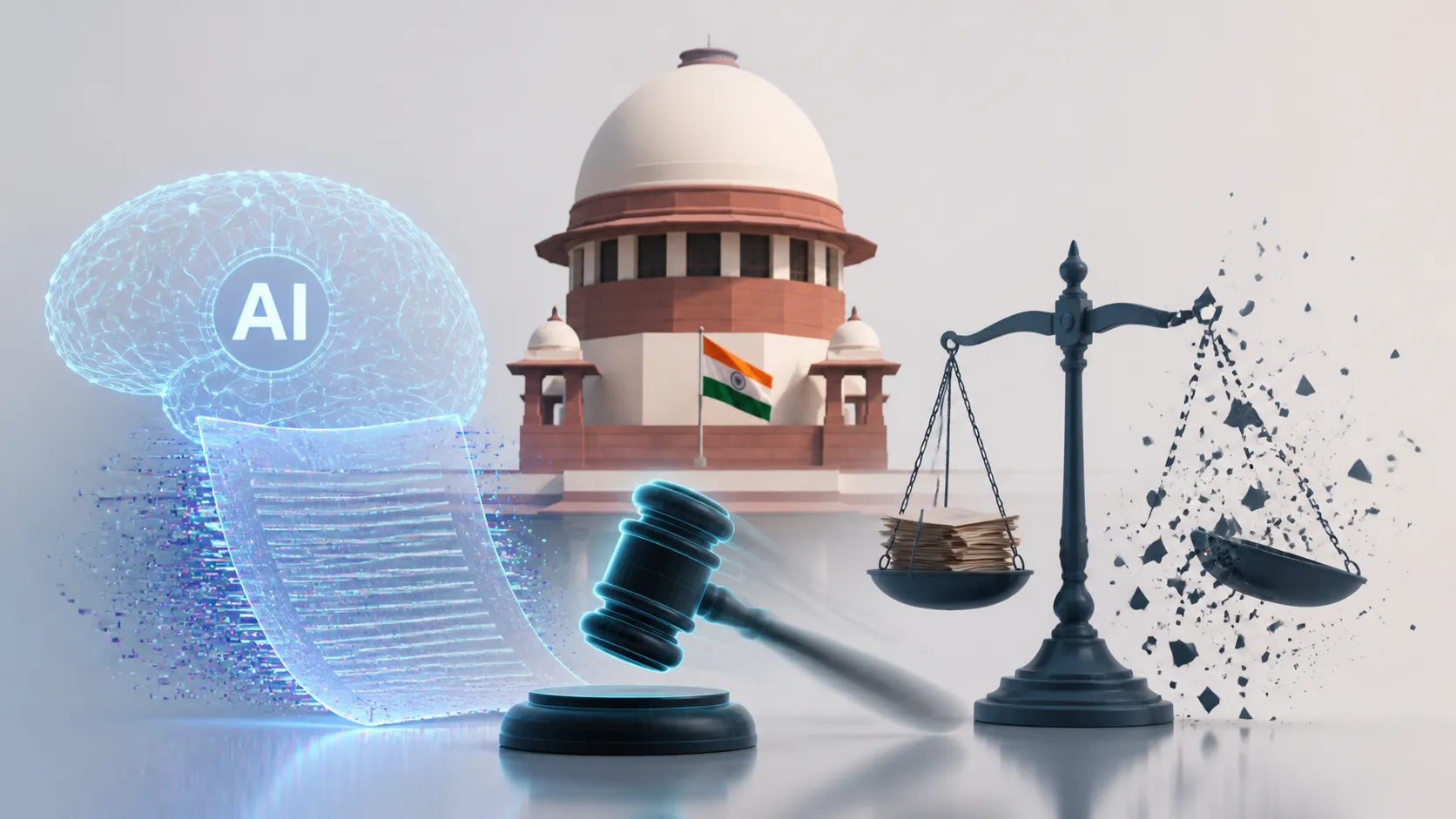
July 4, 2026, (Inside AI) — The Supreme Court of India has set aside a National Company Law Tribunal (NCLT) order after discovering it was built on six AI-hallucinated judgments. Three of the cited cases do not exist, while the remaining three contained fabricated quotes or misattributed references.
The bench of Justices P S Narasimha and Alok Aradhe delivered the ruling on July 2, 2026, in an appeal by Essel Infraprojects Ltd against insolvency proceedings. The court found the NCLT’s 2024 decision, upheld by the NCLAT in September 2025, was fundamentally flawed.
This marks the second time this bench has confronted AI hallucinations in legal rulings. In February 2026, they overturned an Andhra Pradesh trial court order in Gummadi Usha Rani v Sure Mallikarjuna Rao that relied on four non-existent AI-generated judgments.
The NCLT had admitted a Section 7 insolvency petition against Essel Infraprojects as a corporate guarantor for a Rs 200 crore loan from Jammu and Kashmir Bank to Pan India Utilities Distribution Company Ltd. Essel argued its guarantee had been extinguished through a 2014 Bombay High Court-approved demerger and amalgamation.
The tribunal rejected this defense using six citations—none presented by either party. Jammu and Kashmir Bank later stated in an affidavit that its counsel had not cited any of these judgments, suggesting the NCLT sourced them through its “own research.”
The Anatomy of Fabricated Precedent
The Supreme Court’s scrutiny revealed a pattern of deception. Three judgments—ICICI Bank Ltd v Urban Infrastructure Real Estate Ltd (2019), V S Dempo & Co Ltd v Reliance Communications Ltd (2021), and Sarbjit Singh v Union Bank of India (2022)—simply do not exist in legal records.
Two genuine cases, Everest Kento Cylinders Ltd v Union of India (2015) and Canara Bank v N G Subbaraya Setty (2018), were cited with passages that appear nowhere in the actual judgments. The sixth, State Bank of India v M/s Shree Ram Urban Infrastructure Ltd, 2020 SCC OnLine SC 341, is a real case but the quoted passage belongs to a different matter, M Subramaniam v S Janaki.
The NCLT used these hallucinations to dismiss Essel’s key defenses. For example, it quoted the non-existent ICICI Bank case as holding that “a general corporate guarantee remains enforceable even if there is a restructuring of the corporate structure, provided the underlying debt is not discharged.” This fabricated principle directly contradicted Essel’s demerger argument.
Similarly, the tribunal relied on the misattributed State Bank of India case to claim “the guarantor is bound by the terms of the guarantee as long as the underlying debt is valid and enforceable”—a proposition not found in the actual ruling.
The Supreme Court’s language was unusually stark. Justice Narasimha, writing for the bench, compared AI hallucinations in law to a toxic gas leak:
“For those in the province of adjudication and determination of disputes, this by-product of AI, i.e., the production of fake, non-existent, and hallucinated material and its utilisation as precedents in law, is like the release of methyl isocyanate in the province of law and justice: invisible, insidious, and catastrophic by the time anyone notices. It not only contaminates but takes away the very lifeblood of judicial determination.”
The court held that any decision tainted by even “an iota of fake or hallucinated material” must be set aside. It directed the Bar Council of India to form a committee to examine AI use in litigation, warning that citing unverified AI-generated authorities would constitute professional misconduct.
A Systemic Vulnerability in the Digital Age
This incident exposes a growing risk as courts worldwide experiment with AI tools. Unlike previous cases where lawyers introduced fake citations, here the NCLT itself appears to have generated them through internal research—possibly using large language models without verification.
Legal researchers note that AI hallucination rates in legal contexts remain high. A 2025 Stanford study found that leading models fabricated legal citations in 17% to 33% of queries. India’s e-courts project, which aims to digitize and integrate AI, faces urgent questions about safeguards.
The NCLAT’s failure to detect the fabrications during appeal highlights a cascading failure. The Supreme Court emphasized that appellate bodies must independently verify cited authorities, especially when decisions rely on them.
The court has ordered status quo until the NCLT re-hears the insolvency petition. Meanwhile, the Bar Council committee will examine broader regulatory measures, potentially including mandatory disclosure of AI use and verification protocols.
This case follows a February 2026 Supreme Court panel proposal to completely ban AI from deciding verdicts or judging bail criteria. The bench’s consistent stance signals a judicial system grappling with technology that outpaces its ethical frameworks.