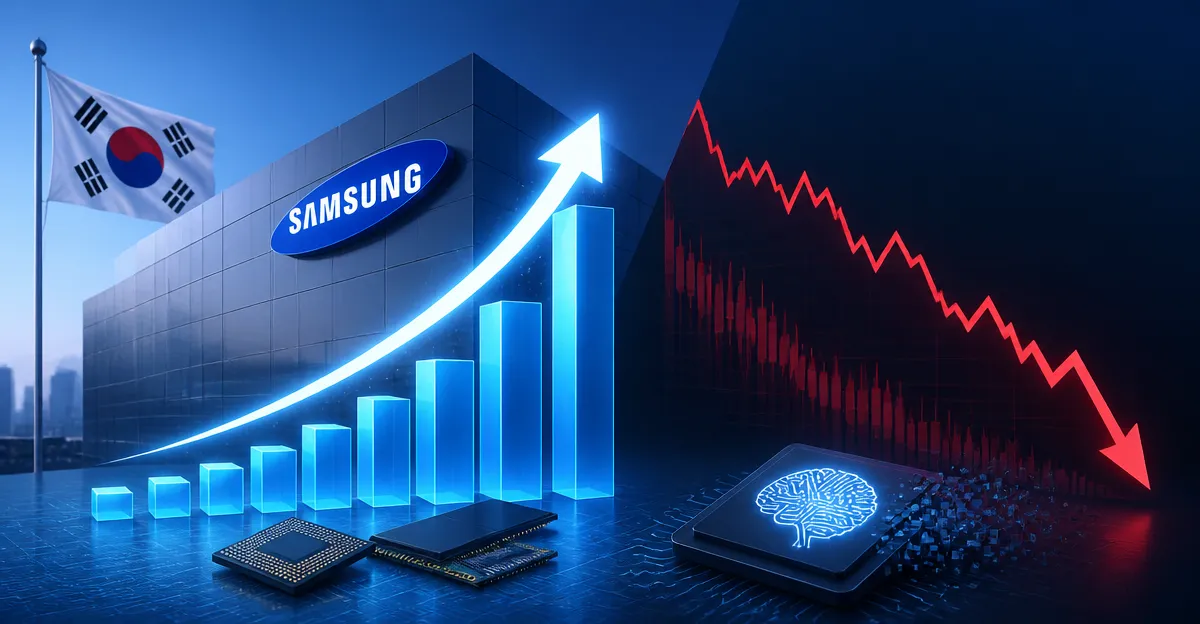
July 7, 2026, (Inside AI) — Samsung Electronics reported a staggering 19-fold surge in second-quarter operating profit on Tuesday, driven by an artificial intelligence boom that has propelled memory chip prices to unprecedented levels. The forecast, which exceeded the company’s combined earnings over the previous three years, underscores the seismic shift in the semiconductor landscape.
Yet, in a stark divergence, Samsung’s shares slid as investors grappled with mounting concerns over the sustainability of AI-driven demand. The sell-off reflects deep-seated anxiety that the explosive growth in memory chips—particularly high-bandwidth memory (HBM) essential for AI accelerators—may be peaking.
The profit leap was fueled by record-high DRAM and NAND prices, as data center operators and AI firms stockpiled advanced chips. Samsung, the world’s largest memory chipmaker, has been a primary beneficiary, with its chip division likely accounting for the bulk of the windfall. Analysts estimate the company’s operating profit for the April-June quarter reached approximately 14 trillion won ($10.5 billion), up from 0.7 trillion won a year earlier.
Despite the blockbuster numbers, the market’s reaction highlights a growing disconnect between current earnings and future expectations. Shares fell as much as 3% in early trading, as investors fixated on signs of softening demand and rising inventories in certain chip segments. The decline mirrors broader tech sector jitters, with questions swirling about whether AI investment can sustain its frantic pace.
Julian Satterthwaite, reporting on the development, noted the paradoxical market response:
“Samsung Electronics on Tuesday (July 7) forecast a 19-fold jump in second-quarter operating profit from a year earlier, surpassing its combined earnings over the past three years as it rides an AI boom that has driven memory chip prices to record highs.”
The AI frenzy has been a double-edged sword for Samsung. While it has supercharged profits, it has also inflated expectations to precarious levels. Memory chip prices, which began their ascent in late 2025, have more than doubled for some HBM products, but industry trackers now warn of a potential glut as production capacity ramps up globally.
Competitors like SK Hynix and Micron Technology have also aggressively expanded HBM output, raising the specter of oversupply. Furthermore, the concentration of AI chip demand among a handful of hyperscalers—such as Google, Microsoft, and Amazon—means any pullback in their capital expenditure could ripple violently through Samsung’s order books.
Samsung’s non-memory businesses, including mobile and consumer electronics, provided little cushion. The smartphone market remains stagnant, and the company’s foundry operations lag behind TSMC in advanced process nodes, limiting diversification benefits. This overreliance on memory chips amplifies the stock’s sensitivity to cyclical swings.
Historical parallels offer cautionary tales. The memory industry is notorious for boom-bust cycles, most recently in 2018 when a supply glut wiped out profits after a similar AI and data center hype. Back then, Samsung’s shares tumbled despite record earnings, as forward-looking indicators turned sour—a pattern eerily reminiscent of today’s dynamics.
Adding to the unease, geopolitical tensions and trade restrictions continue to cloud the outlook. Export controls on advanced chip equipment to China, a major market for Samsung, could disrupt supply chains and dampen demand. The company’s delicate balancing act between U.S. and Chinese interests remains a persistent risk factor.
Looking ahead, Samsung’s guidance for the third quarter will be critical. Any hint of slowing orders or pricing pressure could trigger a sharper correction. The company is expected to provide detailed earnings later this month, but the preliminary forecast already sets a high bar that may prove difficult to clear if the AI investment cycle cools.