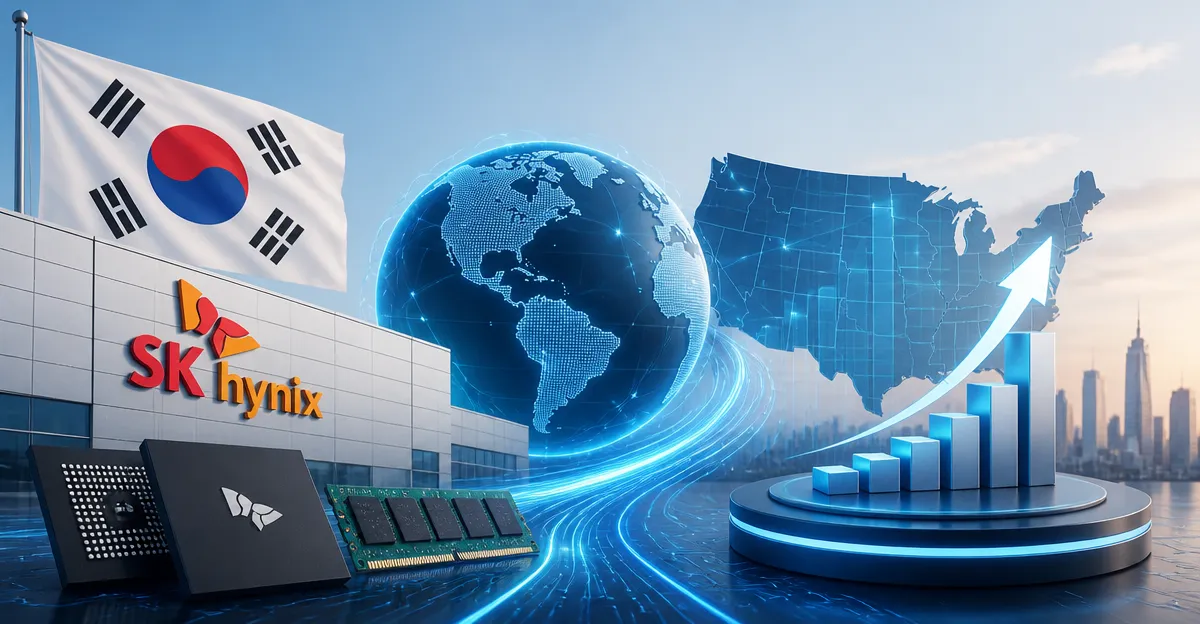
July 6, 2026, (Inside AI) — South Korean memory chip titan SK Hynix will launch a roughly $28 billion U.S. listing on Monday, according to regulatory filings, marking one of the largest new share sales in history. The company plans to sell 17.79 million new shares via a depository receipt listing on the Nasdaq, with ten ADRs representing one common share. The price range will be disclosed Monday, based on SK Hynix’s trading price in Seoul, where shares were up 1% early Monday and have surged about 273% this year.
The listing underscores the relentless investor appetite for AI-linked stocks, as SK Hynix has emerged as a prime beneficiary of the global AI wave. The company is a critical supplier of high-bandwidth memory (HBM) chips essential for AI systems, counting Nvidia and Google among its key customers. The final price is expected to be set on Thursday, with trading commencing Friday, following a management roadshow with global investors this week.
This offering is poised to become the second-largest share sale ever, trailing only SpaceX‘s record $85.7 billion IPO last month. It would surpass Saudi Aramco‘s $25.6 billion IPO in 2019 and Alibaba‘s similarly sized offering in 2014. The move highlights how AI-driven demand is reshaping capital markets, with chipmakers at the epicenter.
HBM Dominance and Strategic Expansion
SK Hynix’s dominance in HBM chips—a specialized memory stacked vertically to boost bandwidth and reduce power consumption—has given it a near-monopoly in supplying advanced AI accelerators. Its latest HBM3E chips are integral to Nvidia’s H200 and B100 GPUs. The company reported a 734% jump in operating profit in the first quarter of 2026, driven by HBM sales, which now account for over 40% of its DRAM revenue.
Last week, SK Hynix announced a 100 trillion won ($64.38 billion) investment to build new chip plants, including one for NAND flash memory, as part of a massive South Korean initiative to spread AI returns. This expansion aims to solidify its lead over rivals Samsung Electronics and Micron, both of whom are racing to close the HBM gap. Samsung recently began mass production of its HBM3E chips, while Micron expects to ramp up output later this year.
A Nasdaq Listing’s Strategic Calculus
While the listing provides a war chest for capital-intensive fabrication plants, some analysts question the timing. The Philadelphia Semiconductor Index has risen 180% in two years, but geopolitical risks loom. U.S.-China tensions over chip exports and potential tariffs could disrupt supply chains. SK Hynix derives about 30% of its revenue from China, where it operates a major DRAM fab in Wuxi.
Moreover, the company’s reliance on Nvidia for a bulk of HBM orders presents concentration risk. Any slowdown in AI infrastructure spending could hit orders. However, SK Hynix’s CFO Kim Woo-hyun stated in a recent filing:
“We see sustained demand for HBM through 2028, driven by the transition to larger AI models and edge inference. This listing will accelerate our technology roadmap and diversify our investor base.”
The ADR structure allows U.S. investors to gain direct exposure without navigating the Korean exchange, potentially boosting valuation multiples closer to U.S. peers like Nvidia, which trades at a higher price-to-earnings ratio. SK Hynix currently trades at a forward P/E of 12, versus Nvidia’s 35.
The roadshow will test whether global funds are willing to pay a premium for AI memory leadership. With the AI boom showing no signs of abating—global AI chip revenue is projected to hit $110 billion in 2026, per Gartner—SK Hynix’s listing could set a new benchmark for semiconductor valuations. Yet, as history shows, chip cycles are notoriously volatile, and today’s memory shortage can quickly become tomorrow’s glut.