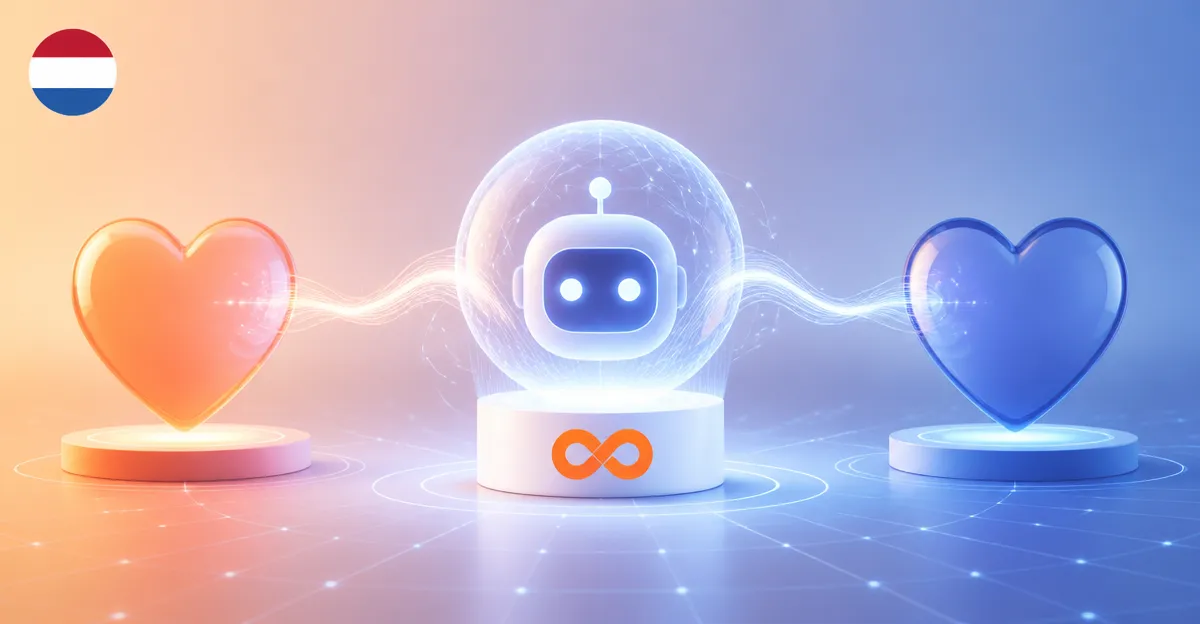
September 15, 2026, (Inside AI) — A Shanghai-based startup is betting that the next major AI use case is not a chatbot you talk to alone, but a shared assistant that sits between two people. Twoo, developed by Shanghai I Don't Care Technology Co., Ltd., treats its AI as a third participant in a relationship, joining conversations, retaining shared memories, and nudging users toward real-world action.
The product marks a departure from the crowded field of AI companions and productivity copilots. Instead of serving one user, Twoo is designed for pairs: couples, friends, family members, or activity partners who invite the same AI into their private chat. The company argues that many relationship conflicts stem not from a lack of care but from incomplete communication, and that an AI with access to both sides of a conversation can close that gap.
From Companion To Relationship Mediator
Twoo began as an experiment in AI companionship, according to founder Cobe Chen. The team initially explored helping people form friendships with AI, but soon noticed a different opportunity. Users wanted help understanding each other, not just a synthetic friend.
"People often fail to fully express what they mean. They may have ten things in mind but communicate only two or three, so the other person has to interpret the limited information and may draw the wrong conclusions," Chen said.
Read: ChatGPT Reunites Man With Long-Lost Half-Sister After Decades
That insight shaped Twoo's core architecture. When two users chat, the AI can answer questions or offer context without forcing them to leave the conversation and open a separate AI tool. It also tracks common interests, goals, and shared experiences over time. The company describes its approach in three stages: remembering, understanding, and taking action.
Remembering is straightforward. Every message in the shared space becomes part of the AI's context. Understanding is harder. The system must infer personalities, preferences, and the nature of the relationship from fragmented clues accumulated across many conversations. Taking action is the final step. Twoo includes a shared notebook and reminder features that turn casual plans into concrete commitments, such as a weekend trip or a joint learning goal.
The design choice reflects a broader shift in the AI industry. Most consumer AI products optimize for individual engagement, measured in daily active users and session length. Twoo optimizes for a metric that is harder to quantify: whether two people actually follow through on what they discuss. That focus could make the product stickier, but it also raises questions about privacy and data sharing between users. Twoo has not publicly detailed how it handles consent when one person wants to remove shared memories or leave the AI-assisted relationship.
Users Reshape The Product Beyond Couples
Twoo initially targeted romantic couples and best friends. But users have pushed it into unexpected territory. According to Chen, people have used the app for family coordination, casual friendships, hobby groups, and even stranger matching. Some users have posted on Chinese social platform Xiaohongshu seeking Twoo partners, a behavior that resembles early internet days when people exchanged QQ numbers to make new friends.
The company says it does not define its core audience by age or relationship type. Instead, it looks for people willing to make AI part of their social interactions. One observed effect is that some users behave differently on Twoo than on WeChat. A normally reserved friend may become more playful, leading to looser and more entertaining exchanges. The team describes the experience as somewhere between a private chat and a group chat, offering more spontaneity than a one-on-one conversation while preserving more privacy than adding another human participant.
That positioning could appeal to a generation already comfortable with AI in daily life. But it also invites competition. Major platforms like Tencent's WeChat and ByteDance's Douyin have vast social graphs and could add similar shared-AI features. Twoo's advantage, if any, lies in starting from a blank slate rather than retrofitting AI onto an existing social network. The company has not disclosed user numbers or retention rates, making it difficult to assess traction.
Read: The Uncanny Valley Now Swallows Human Identity, Not Just Robots
Monetization: Emotional Shells And Professional Tools
Twoo is testing two revenue paths. The first monetizes emotional attachment. The AI character is a small octopus, and users can buy "shells," an in-app token, to unlock outfits. Chen said this spending is driven by affection for the character, similar to how users buy virtual gifts for streamers or avatars in games.
The second path targets professional use. Some users already employ Twoo for collaborative writing. Teachers have used it to manage student study plans, reminders, and learning records. In the future, premium memberships could offer stronger file processing and larger storage. That mix of emotional and functional monetization is unusual. Most AI companion apps rely on subscriptions or virtual goods, while productivity tools rely on seats and storage. Twoo is attempting both, which could confuse users or create a coherent bundle depending on execution.
International expansion is next. Twoo is preparing to enter North America, Japan, and South Korea. Chen said communication challenges are universal, and growing AI adoption provides a foundation. The company has not announced a launch date or local partnerships. Cultural differences in relationship norms could complicate the product. In some markets, sharing an AI with a partner may feel intrusive. In others, it may feel like a natural extension of shared calendars and messaging apps.
Twoo's vision is not to replace human relationships with AI. It is to give AI a new role within them. Whether users want a third member in their private chats remains an open question. The company's early user-driven expansion suggests at least some do. But the bigger test will come when the product leaves China and faces markets with different privacy expectations and social habits. For now, Twoo is a small but telling experiment in what happens when AI stops being a tool you use alone and becomes a participant in your relationships.