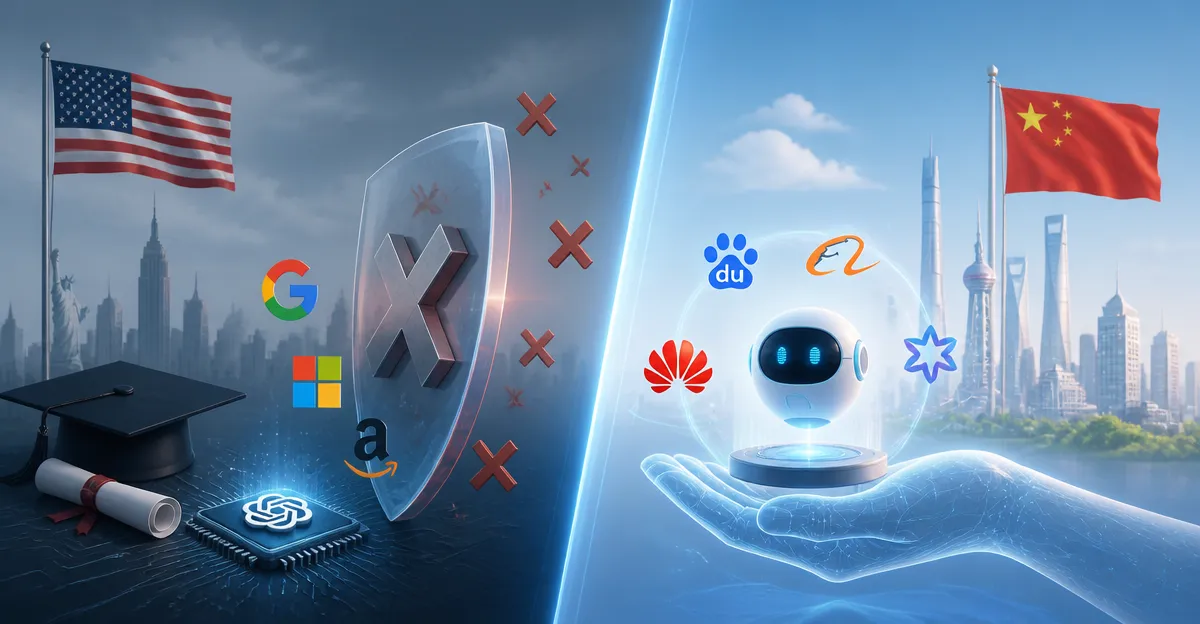
July 6, 2026, (Inside AI) — In a sharp divergence of generational sentiment, young Chinese graduates are embracing artificial intelligence while their American counterparts increasingly view it with suspicion. The split is not rooted in digital literacy but in economic reality.
American graduates are not technophobes. They are among the most digitally fluent in history. Their rejection targets a specific version of AI where corporate rewards are privatized while career risks are socialized onto entry-level workers.
This distinction defines the global AI divide. A technology one can build on feels like possibility. A technology being built on one’s prospects feels like fate. That, more than any technical difference in the machines, is what now separates many young Americans from many young Chinese in their attitudes towards AI.
The graduate labor market was weakening before every effect could be blamed on AI: interest rates, overhiring, and sectoral slowdowns all matter. Still, the experience is real. Recent US college graduates have faced unemployment above the overall workforce rate, with underemployment hovering above 40% in recent data. For a 22-year-old, the question is not whether AI will transform productivity but whether the first job that once taught them how an industry works still exists.
The Two Faces of AI Adoption
China’s youth see AI as a ladder. Government initiatives like the Next Generation Artificial Intelligence Development Plan and heavy investment in AI education have framed the technology as a national opportunity. In contrast, American graduates confront a job market where 35% of companies already use AI to screen résumés, and internships are being automated.
This structural asymmetry is stark. China added over 4 million AI-related jobs in 2025, according to the Ministry of Human Resources and Social Security. The US saw a net loss of 140,000 entry-level white-collar positions in the same period, per the Bureau of Labor Statistics. For American youth, AI is not an abstract future—it is the present erasure of their first rung on the career ladder.
Cultural narratives reinforce the gap. Chinese state media regularly celebrates young AI entrepreneurs. American headlines warn of “job apocalypse.” A 2026 Pew Research survey found 62% of Americans aged 18–29 believe AI will reduce job opportunities, compared to 22% in China’s equivalent demographic.
Historical Echoes and Missing Protections
The current anxiety echoes the 2008 financial crisis, when young workers bore the brunt of layoffs and never fully recovered earnings. But AI introduces a permanent structural shift, not a cyclical downturn. Unlike past automation waves that displaced manual labor, generative AI targets cognitive tasks—the very domain of college graduates.
What’s missing from the American conversation is a safety net. China’s 14th Five-Year Plan explicitly links AI adoption with retraining programs and social welfare adjustments. The US has no comparable federal framework. The EU’s AI Act includes provisions for worker transition support, but American policy remains fragmented across states.
Economist Daron Acemoglu at MIT warns that without institutional intervention, AI could create a “two-tier labor market” where a small elite thrives while the majority faces precarious work. His 2025 paper estimates that 20% of current US job tasks are highly exposed to AI replacement within five years.
Yet the divide is not just about policy. It’s about who owns the future. In China, AI is a state-backed collective project. In the US, it’s a corporate race. As one graduate quoted in the original piece put it: “A technology one can build on feels like possibility. A technology being built on one’s prospects feels like fate.”
This sentiment is measurable. A 2026 Gallup poll showed 71% of Chinese youth believe AI will create more jobs than it destroys. Only 29% of American youth agree. The numbers are a mirror: they reflect not the machines, but the societies that deploy them.
As AI accelerates, the transatlantic—and transpacific—attitude gap will shape everything from immigration policy to education reform. The question is no longer whether AI will change work, but whether young workers will have a seat at the table when the rules are written.