July 8, 2026, (Inside AI) — India’s engineering education system is facing a quiet crisis. Despite the country’s ambition to lead in artificial intelligence, semiconductors, and quantum technologies, a large segment of its engineering colleges is collapsing under the weight of outdated curricula, weak faculty, and plummeting admissions. The All India Council for Technical Education (AICTE) has placed 58 engineering colleges under progressive closure and discontinued more than 950 courses in 2025-26, signaling a structural reckoning.
The core issue is not a lack of demand for engineers. The AI revolution has created an insatiable appetite for talent in computer science, data science, and allied fields. Yet, student preferences have shifted so dramatically that traditional branches like mechanical and electrical engineering are seeing 20-40% of seats go unfilled even at some National Institutes of Technology (NITs). Meanwhile, India’s premier Indian Institutes of Technology (IITs) continue to thrive, creating a two-tier system that masks deep systemic rot.
The AICTE, India’s apex technical education regulator established under the AICTE Act, 1987, mandates that every engineering institution obtain approval before admitting students. Compliance depends on infrastructure, faculty, governance, and financial viability. Progressive closure—barring new admissions while allowing existing students to graduate—is invoked for persistently low admissions or non-compliance. This mechanism, while protective, exposes the consequences of decades of unregulated expansion.
Until the late 1990s, engineering education was limited to publicly funded institutions. The Y2K-driven IT boom triggered a massive proliferation of private colleges across India. Today, the country has an approved undergraduate intake of nearly 15 lakh seats, with IITs accounting for just 19,000, NITs for 25,000, and IIITs for 11,000. The rest are state universities and private institutions, many of which are now struggling to survive as admissions concentrate in top-tier colleges.
The COVID-19 pandemic accelerated the crisis. AICTE removed the requirement for National Board of Accreditation (NBA) accreditation to expand programs, allowing institutions to quickly shift capacity toward high-demand disciplines like AI. This move helped premier colleges but left hundreds of lower-tier institutions with depleted enrollments and eroded financial viability. The author, a former computer science professor at IIT Kharagpur, IIT Kanpur, BITS Pilani, and JNU, notes that the policy shift from expansion to excellence has left many colleges behind.
The AI Era’s Unforgiving Demand Curve
The AI revolution, gathering momentum since the mid-2010s, has fundamentally reshaped engineering education. Industry demand now heavily favors computer science, AI, and data science, while traditional branches languish. This mismatch is not just a curriculum problem; it’s a survival problem. Institutions that fail to adapt face extinction, as AICTE’s progressive closures demonstrate.
But the crisis is also a symptom of deeper regulatory failures. For years, AICTE’s input-based approval process—focused on infrastructure and faculty counts—did little to ensure learning outcomes. The NBA’s shift to outcome-based accreditation, aligned with the Washington Accord, was meant to fix this, but its influence waned when AICTE relaxed accreditation requirements during the pandemic. The result is a system that measures compliance, not competence.
Critics argue that the government’s focus on expanding Institutes of National Importance (INIs) has diverted resources from the broader ecosystem. India now has 79 INIs: 23 IITs, 31 NITs, and 25 IIITs. While these institutions produce world-class talent, they represent a tiny fraction of total capacity. The vast majority of engineering graduates emerge from colleges that lack research ecosystems, industry linkages, and updated curricula.
Some experts point to the over-reliance on rote learning and exam-centric pedagogy as a root cause. A former AICTE chairman once remarked that “engineering education in India is producing graduates who are unemployable because they cannot think critically or solve real-world problems.” This echoes the author’s call for a shift to competency-based education through project-based learning, interdisciplinary problem-solving, and stronger industry-academia collaboration.
From Quantity to Quality: A Strategic Imperative
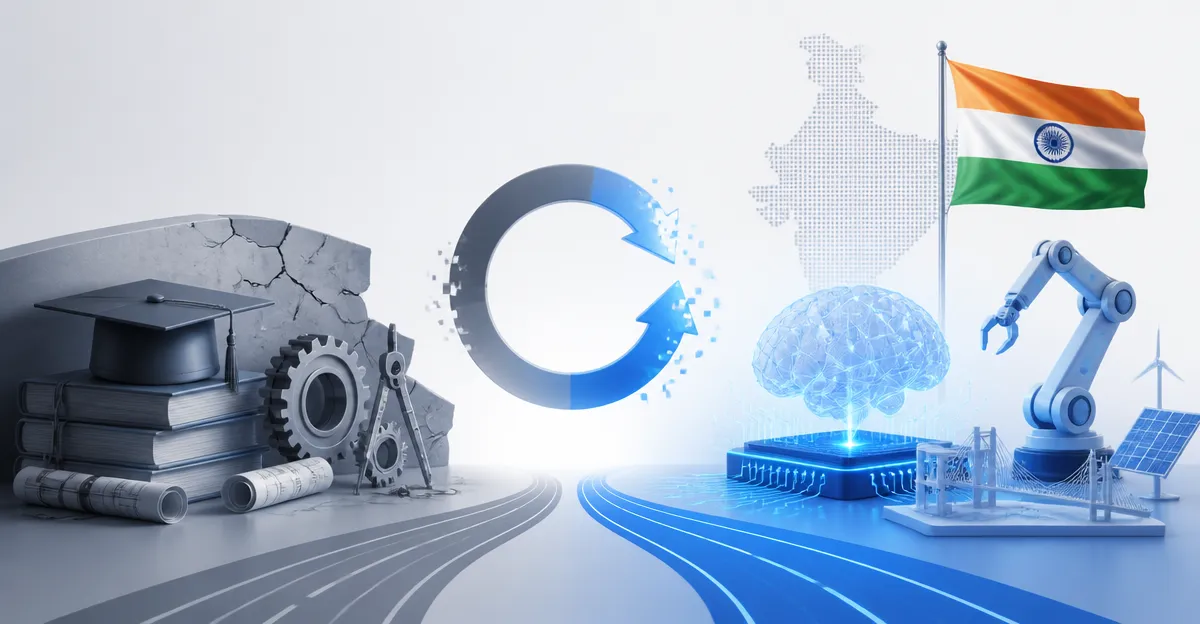
The path forward demands a radical reorientation. Curricula must continuously align with emerging technologies like cybersecurity, semiconductor design, and robotics, while preserving foundational rigor in mathematics and science. Regulation must evolve from input-based compliance to outcome-based accountability, judging institutions on graduate employability, research output, patents, and startup creation.
The author, drawing on decades of experience across India’s top institutions, emphasizes that “transforming engineering education is no longer an academic reform—it is a strategic imperative.” India’s ambition to lead the AI and semiconductor era hinges on producing globally competitive engineers, not just more graduates. The orderly exit of non-performing institutions, while painful, is necessary to reset the ecosystem.
Yet, the human cost of these closures cannot be ignored. Thousands of students and faculty in affected colleges face uncertainty. The government must ensure that displaced students are absorbed into other institutions and that faculty receive retraining opportunities. Without a safety net, the closures risk deepening regional inequalities, as many struggling colleges are in rural and semi-urban areas.
The AICTE’s actions, while belated, signal a willingness to confront the crisis. But regulatory reform alone will not suffice. Industry must play a larger role in curriculum design, faculty development, and internship provision. The success of India’s IT industry was built on a symbiotic relationship with engineering colleges in the 1990s; a similar partnership is needed for the AI age.
As India aspires to be a global knowledge powerhouse, its engineering education system stands at a crossroads. The choice is clear: continue with a broken model that prioritizes capacity over capability, or embrace a future-ready approach that values quality, relevance, and adaptability. The AI era will not wait for India to catch up.