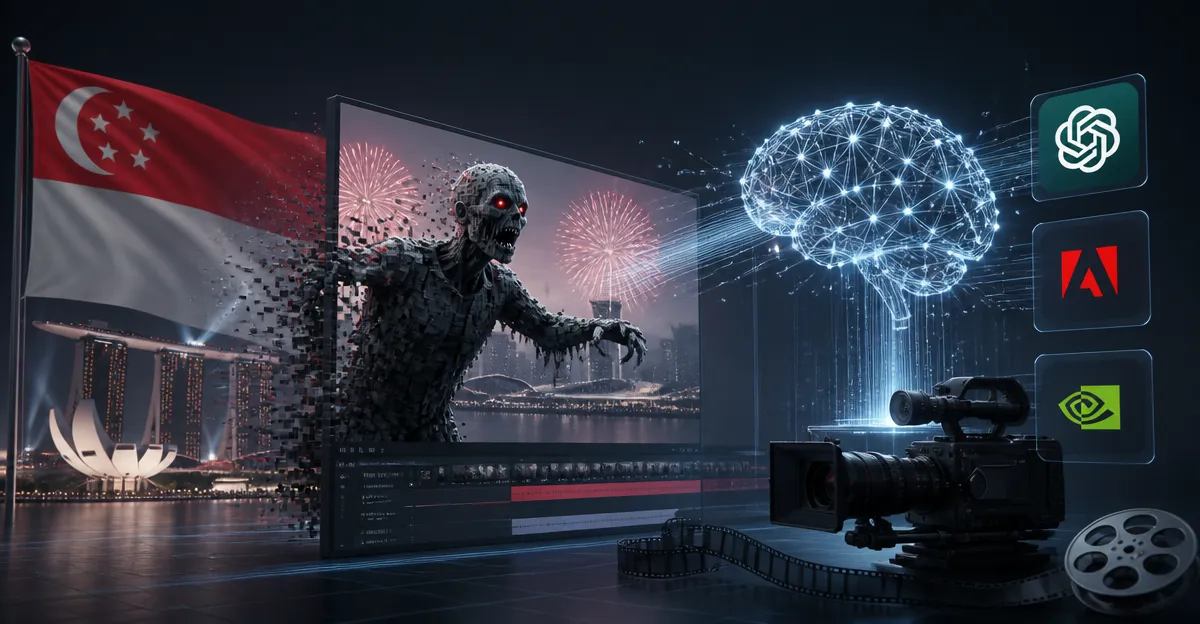
August 10, 2026, (Inside AI) — A short AI-generated film reimagining Singapore’s National Day Parade as a zombie apocalypse has ignited fierce debate about the future of filmmaking, after premiering on YouTube to coincide with the annual celebration this past Sunday.
The video, titled Bersama Majulah, is part of Spore Fall, billed as Southeast Asia’s first human-written but AI-realized transmedia franchise. Creator and showrunner Joel Boh says the project deliberately courts controversy to prove a point: audiences will watch AI content, even when they claim to hate it.
“The fact that people are talking – whether in support or in criticism – tells us the film is landing as intended. We view the debate as a healthy sign of cultural impact,” Joel Boh, creator and showrunner of Spore Fall
Boh revealed that the short film achieved an 85 to 93 percent audience retention rate on YouTube, a metric that undercuts the widespread dismissal of AI-generated video as disposable “slop.” Viewers are watching all the way through, he notes, even if only to leave a negative comment.
Read: George Lucas Says AI in Film Is Unstoppable, Dismisses Critics as Luddites
“They’re watching till the end – just to leave a negative comment. That suggests something deeper. Audiences are hungry for connection, but they can’t quite get past the fact that the content is AI-generated. They feel strongly enough to finish engaging, only to push back on the medium,” Joel Boh
The production methodology behind Spore Fall draws a hard line between creative and technical labor. Boh insists that the “soul of the work” — story arcs, character motivations, narrative structure — is entirely human-crafted. AI tools are deployed only for execution: generating environments, visual effects, and scaling production. This hybrid model is emerging as a common defense among creators who want to leverage generative AI without ceding authorship.
Yet the zombie parade has become a flashpoint in a broader industry reckoning. Detractors argue that even “human-written, AI-realized” pipelines devalue traditional filmmaking crafts, from cinematography to set design. Supporters counter that such tools democratize high-end production, allowing independent creators in regions like Southeast Asia to compete with Hollywood budgets.
Singapore’s media regulator has not commented on the film, but the city-state has been actively courting AI innovation through initiatives like the National AI Strategy 2.0. The government views AI as a pillar of economic growth, even as it grapples with ethical guidelines for synthetic media. This tension mirrors global debates: the European Union’s AI Act imposes transparency obligations on AI-generated content, while the U.S. Copyright Office continues to deny registration for purely machine-authored works.
Boh’s experiment taps into a deeper anxiety about authenticity in the age of generative AI. When an AI can convincingly render a national tragedy or celebration, what happens to the shared cultural experience? The high retention rate suggests that viewers are not indifferent — they are emotionally engaged, even if that engagement manifests as anger. That paradox may define the next phase of AI entertainment: content that compels attention not despite its synthetic origins, but because of them.
Read: Carry on Jatta 4 Uses AI to Recreate Late Actor Jaswinder Bhalla in a First for Indian Cinema