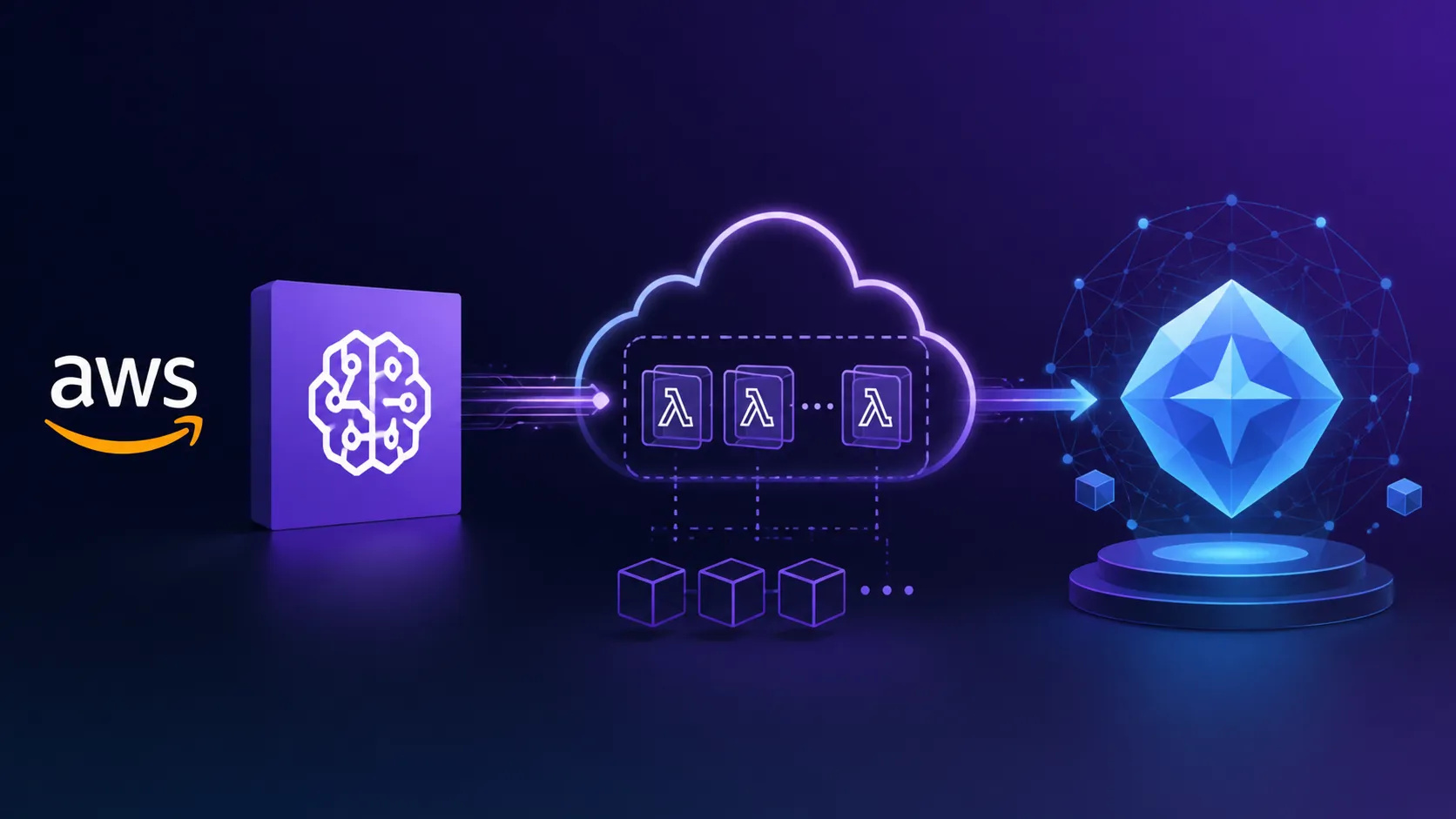
July 1, 2026, (Inside AI) — Amazon SageMaker AI now lets users fine-tune Google DeepMind’s Gemma 4 models without managing servers. The new serverless customization supports the E4B and 31B parameter versions through supervised fine-tuning, direct preference optimization, and reinforcement fine-tuning.
This move expands the model catalog available for serverless adaptation. It already includes families like Nova, Nemotron 3, Qwen, Llama, gpt-oss, and DeepSeek. Users can now bring proprietary data to Gemma 4 for domain-specific accuracy, tone alignment, or new task performance.
SageMaker AI abstracts away infrastructure provisioning and training orchestration. Teams focus on data and evaluation, not cluster management. Billing follows a pay-per-use model, with no upfront commitments.
The service is live in four AWS regions: US East (N. Virginia), US West (Oregon), Asia Pacific (Tokyo), and EU (Ireland). Users can start jobs via the Models page in Amazon SageMaker Studio or the SageMaker Python SDK.
Read: Amazon SageMaker AI Cuts Generative AI Scaling Time by Half with Container Caching
Serverless customization removes the heavy lifting of distributed training. It automatically scales resources based on job size, reducing idle costs. This aligns with the industry shift toward managed AI services that lower the barrier to model adaptation.
Gemma 4 models are lightweight yet powerful open models. Their addition signals AWS’s commitment to offering diverse, state-of-the-art options. The supported techniques cover a spectrum of refinement: supervised fine-tuning for labeled examples, DPO for human preference alignment, and reinforcement fine-tuning for reward-driven optimization.
Competing cloud providers offer similar serverless tuning, but SageMaker’s unified studio and SDK integration streamline the workflow. Analysts note that the real differentiator is the breadth of model families available under one roof.
However, serverless abstraction can obscure cost drivers. Users must monitor training duration and data throughput to avoid surprises. AWS provides documentation on estimating job costs, but fine-grained control remains limited compared to self-managed clusters.
The launch follows Google’s recent expansion of Gemma 4 on Vertex AI, intensifying the multi-cloud model customization race. Enterprises can now compare tuning experiences across platforms more directly.
Read: AWS Launches Claude Sonnet 5 and AI Agent WorkSpaces in Latest Updates
Looking ahead, AWS may extend serverless customization to reinforcement learning from human feedback or parameter-efficient methods like LoRA. The documentation hints at future support for additional model architectures.