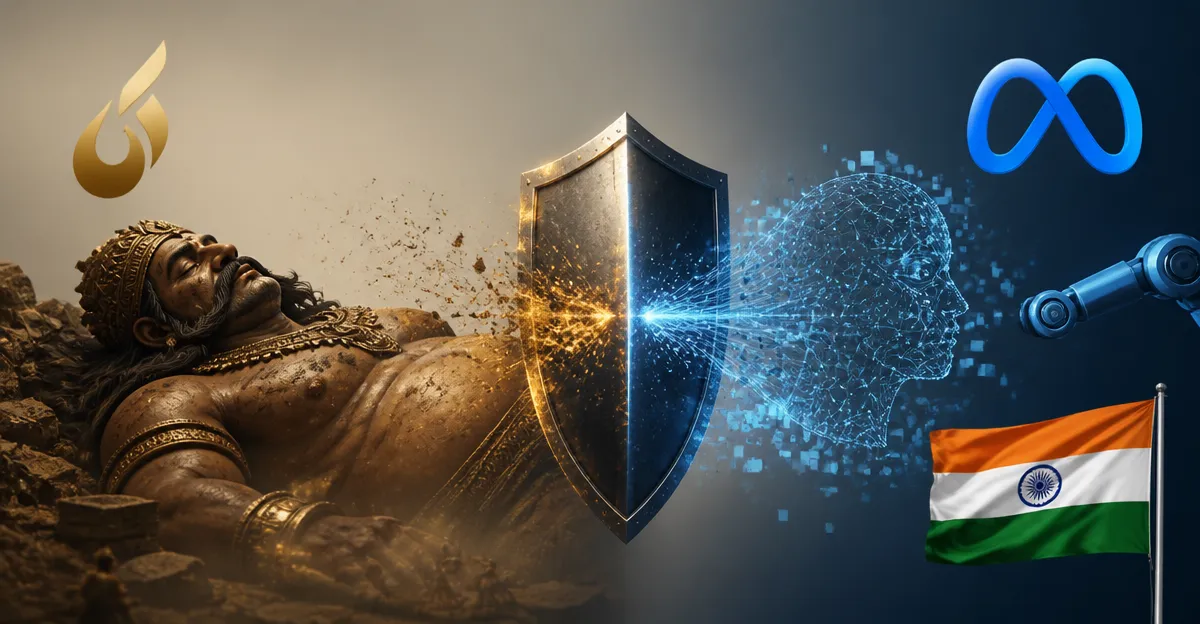
November 27, 2026, (Inside AI) — Actor Faisal Malik has pushed back against viewers who claim the visual effects in Ramayana: Part 1 are AI-generated, calling the criticism a misunderstanding of the difference between CGI and artificial intelligence. Malik, who plays the giant demon Kumbhkaran in the film, made the remarks in an interview with Hindustan Times, describing the production as a heavily VFX-driven project that relied on thousands of artists, including a foreign crew, rather than generative AI tools.
The film, directed by Nitesh Tiwari and produced by Namit Malhotra, has grossed over Rs 1,777 crore worldwide, according to trade reports. Its sequel is scheduled for release on Diwali 2028. Malik’s comments arrive as Indian audiences increasingly scrutinize big-budget VFX sequences for signs of AI generation, a debate that has gained momentum since 2025 as generative video tools became more accessible.
Malik, known for Gangs of Wasseypur - Part 2, Thamma, and Panchayat, said the shoot required him to abandon his usual acting method and undergo specialized training. He described the experience as “one-of-a-kind” and recalled a scene with Yash, who plays Ravana, in which the two characters interact across separate shoots.
“Major shooting has been done separately, but I have some critical scenes with him in the second part. We saw Ravana walking on Kumbhakaran's hand to bless him, so that was shot separately, keeping in mind the eye, face, and body movement. We had seen the making videos of Lord Of The Rings and Avatar, but here we got to be part of the amazing process. I feel, before and after this, nothing as grand as this will happen in Indian cinema in the near future.” Faisal Malik, actor, Ramayana: Part 1
Read: AI Historical Drama Concerns
The actor directly challenged critics who dismiss the film’s visuals as AI. “Thousands of people working on a scene, including a foreign crew, is amazing. On one character and scene, so many teams are working together and improvising things for days and months. It's very easy to be critical and say it's AI. But the fact is that most people don't understand the difference between CGI and AI.”
The distinction matters. CGI, or computer-generated imagery, refers to artist-driven digital effects created using software like Maya or Houdini, where animators and technical directors manually craft each frame. AI-generated imagery, by contrast, typically involves models such as diffusion networks that produce images or video from text prompts with limited human frame-by-frame control. In practice, high-end productions often blend both, using AI for tasks like rotoscoping or de-aging, but the core visual effects in Ramayana were built through traditional CGI pipelines, according to production sources.
This is not the first time Indian cinema has faced such accusations. Since 2024, several big-budget films have been criticized for using AI to cut costs on VFX, leading to a broader skepticism among viewers. However, the scale of Ramayana’s box office success and its reliance on practical sets and extensive post-production has made it a flashpoint. The film’s VFX team, which includes artists from India and abroad, worked for months on individual scenes, Malik said.
The debate also reflects a growing tension in the industry: as AI tools become more capable, audiences and critics may increasingly attribute any polished visual to automation, even when human artists are responsible. For now, Malik’s rebuttal offers a window into the labor-intensive reality behind the film’s spectacle, and a reminder that the line between CGI and AI remains blurry for many moviegoers.
Read: Saranagati Hybrid AI Film
Ramayana: Part 1 continues to draw audiences in theaters, with its sequel already in production. Neither the film’s producers nor Malik have indicated any plans to release detailed breakdowns of the VFX work, leaving the public debate to simmer.

Shamil has a low tolerance for AI that only works in controlled demos. He covers agentic systems and generative AI with the skepticism of someone who has seen too many “revolutionary” tools quietly disappear six months after launch.