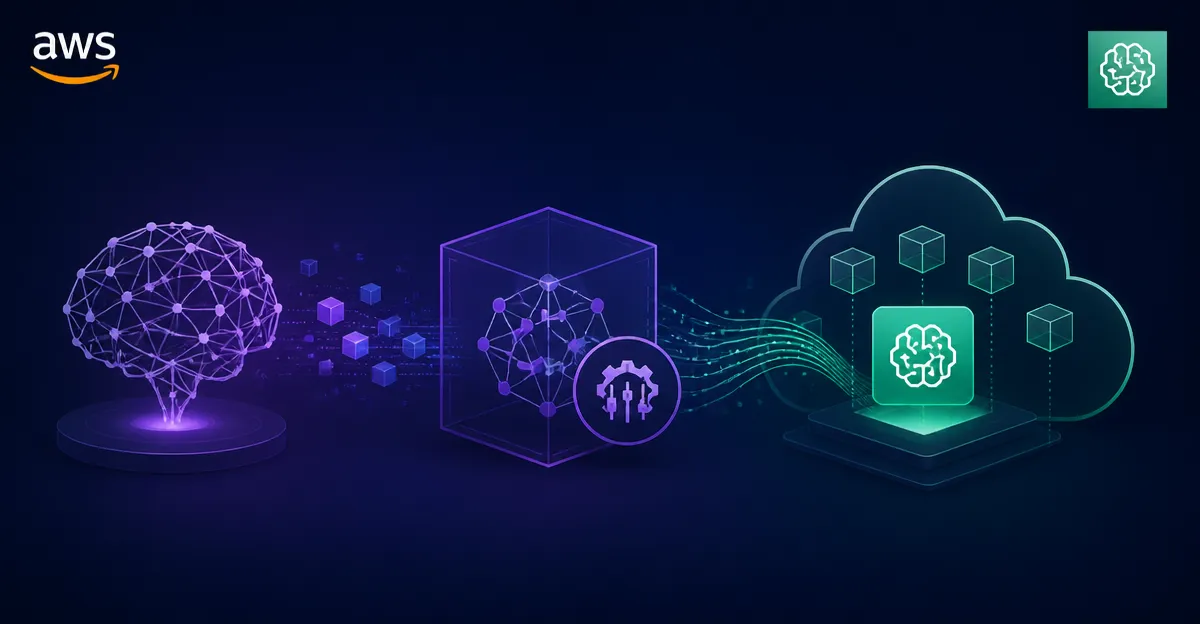
November 19, 2026, (Inside AI) — Amazon Web Services has added Full Fine-Tuning (FFT) to SageMaker AI Serverless Model Customization, letting enterprises retrain every parameter of a pretrained model without provisioning a single GPU. The company detailed the capability alongside benchmark results showing FFT outperforming Low-Rank Adaptation (LoRA) on code-generation tasks once training data crosses roughly 100,000 examples.
The announcement lands at a moment when enterprises are rethinking the cost calculus of large language models. A smaller model fine-tuned on proprietary data can match a frontier model on narrow tasks at a fraction of the per-token inference price. That math compounds across millions of requests, which is why the choice between parameter-efficient methods and full retraining has become a board-level budget question rather than a purely technical one.
LoRA has dominated enterprise fine-tuning because it freezes the base model and trains small adapter matrices, cutting GPU requirements sharply. But the low-rank structure caps how much of the model's representational capacity can change. AWS engineers found that increasing the rank eventually stops closing the accuracy gap with full fine-tuning. The plateau, they argue, stems from rank deficiency itself, not from a shortage of trainable parameters.
When Rank Deficiency Becomes a Ceiling
In controlled experiments, AWS fine-tuned a Qwen3-4B base model on the Magicoder-Evol-Instruct-110K dataset, a corpus of 110,000 coding instruction-response pairs spanning algorithm design, debugging, and systems programming. The split allocated 99,000 records for training, 5,500 for validation, and 5,500 as a held-out test set.
Read: AWS Shows How a 4B Model Matches Frontier Agents at Lower Cost
At 100K+ training examples, FFT reached 90.0 percent on LLM-as-Judge semantic correctness, judged by Amazon Nova Pro as an automated evaluator. The same evaluation showed LoRA slightly ahead on subjective quality, at 81.5 percent versus FFT's 79.5 percent, a result that complicates any simple narrative of full fine-tuning superiority.
The gap widens on deterministic metrics. FFT led on BLEU, ROUGE-1, ROUGE-2, and ROUGE-L, which measure how closely generated code matches reference solutions in surface structure. Because these scores are fully reproducible, they offer cleaner evidence than judge-based evaluation, which can drift with evaluator model updates.
Switching between methods requires a single code change. Developers set TrainingType.FULL instead of TrainingType.LORA in the SageMaker Python SDK, and the rest of the job configuration stays identical. The service handles compute allocation, checkpoint management, and distributed training automatically.
The strategic significance extends beyond a feature release. AWS is positioning serverless fine-tuning as a way to capture workloads that previously required dedicated GPU clusters or third-party training vendors. By absorbing infrastructure management, the company lowers the operational barrier that kept many mid-sized enterprises on LoRA despite its accuracy ceiling. The real contest now shifts to data quality and hyperparameter discipline, where cloud providers can differentiate through tooling rather than raw compute.
That discipline matters because FFT rewrites every weight in the model, including the ones encoding general knowledge. AWS measured this risk with MMLU, a benchmark covering 57 academic subjects. Aggressive learning rates proved destructive. At 5e-5 or higher, MATH scores collapsed to 2-3 percent and MMLU accuracy fell to 3.6 percent, a clear case of catastrophic forgetting.
The safe zone in AWS experiments was a learning rate of 2e-5 paired with a dataset above 100,000 examples. A configuration with 5 percent warmup, batch size 8, and that learning rate best preserved general knowledge. Epoch count behaved as a forgetting dial rather than a loss-curve knob. Correctness peaked at 3 epochs, and every variant degraded beyond that point.
Read: Zhang Yiming Says ByteDance’s Seed Team Won’t Rely on AI Distillation
Neither method escaped every test intact. Both FFT and LoRA underperformed the base model on MATH exact match, underscoring how hard it is to preserve reasoning skills during domain-specific training. AWS researchers were explicit about the limits of their own results.
"FFT isn't universally superior to LoRA, and its effectiveness is extremely sensitive to hyperparameter choices," the engineering team wrote in its technical documentation.
The experimentation itself ran at unusual speed. AWS executed tens of customization jobs across Qwen3-4B, DeepSeek-R1-1.5B, Nemotron-30B, and Gemma-4-26B, ablating learning rate, batch size, warmup ratio, epoch count, and dataset scale. Each job, from submission to evaluation, finished within a few hours, and resulting models registered automatically in the SageMaker Model Registry as versioned packages.
For enterprises weighing the switch, the decision rule emerging from these benchmarks is narrow but clear. FFT pays off when task complexity is high, datasets are large and clean, and teams can afford careful hyperparameter sweeps. LoRA remains the pragmatic default for smaller datasets, rapid iteration, and subjective quality tasks where its adapter-based updates hold their own.
AWS has published documentation on supported base models and hyperparameter configuration for FFT jobs. The capability is available now through SageMaker AI Serverless Model Customization, with no cluster setup or capacity planning required.

Sofia spent years studying how machines parse human language before pivoting to cover the systems now rewriting it. She reads technical papers the way others read news and looking for what the numbers are actually saying beneath the headlines.