July 24, 2026, (Inside AI) — Pakistan's push to become a serious player in robotics and AI took center stage as the Indus Robotics and Autonomous Systems Expo 2026 drew more than 25,000 registered visitors to the Pak China Friendship Centre in Islamabad. The two-day event, which concluded this week, showcased a surge of locally developed technologies—from defence robotics to agritech—while the government unveiled a new USD 20 million venture fund to fuel innovation.
Prime Minister Muhammad Shehbaz Sharif inaugurated the Expo, with Chief of Army Staff and Chief of Defence Forces Field Marshal Syed Asim Munir attending as Guest of Honour. The presence of top leadership underscored the strategic importance of autonomous systems for national resilience. Organized by the Ignite National Technology Fund under the Ministry of Information Technology and Telecommunication, the event was held in collaboration with the National Centre of Robotics and Automation and the NUST College of Electrical and Mechanical Engineering.
During the opening, Sharif announced the Pakistan Venture Fund with an initial USD 20 million commitment, alongside the SPARK and ELEVATE programmes. These initiatives aim to bridge the gap between research and market-ready products, targeting startups and researchers who often struggle with commercialization. The move addresses a chronic funding gap: Pakistan's tech ecosystem has seen sporadic investment, but a dedicated state-backed fund could de-risk early-stage ventures in hardware-heavy fields like robotics.
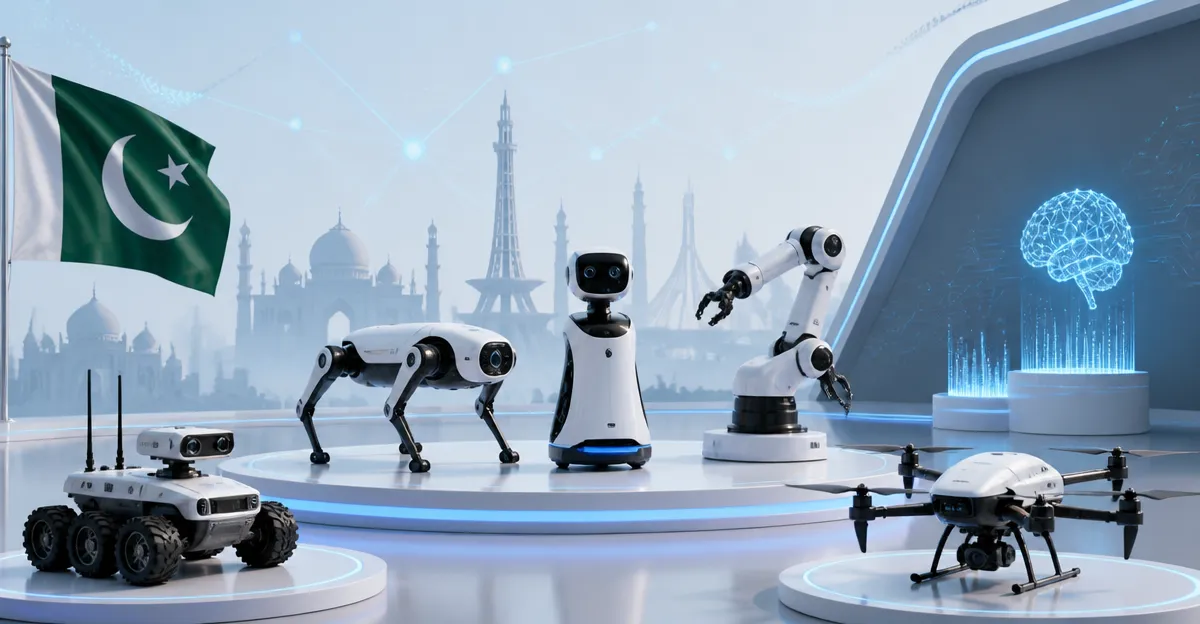
The Expo floor featured 55 pavilions, including 13 startups and 42 organizations from defence and private sectors. Exhibits ranged from unmanned aerial vehicles and maritime autonomous systems to industrial automation and what organizers called "Physical AI"—embodied intelligence in machines. A notable draw was the Immersive Experience Dome, a 360-degree digital journey projecting Pakistan's tech ambitions. Such showcases are critical for a nation where robotics R&D has often remained siloed in university labs.
Competitions injected a competitive edge, with a combined prize pool of PKR 5 million. The RoboWars winners took PKR 2 million, while PKR 3 million was split among RAS Innovation Challenge victors. Such contests are proven talent magnets—similar to how DARPA challenges accelerated autonomous vehicle development globally. Here, they spotlighted student-built prototypes tackling local problems, from precision agriculture to disaster response.
Federal Minister for IT and Telecommunication Ms. Shaza Fatima Khawaja framed the event as an economic imperative.
"Robotics and autonomous systems are becoming fundamental drivers of economic competitiveness, industrial modernization and national resilience. Indus RAS Expo 2026 reflects the Government of Pakistan's and Prime Minister Muhammad Shehbaz Sharif's commitment to investing in innovation, empowering local talent and creating opportunities for our researchers and entrepreneurs to develop technologies that can compete on the global stage." — Ms. Shaza Fatima Khawaja, Federal Minister for IT and Telecommunication
Her words echo a broader shift: Pakistan's IT exports hit $2.6 billion in 2025, but hardware and robotics remain nascent. The Expo's focus on defence applications—a sector with deep pockets—could accelerate spin-offs into civilian markets, a path seen in Israel's tech ecosystem.
CEO Ignite Muhammad Bilal Abbasi stressed the collaborative thrust.
"The Expo showed the importance of bringing government, academia, industry, and innovators together on one national platform. He said the event strengthened connections, supported the commercialization of indigenous technologies, and gave innovators opportunities to present solutions that can contribute to Pakistan's technological future." — Muhammad Bilal Abbasi, CEO Ignite
The program included six panel discussions, three plenary sessions, and four workshops, tackling industrial adoption, skills gaps, and policy frameworks. However, without coordinated standards, such events risk becoming mere showcases rather than catalysts. The Expo's emphasis on a national policy framework suggests organizers are aware of this pitfall.
Yet questions linger. The USD 20 million fund, while significant, is modest compared to regional peers—India's ₹10,000 crore AI mission dwarfs it. And Pakistan's energy and import constraints could hamper hardware startups. Still, the Expo's sheer scale—25,000 attendees—signals a groundswell of interest that could pressure policymakers to sustain momentum. As part of the broader Indus AI initiative, the event planted seeds for a connected ecosystem, but the real test will be how many prototypes evolve into products that compete globally.