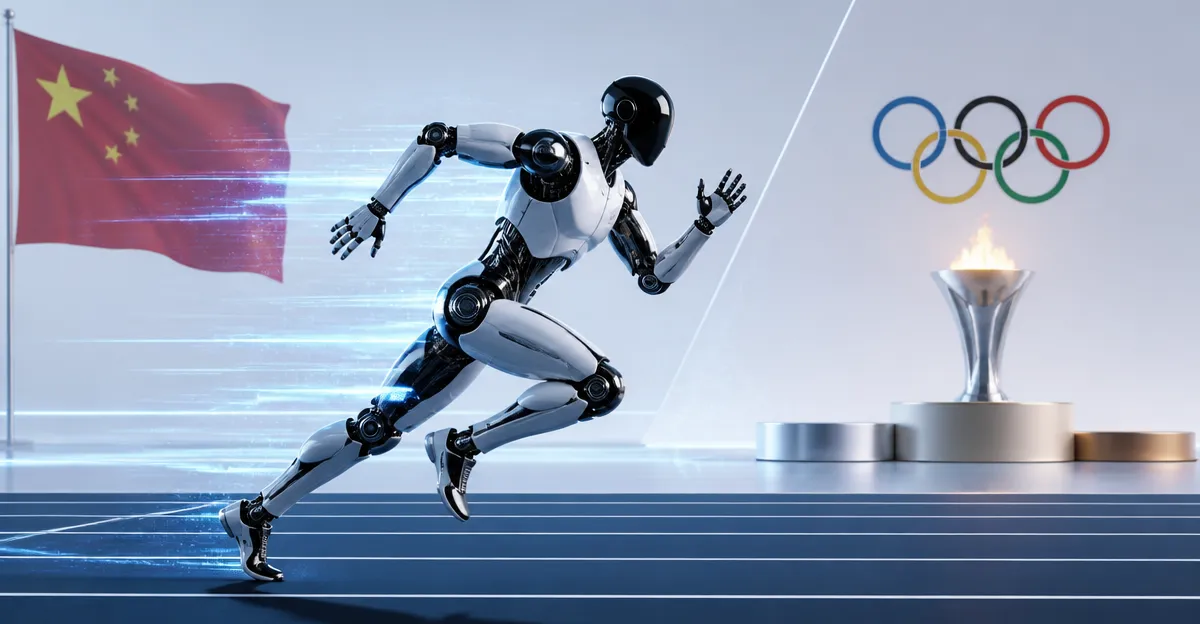
August 26, 2026, (Inside AI) — A Chinese humanoid robot ran 100 meters in 8.64 seconds on Wednesday, nearly a second faster than Usain Bolt’s human world record of 9.58 seconds, at the closing of the second World Humanoid Robot Games in Beijing.
Tiangong Ultra, developed by the Beijing Humanoid Robot Innovation Centre, won the large-size robot 100m final. The robot improved rapidly through the event, posting 9.39 seconds and 8.86 seconds in qualifying before the final.
The five-day competition, dubbed the “Robot Olympics,” brought together more than 2,000 robots from 666 teams, most of them Chinese. Its 51 disciplines included sports contests as well as task-based challenges in simulated factories, restaurants, offices, and emergency settings.
Spectators said the robots appeared more capable than those seen at the inaugural games.
“Last year’s robots looked a little stiff and uncoordinated,” said 34-year-old Niu. “This year, they are much better. They are like healthy newborn babies growing up.”
Yang, 29, said she could imagine robots becoming as commonplace as smartphones. “Maybe there will be one at home and one at work,” she said, adding that robots could help with chores or care for elderly people.
For developers, the games offered a public test bed for embodied artificial intelligence, which combines AI software with machines that can perceive and act in the physical world.
He Wang, founder and chief technology officer of Galbot, said the competition would help teams improve their technology while showing what embodied AI systems could do autonomously. “It will provide a huge boost for industry development,” he said.
Speed Is Only One Metric
The 8.64-second sprint is a striking number, but it does not mean humanoid robots have surpassed human athletes in overall capability. The 100m event at the Robot Olympics is not directly comparable to a human track race. Robots run on a flat, controlled surface, often with specialized hardware and no wind resistance concerns. Human sprinters must contend with biomechanics, reaction times, and physiological limits.
Still, the improvement from 9.39 to 8.64 seconds within a single event signals rapid progress in robot mobility, balance, and control systems. Tiangong Ultra likely uses advanced actuators, real-time gait planning, and reinforcement learning to maintain stability at high speeds. The Beijing Humanoid Robot Innovation Centre has not released full technical specifications, but the performance suggests a leap beyond the stiff, uncoordinated movements seen in last year’s robots.
Embodied AI Moves From Lab To Arena
The Robot Olympics is more than a sports spectacle. It is a public stress test for embodied AI, the field that combines AI software with physical machines. The 51 disciplines included simulated factory tasks, restaurant service, office work, and emergency response. These scenarios matter more for real-world adoption than sprint times.
China has invested heavily in humanoid robotics as part of its national technology strategy. The Beijing Humanoid Robot Innovation Centre is a state-backed initiative, and the games serve as a showcase for domestic capabilities. International teams participated, but the field was overwhelmingly Chinese, reflecting the country’s push to lead in robotics and AI.
Industry analysts note that speed records attract attention, but the real test is reliability, cost, and safety in unstructured environments. A robot that can sprint 100 meters in 8.64 seconds may still struggle to open a door or navigate a cluttered home. The games’ task-based challenges are designed to measure those practical skills.
The event also highlighted a shift in public perception. Spectators like Niu and Yang expressed optimism about robots becoming everyday helpers. That sentiment aligns with China’s aging population and labor shortages, which drive demand for robotic assistance in eldercare and household chores.
Looking ahead, the World Humanoid Robot Games will likely become an annual benchmark for embodied AI progress. The 8.64-second sprint may be broken again next year, but the more important metric will be how many robots can complete real-world tasks without human intervention.