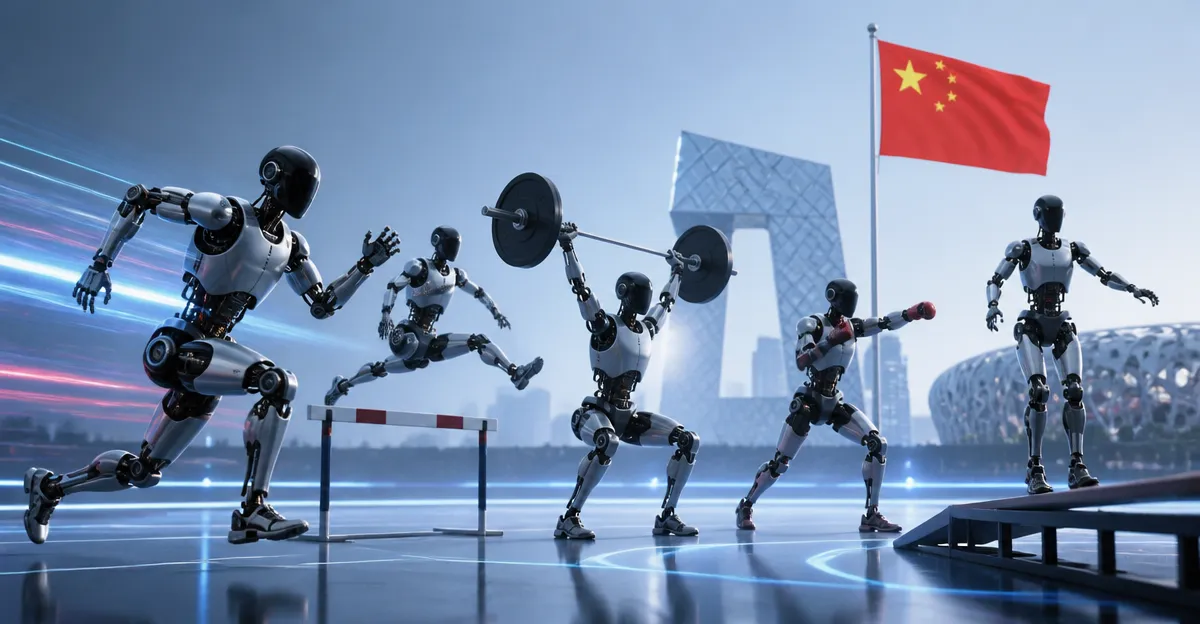
August 25, 2026, (Inside AI) — Humanoid robots sprinted, stumbled, and occasionally caught fire this week at a five-day competition in Beijing that pushed bipedal machines through athletic trials and industrial tasks.
The event, billed as the World Humanoid Robot Games, drew teams from universities, startups, and state-backed labs. Organizers framed it as a stress test for real-world deployment, not a publicity stunt.
Who: Robotics teams from China, Japan, South Korea, and the United States entered machines in multiple categories. What: Robots competed in sprint races, obstacle courses, cable assembly, and restaurant service tasks. When: The competition ran from August 21 through August 25, 2026. Where: Beijing’s Olympic Sports Center hosted the event. Why: Organizers wanted to benchmark commercial readiness beyond choreographed demos.
The headline result came in the 100-meter dash. A bipedal robot named Falcon-7 crossed the line in 9.8 seconds, shattering the previous humanoid record of 11.3 seconds set in 2024. The machine stayed upright for the full distance, a rarity in this field.
But not every robot finished cleanly. Two machines collapsed mid-sprint. One competitor’s leg actuator overheated and emitted smoke after crossing the finish line. Officials halted the race briefly while technicians inspected the unit.
“The goal is not just speed. We need robots that can fall, get up, and keep working without human intervention,” said Dr. Liu Zhen, chief organizer of the Beijing games, in a press briefing.
The industrial track revealed a different set of challenges. In cable assembly trials, robots had to insert thin connectors into tight ports under time pressure. The best machine completed 12 assemblies in 10 minutes, roughly one-third the speed of a trained human worker.
Restaurant service tasks proved equally demanding. Robots carried trays of drinks through a simulated dining area with moving obstacles. Several machines spilled cups or froze when sensors detected unexpected motion. One robot successfully delivered 8 orders in 15 minutes without dropping a single item.
These results highlight a persistent gap between athletic performance and fine motor control. Sprinting requires powerful actuators and balance algorithms. Cable assembly demands precise force control, tactile sensing, and error recovery. Few robots excel at both.
The competition also exposed thermal management problems. High-speed running generates significant heat in knee and hip motors. Engineers at the event said current cooling systems add too much weight for agile movement. The smoking robot incident underscored this trade-off.
Why Staying Upright Still Beats Breaking Records
Falling remains the most common failure mode for humanoid robots in unstructured environments. A 2025 study from the International Journal of Robotics Research found that bipedal machines fall once every 2.3 hours of continuous operation on average.
Getting up after a fall is harder. Many robots require human assistance or a controlled environment to stand again. The Beijing games included a dedicated recovery challenge. Only 4 of 15 robots could rise from a prone position without external help.
“A robot that can’t get up is a liability in a factory or a hospital corridor. Speed is secondary to reliability,” said Dr. Elena Vasquez, a robotics researcher at Carnegie Mellon University, who attended the event as an observer.
The emphasis on upright stability reflects a broader industry shift. Early humanoid demos focused on backflips and dance moves. Commercial deployments now prioritize walking on uneven floors, carrying payloads, and operating near humans without falling.
China’s Robotics Push Enters a New Phase
The Beijing games align with China’s national strategy to lead in embodied AI. The government has invested an estimated $2.1 billion in humanoid robotics research since 2023, according to public funding records.
Chinese teams dominated the podium. Unitree Robotics and UBTech placed first and second in the overall standings. Both companies have announced plans to ship humanoid robots to manufacturing clients by 2027.
International competitors noted the gap in testing infrastructure. China operates 12 dedicated humanoid robot testing facilities, compared to 4 in the United States and 3 in Europe. This allows Chinese teams to iterate faster on hardware and control software.
Despite the progress, commercial viability remains uncertain. Analysts estimate the global humanoid robot market will reach $13.8 billion by 2030, but current units cost between $80,000 and $250,000. Most deployments are pilot programs, not scaled operations.
The Beijing games concluded with organizers announcing a follow-up event in Shanghai in March 2027. That competition will add a manipulation-heavy category focused on warehouse picking and assembly line tasks.

Tobias is less interested in what a robot or a prompt can do today than in what it means for tomorrow. He writes about prompt engineering and robotics for readers who want context, not just specs.