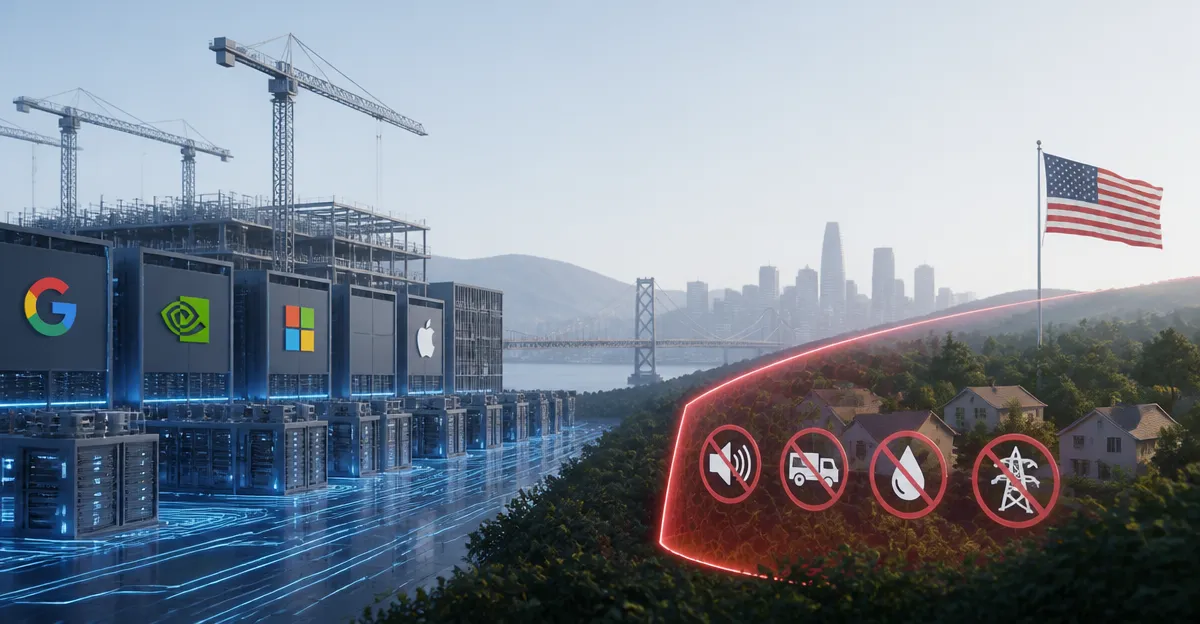
September 18, 2026, (Inside AI) — Residents and environmental groups in San Jose, California, are organizing against a wave of proposed data center projects. The resistance has reached the doorstep of Silicon Valley's biggest city. Local officials had courted these projects to position San Jose as a hub for artificial intelligence infrastructure.
The conflict marks a shift in the geography of AI opposition. For years, fights over data centers focused on rural counties and power-grid bottlenecks. Now, the pushback has arrived in the tech industry's own backyard. San Jose, a city of roughly 970,000 people, sits at the center of the world's densest concentration of AI talent and capital.
At issue is the physical cost of the AI boom. Data centers consume vast amounts of electricity and water. They also generate noise and strain local grids. Residents near proposed sites say they were not consulted. Environmental groups argue that the projects conflict with the city's climate goals.
The backlash follows a pattern seen in Northern Virginia, Georgia, and Arizona. In those regions, utility regulators and local boards have slowed or rejected data center proposals. The difference in San Jose is symbolic. If the city that birthed the semiconductor industry cannot host AI infrastructure, the industry's growth story faces a new constraint.
Read: Finland Risks Strained Power Supply After Google AI Deal, Opposition Warns
San Jose officials have not publicly detailed how many projects are under review. But the city's general plan update has become a flashpoint. Environmental groups want stricter limits on power procurement and water use. Residents want more transparency about tax breaks and land deals.
Industry analysts note that AI data centers differ from earlier cloud facilities. They require more power per square foot and more cooling capacity. That makes them harder to hide in industrial parks. It also makes local opposition more likely to succeed.
The timing is awkward for AI companies. They are racing to build capacity for models that require ever-larger compute clusters. Any delay in permitting or power delivery can push back product timelines. San Jose's resistance could become a template for other tech hubs.
City officials had hoped to attract data centers as a revenue source. Property taxes and utility fees can fund public services. But the political calculus has shifted. Environmental justice groups have learned to use planning commissions and environmental review laws to slow projects.
The outcome in San Jose may hinge on whether the city can negotiate binding community benefits. Those could include local hiring, grid upgrades, and water recycling. Without such deals, the opposition is likely to harden.
Read: US Power Use to Beat Record Highs in 2026 and 2027 as AI Use Surges, EIA Says
For now, the fight is local. But its implications are national. The AI industry's expansion depends on physical infrastructure. That infrastructure depends on local consent. Silicon Valley is learning that lesson in its own capital.