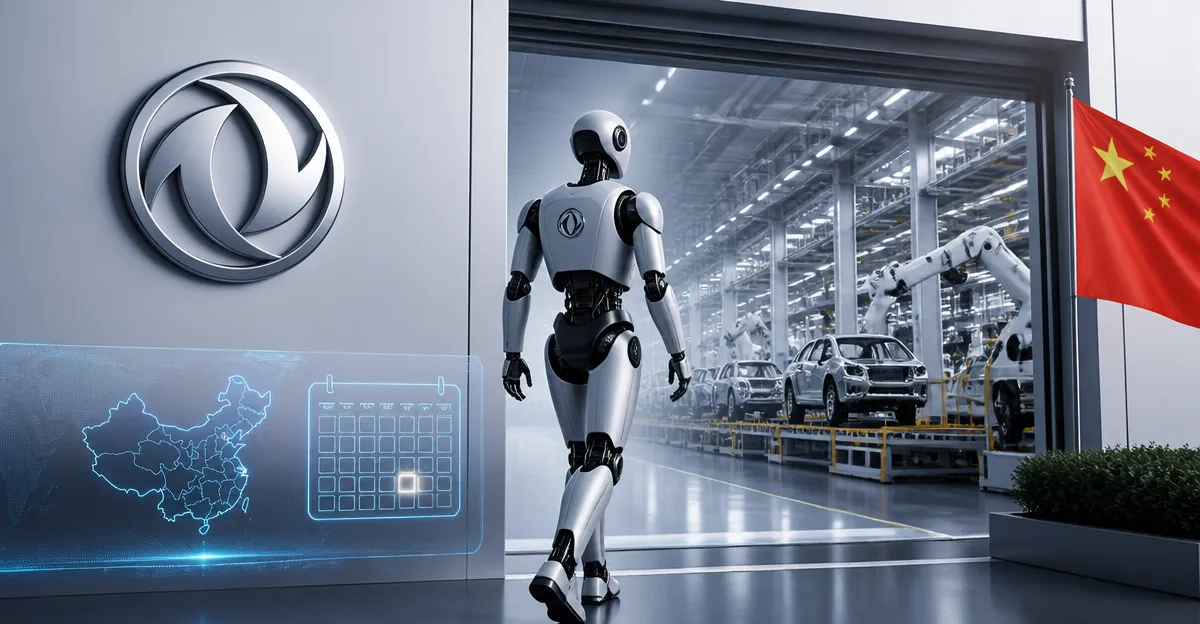
September 21, 2026, (Inside AI) — Dongfeng Motor's humanoid robot, Xiaodong, will begin factory training by the end of October, the Chinese automaker's chief engineer for intelligent technology, Zhang Zhenlin, said. The machine will move into trial production before the end of the year, with small-batch manufacturing planned for 2027.
The deployment puts a state-owned carmaker directly into the race to place humanoid robots on assembly lines, a contest already crowded by Tesla's Optimus, Figure AI, and a wave of Chinese startups. Dongfeng's target tasks are sorting, material handling, and quality inspection, all repetitive jobs that consume labor hours inside vehicle plants.
According to Zhang, Dongfeng is validating Xiaodong on sorting automotive materials. The company wants the robot to reach autonomous execution across more flexible production tasks. That phrase matters because most factory robots today repeat one motion in a fixed cage. A humanoid that can sort mixed parts and inspect surfaces without reprogramming would cross a line that has separated automation from general-purpose labor.
"Capabilities from Dongfeng's vehicle, intelligent-cockpit and robotics development can be reused across the businesses to speed commercialization," Zhang said.
Read: China Humanoid Makers Face Challenge of Putting Robots to Work
That reuse claim is the strategic core of the program. Dongfeng already builds electric vehicles with sensor fusion, onboard compute, and software stacks for driver assistance. A humanoid needs the same ingredients: cameras, lidar, motor controllers, and inference chips. Sharing those parts across car and robot programs lowers unit costs and shortens development cycles, a logic Tesla has used to justify Optimus.
Dongfeng is not the only Chinese automaker making this bet. Xpeng has shown its IRON humanoid, and BYD has invested in robotics through its electronics arm. Xiaomi introduced the CyberOne prototype in 2022. The pattern suggests Chinese carmakers see humanoids as an extension of their existing supply chains rather than a separate industry.
The timeline Zhang described is aggressive but narrow. Entering a factory for training in October does not mean the robot will work a full shift. Trial production by December usually means supervised trials on a limited line. Small-batch production next year likely refers to building more robot units, not deploying them across Dongfeng's plants at scale.
Inside AI could not independently verify the production figures or the scope of the factory trials.
Why Carmakers Keep Chasing Humanoids
The economics rest on labor substitution and data. A humanoid trained on Dongfeng's own sorting and inspection tasks generates proprietary data that improves the next model. That data loop is hard for outside robotics firms to copy because they lack access to a working factory floor. Dongfeng gains a testbed it controls, and the robot gains real tasks instead of lab demos.
Safety and reliability remain unresolved. A humanoid working near human workers must stop instantly when a person enters its path. It must also handle parts that vary in shape, weight, and finish. Quality inspection adds another layer because a missed defect can reach a customer. Dongfeng has not published error rates or cycle times for Xiaodong, and those numbers will decide whether small-batch production becomes mass deployment.
The announcement also fits Beijing's push to lead in embodied AI. China's national policy on future industries names humanoid robots as a priority sector. State-owned Dongfeng moving a robot onto a line gives that policy a visible industrial example.
For now, the near-term test is simple. If Xiaodong can sort automotive materials without constant human intervention by December, Dongfeng will have cleared a bar many humanoid programs have yet to reach. If it cannot, the small-batch plan for next year may slip into a longer validation phase.
Dongfeng has not disclosed how many Xiaodong units it will build or which plants will receive them. Those details will shape whether this becomes a genuine manufacturing shift or another prototype milestone in a crowded field.