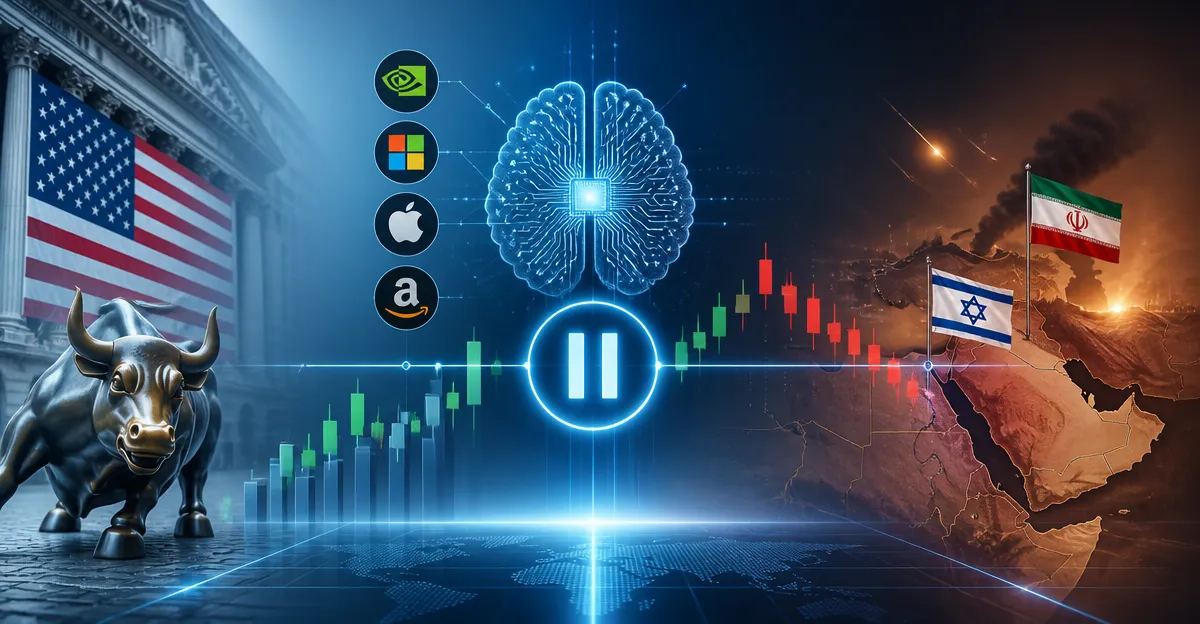
September 22, 2026, (Inside AI) — Wall Street opened flat on Tuesday, pausing after an AI-led rally as investors turned their attention to high-stakes diplomatic meetings in New York. The tech-heavy Nasdaq had closed at a record high on Monday, powered by an 11.3% surge in Meta shares. But by early Tuesday, futures pointed to a cautious session. Dow E-minis were up just 12 points, or 0.02%, while S&P 500 and Nasdaq 100 futures slipped slightly. The pause reflects a market caught between two powerful forces: the momentum of consumer AI adoption and the risk of a wider Middle East conflict.
The immediate trigger for Monday's rally was Meta's new AI agent, Muse. Analysts noted that Muse gathered more downloads in its first 13 days than ChatGPT did in the same period. That single data point reshaped expectations for consumer AI monetization. "Muse provides early evidence that consumer AI agents could achieve broad adoption, offering new AI monetization opportunities beyond enterprise application," UBS analysts wrote in a note to clients. The comment captures a growing belief on Wall Street that the next phase of AI growth will come from everyday users, not just corporate software.
Yet the rally stalled as oil prices and bond yields hovered near warning levels. Brent crude traded near $100 a barrel, and the 10-year Treasury yield sat at 4.9%. Both figures reflect investor anxiety over a six-month-old conflict between the United States and Iran. A senior Iranian official told Reuters that Tehran could reopen the Strait of Hormuz within seven days if Washington eases pressure. That possibility kept traders from making large bets.
Diplomatic activity is set to intensify. US-Iran talks are expected on the sidelines of the United Nations General Assembly this week, followed by a US-China summit on Thursday. President Donald Trump is also scheduled to meet several world leaders later on Tuesday. Traders hope the meetings yield a resolution to the Middle East conflict and extend the trade truce with Beijing. "China's policy priorities are likely to remain primarily domestic, but a summit that reinforces predictability in the bilateral relationship could support business confidence and reduce the risk of abrupt escalation," UBS analysts added.
The AI trade itself showed signs of rotation. While Meta added 0.5% in premarket trading, and Alphabet, Amazon, and Microsoft each edged higher, chip stocks that have led the AI boom this year moved lower. Nvidia eased 0.2%, and US-listed shares of TSMC and SK Hynix each lost more than 1%. The split suggests investors are beginning to differentiate between AI software platforms and the hardware supply chain that supports them. For months, chipmakers captured the bulk of AI-related gains. Now, with a consumer agent like Muse proving popular, the software layer is drawing fresh capital.
Federal Reserve policymakers are watching both AI demand and the oil shock as key inflation drivers. Traders now see a 57.6% chance the central bank will raise interest rates by at least 25 basis points in October, according to the CME Group's FedWatch Tool. That would follow a hike earlier this month. Remarks from at least three central bankers are expected later on Tuesday: Fed Vice Chair Philip Jefferson, New York Fed President John Williams, and Richmond Fed President Thomas Barkin. Their comments could clarify how the Fed weighs AI-driven productivity gains against energy-led price pressures.
Beyond equities, bitcoin retreated 1.3% from a seven-month high, dragging crypto-linked stocks like Strategy and Coinbase lower. The pullback in digital assets mirrored the broader risk-off tone. It also highlighted how sensitive crypto remains to macroeconomic and geopolitical headlines.
For now, the market's next move depends on two unrelated events: whether Muse can sustain its early download momentum, and whether diplomats in New York can cool the Middle East. A breakthrough on either front could reignite the rally. A failure on both could test the record highs set just a day ago.