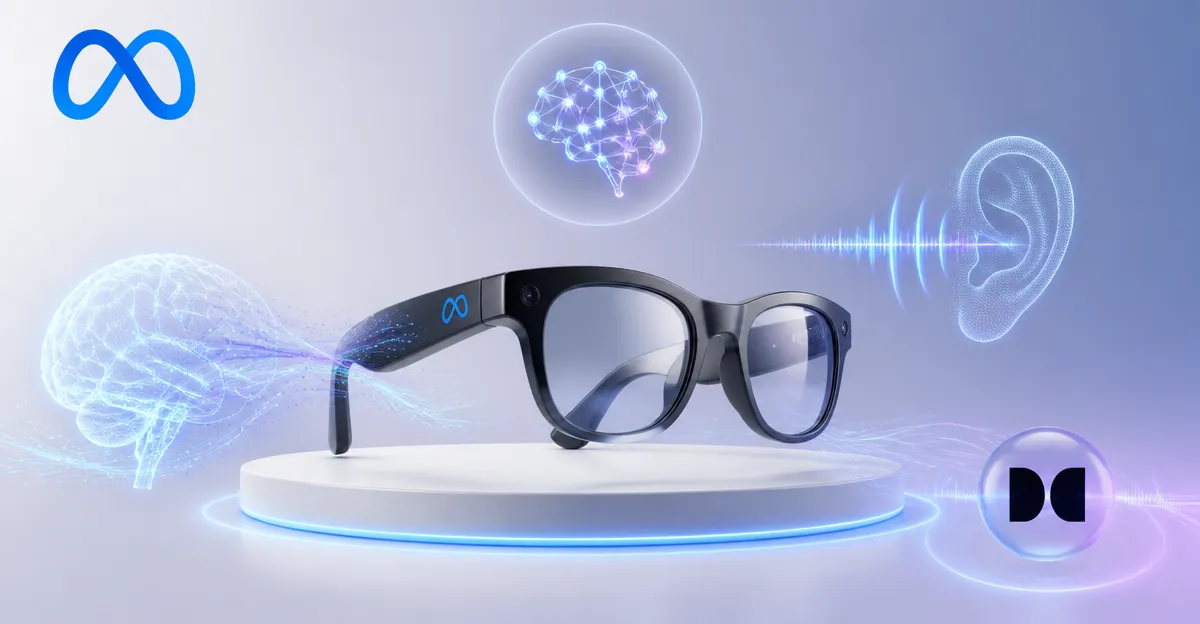
September 24, 2026, (Inside AI) — Meta unveiled its most aggressive push into wearable AI at its annual Connect conference in Menlo Park, California, on Wednesday, September 23. The company introduced a new personal AI agent called Muse, FDA-cleared hearing enhancement software, and the first consumer device capable of capturing Dolby Atmos audio. It also launched Ray-Ban Meta Audio, its first camera-free audio glasses, and expanded its display glasses into five new markets.
The announcements position Meta at the center of a growing race among technology companies to define how artificial intelligence integrates into daily life. The company's strategy now spans hardware, software, and a vision it calls 'personal superintelligence,' an effort to embed AI across WhatsApp, Instagram, Facebook, Messenger, and wearable devices.
Muse AI Agent Arrives On Glasses
Muse is Meta's first major product built around agentic AI. Unlike conventional voice assistants that answer questions, Muse performs tasks on behalf of users. It runs on Muse Secure VM and is powered by Muse Spark, which Meta describes as its most capable model for agentic work. The agent can send emails, book travel, fill out forms, and make purchases.
The company said its AI glasses will be powered by users' personal Muse agent. "We're working on bringing Muse to our AI glasses to help you stay on top of things, take tasks and projects off your plate, and turn long-term goals into action plans, all hands-free," Meta said in its official blog post.
Read: Meta Touts Cost-Saving Benefits of In-House AI Chips
A wearer can ask Muse to guide a personalized workout, log meals, get nutrition insights, or help buy products they see. Users can request appointment bookings, flight prices, or locate missing items while driving, cooking, or exercising without reaching for a phone. Muse activates by saying its name and stating a request. It works in the background and checks back when finished. The feature is currently limited to users in the United States.
The agent represents a significant shift in how Meta envisions AI interaction. Rather than requiring users to open apps, Muse operates across connected services and websites. This approach mirrors efforts by Google, OpenAI, and Anthropic, which have all released agentic tools capable of autonomous task completion. Meta's advantage lies in its existing ecosystem of over 3 billion daily users across its apps.
Hearing Enhancement And Audio Breakthroughs
Meta also demonstrated hearing enhancement software cleared by the FDA for adults with perceived mild to moderate hearing loss. The feature requires no clinic visit or prescription and can be set up at home within minutes. During a demo, users plugged their ears with foam earplugs to block surrounding noise. When a Meta spokesperson activated the feature, their voice remained audible and clear.
The technology results from over five years of research into making hearing enhancement viable for consumer devices. It will launch in the United States later this year on select styles and can be added to supported AI glasses for $149.99 or through a Meta One subscription.
Meta also announced Dolby Atmos Capture, making its glasses the first consumer device to record and experience video with 360-degree spatial sound. Additional features include Dynamic Photo, which captures multiple frames and uses Meta AI to suggest the best one, and Landscape Crop Mode for horizontal captures. The Private Processing feature claims to deliver AI experiences without Meta or anyone else seeing user data.
The Ray-Ban Meta (Gen 3) arrives with up to nine hours of battery life, an hour more than its predecessor. It features a six-microphone array that reduces background noise by over 90 percent, a 12MP camera with 3K Ultra HD video, and 27 color and lens combinations. Two new styles, Zena and Aviator, join the existing Wayfarer. The Gen 3 is available starting today at $449 and will also launch in India, with prices yet to be announced.
Ray-Ban Meta Audio, the company's first audio-only glasses, weighs 43 grams and offers up to 12 hours of battery life, extending to 48 hours with the charging case. It comes in 23 color and lens combinations across two new styles, Clubmaster and Burbank. The camera-free design makes it a convenient AI-powered wearable for daily use. It ships October 13 and can be pre-ordered today starting at $349 in the United States. An India launch date has not been announced.
Read: HP ProBook 4 Flip G2i AI PC Built for Leaders Who Work in Motion
Meta Ray-Ban Display glasses are expanding to the UK, Canada, France, Italy, and Germany. The device goes on sale today in the UK and Canada, starting at £749 and CA$1,149 respectively. Pre-orders begin today in France, Italy, and Germany at €899, ahead of availability on October 13. In the United States, the display glasses start at $799 and are now available for online ordering.
New features for the display model include cycling and public transit directions through Heads-Up Navigation, available later this month in the US and Canada. The navigation now uses enhanced visual understanding to describe landmarks, telling users to turn left at the yellow house instead of the third street. A Hologram feature creates a photorealistic digital version of the caller's face for video calls, driven entirely by voice and expression inference. It begins rolling out in Early Access on WhatsApp to Meta Ray-Ban Display users in the US later this fall.
Meta is also introducing Explore, an on-glasses app for discovering web applications, along with photo editing directly within the display, a more powerful calendar, Mirror Notifications for phone alerts, and Threads for Community Feeds. The company announced collaborations with Kylie Jenner and LISA, a limited-edition Ray-Ban Aviator for the model's 90th anniversary, and new styles Capri and Nova. A more affordable Meta Adventurer starts at $249.
Meta Glasses are expanding to Singapore, South Korea, Mexico, and the UAE, with Brazil coming soon. By the end of the year, Meta plans to offer over 100 glasses options across Ray-Ban, Oakley, and Meta Glasses. The breadth of Wednesday's announcements signals Meta's intent to dominate the emerging AI wearable category before competitors like Apple and Google establish significant presence. Whether consumers embrace glasses as their primary AI interface remains the central question the company now must answer.