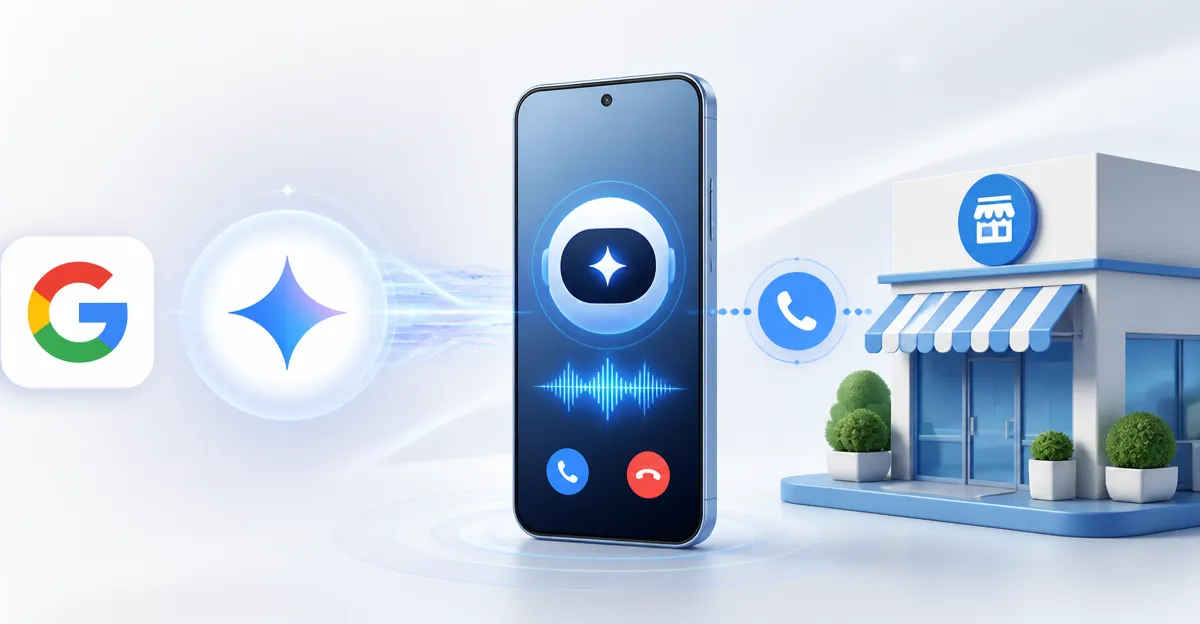
September 25, 2026, (Inside AI) — Google on Thursday launched a new feature that lets its Gemini AI assistant place real phone calls to businesses on behalf of users. The tool, called Call for Me, is available only to Pixel 11 owners with a Gemini subscription in the United States and requires the beta version of Google's Phone app for Android. The feature is still experimental and rolling out at a small scale.
With Call for Me, users can ask Gemini to call a store to check product stock, a restaurant to book a table, or a doctor's office to schedule an appointment. The AI assistant dials directly from the user's phone using their personal number. Once the call connects, Gemini introduces itself and can navigate automated phone menus and wait on hold. Users can monitor the conversation through a live transcript and take over at any time. Gemini can also share the user's personal information with the business, but only after the user approves.
The launch marks a shift in how smartphones are being positioned. Devices are moving from app-centric platforms to AI agent-centric systems that understand user intent and handle tasks autonomously. Google's move follows similar efforts from Meta, whose Muse and Instinct agents can also make calls on users' behalf. But Google's approach is notable for its tight integration with the phone's native dialer and its reliance on the user's own phone number, which could raise privacy and consent questions.
Why Google Is Starting Small
Google says the feature is experimental because "real-world conversations are nuanced," and it needs time to get the feature right before a broader rollout. That caution is warranted. AI agents that interact with humans over the phone must handle accents, background noise, interruptions, and unpredictable dialogue. Previous Google demos, like the 2018 Google Assistant call to a salon, impressed audiences with natural-sounding "umms" and "ahhs," but real-world deployment is far messier.
The company has been building toward this for years. In 2024, Google rolled out Ask for Me, which let Gemini call businesses to inquire about pricing or services. Other Pixel features include Hold for Me and Talk to a Live Rep, which navigate phone trees and wait on hold. Direct My Call displays numbers to navigate IVR systems. Call for Me combines these capabilities into a single agentic workflow.
But the feature also raises unresolved questions. How will businesses react to AI callers? Will they be required to disclose that they are speaking to a machine? Google says Gemini introduces itself, but the company has not detailed how it handles consent from the business or what happens if a business refuses to talk to an AI. The live transcript and user takeover option provide some oversight, but the feature still places a significant amount of trust in an AI system to represent a user accurately.
Privacy advocates may also note that Gemini can share personal information with businesses. While user approval is required, the process for granting that approval and the scope of data shared remain unclear. Google has not specified whether the feature records calls or stores transcripts on its servers.
The launch comes as regulators in the European Union and United States are increasingly scrutinizing AI agents that act on behalf of users. The Federal Trade Commission has signaled interest in AI systems that make autonomous decisions, and the EU AI Act includes provisions for transparency in AI interactions. Google's decision to limit Call for Me to a small test group may be a way to gather data before facing broader regulatory attention.
Read: Meta Launches Muse AI Agent: What It Can Do and How It Handles Your Data
For now, Call for Me is a limited experiment. It requires a Pixel 11, a Gemini subscription, and the beta Phone app. That narrow eligibility suggests Google is treating this as a learning phase. The company has not said when it will expand to other devices or countries. But the direction is clear: AI agents are moving from answering questions to taking actions in the physical world. The phone call, one of the oldest real-time communication methods, is becoming a testbed for the next generation of AI autonomy.