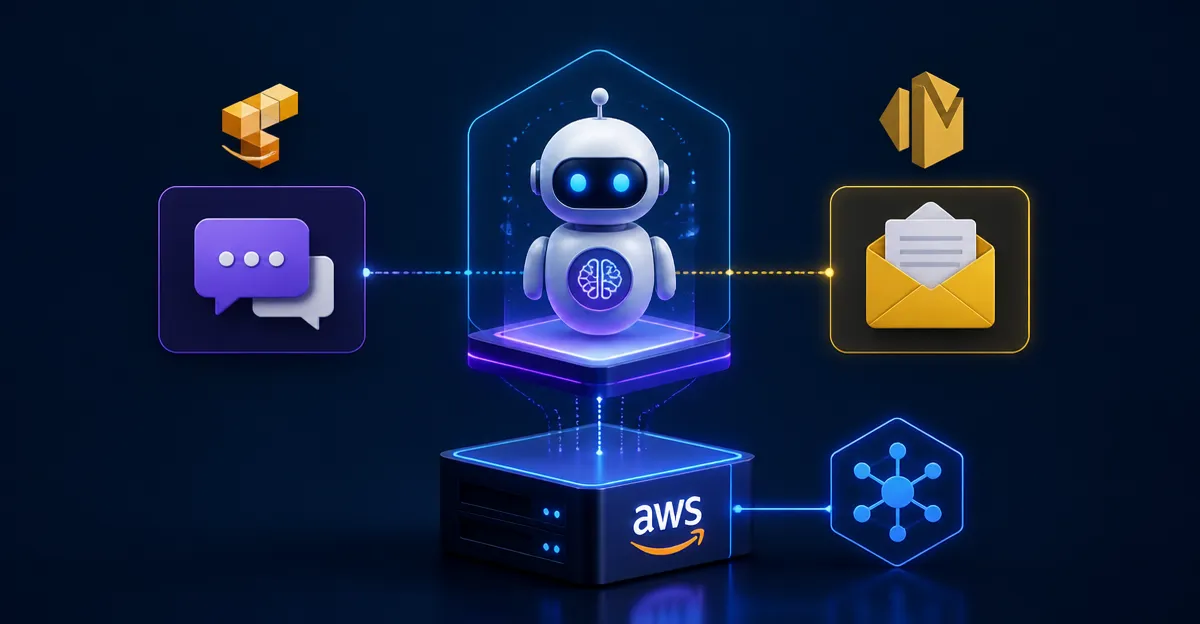
September 26, 2026, (Inside AI) — Amazon Web Services has extended its Model Context Protocol (MCP) server with new AI agent skills for two of its messaging services, AWS End User Messaging and Amazon SES. The update, announced by AWS, allows developers to configure and deploy messaging workflows using plain-language commands through AI coding assistants such as Claude Code, Codex, Cursor, and Kiro.
The move signals a broader shift in how cloud infrastructure is managed. Instead of navigating documentation and console screens, developers can now ask an AI agent to verify a sending identity or build a branded Rich Communication Services (RCS) agent. Each skill provides step-by-step, validated guidance, reducing manual configuration errors.
From Console Clicks to Conversational Commands
Previously, setting up Amazon SES for production email required multiple steps across the AWS Management Console and documentation. Developers had to verify domain identities, configure DKIM records, and adjust sandbox limits. AWS End User Messaging for SMS, WhatsApp, and RCS involved similar complexity. The new skills bundle these tasks into natural language workflows.
For example, a developer can tell their coding agent to verify a sending identity and send a first production email. The agent then executes the necessary API calls and configuration changes. Similarly, for RCS, a developer can ask the agent to build a branded agent and send a rich message with cards and buttons.
Read: ImagineArt Launches MCP Server for ChatGPT, Claude, and More
The skills integrate with the AWS MCP Server, which acts as a bridge between AI coding agents and AWS services. In Claude Code, Codex, and Cursor, the aws-core plugin bundles the server and a curated set of skills in one install. In Kiro and other agents, developers add the server to their MCP configuration file and then add the skill for the desired channel.
"These skills eliminate the need to manually search documentation or switch between console screens," AWS stated in its announcement. The company positions the update as a way to complete messaging workflows directly through natural language commands.
Why AWS Is Betting on Agentic Workflows
The announcement reflects a wider industry trend toward agentic AI in developer tooling. Microsoft has integrated similar capabilities into GitHub Copilot, allowing developers to query Azure services. Google Cloud has introduced Duet AI for infrastructure management. AWS, however, is leveraging the open MCP standard, which it helped popularize, to create a vendor-neutral approach.
MCP, originally developed by Anthropic, allows AI models to connect to external tools and data sources. AWS adopted it for its MCP Server earlier this year. By publishing skills for specific services, AWS is effectively creating a library of reusable agent behaviors. This could reduce the learning curve for new developers and speed up deployment cycles.
Analysts note that the real value lies in validation. Each skill provides validated guidance, meaning the agent follows AWS best practices. This reduces the risk of misconfiguration, a common problem in cloud messaging setups. For enterprises, that translates to fewer support tickets and faster time-to-market.
However, some developers remain skeptical. Natural language commands can be ambiguous, and AI agents may misinterpret intent. AWS mitigates this by providing step-by-step guidance, but the agent still relies on the underlying model's reasoning. For complex, multi-step workflows, manual configuration may still be preferred.
Read: AWS Launches Amazon CloudWatch Omni for AI Agent Observability
The skills are available now for AWS End User Messaging SMS, RCS, WhatsApp, and Amazon SES. AWS has published setup guides for each channel. Developers can install the aws-core plugin or manually add the server to their MCP configuration.
Looking ahead, AWS is expected to expand the skill library to other services. The company has not announced specific timelines, but the pattern suggests a gradual rollout across its portfolio. For now, the messaging skills offer a glimpse of how cloud management may evolve from clicking through consoles to conversing with AI agents.