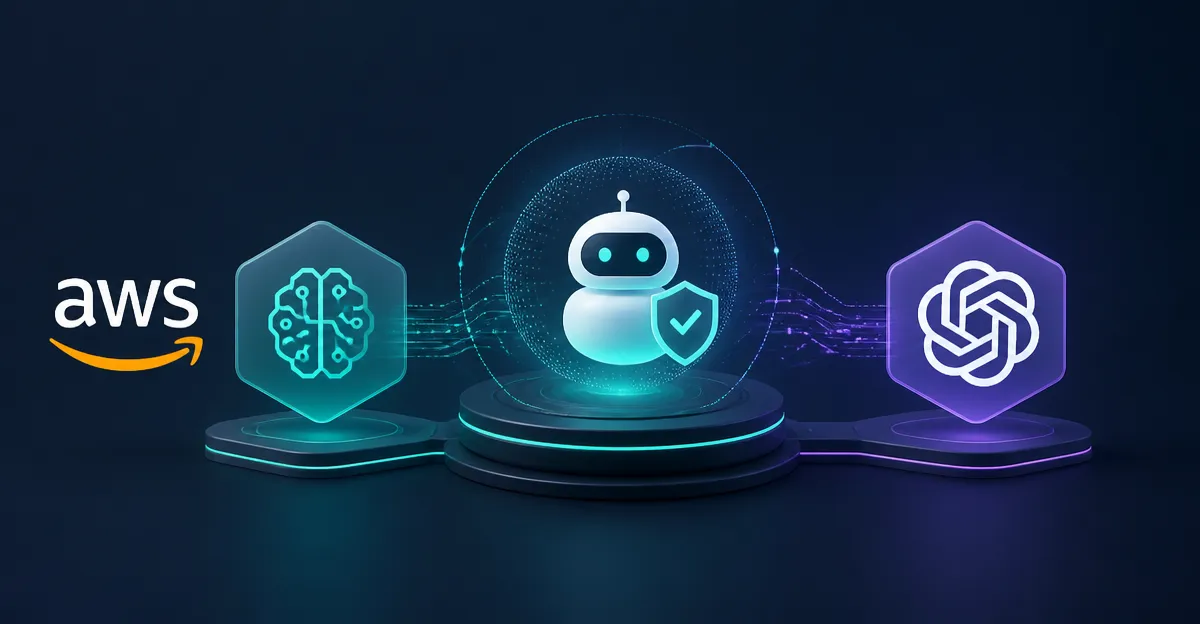
September 30, 2026, (Inside AI) — Amazon Web Services and OpenAI have jointly launched Amazon Bedrock Managed Agents (BMA), a new service that lets enterprises build and run AI agents powered by OpenAI models entirely inside their own AWS environments. The service is now available in preview across three AWS regions: US East (N. Virginia), US West (Oregon), and US East (Ohio).
The move marks a notable shift in the cloud AI landscape. Until now, companies wanting to deploy OpenAI-powered agents typically had to route data and orchestration through OpenAI's own infrastructure or stitch together third-party frameworks. BMA changes that by embedding a customized version of OpenAI's Agents API directly into AWS, letting organizations use their existing identity and access management (IAM) roles, permissions, and governance controls.
According to AWS, BMA handles the complex mechanics of agent operation: preserving state across interactions, selecting and invoking tools, executing code, and coordinating multi-step decisions. The system introduces durable sessions that retain messages, tool calls, and intermediate results, so users can pause an agent's work, return later with new information, and resume from where it left off.
The service also supports reusable skills for specialized procedures and connects agents to external tools through Model Context Protocol (MCP) servers. Each agent operates under its own IAM role, and the platform supports human approval before consequential actions. All supported API activity is recorded through AWS CloudTrail, giving security teams an audit trail.
Read: Enterprise AI Agents Fail Without Employee Trust, Wharton Blueprint Finds
"Developed jointly by AWS and OpenAI, Bedrock Managed Agents (BMA) is built on a customized version of OpenAI's Agents API engineered to be AWS-native and integrated with AWS resources," the companies said in a joint statement. "You can now build agents optimized for OpenAI models that run entirely inside AWS with the identities, permissions, and governance controls you already use."
During the preview period, AWS will not charge an additional fee for BMA beyond the underlying AWS resources the agents consume. Pricing is subject to change at general availability, a detail that could influence enterprise adoption timelines.
The collaboration is significant for several reasons. OpenAI has spent the past two years expanding its enterprise footprint, but many large organizations remain cautious about sending sensitive data outside their cloud perimeter. By running agents inside AWS, BMA addresses that concern directly. It also gives AWS a stronger answer to Microsoft's Azure AI Foundry and Google Cloud's Vertex AI, both of which have moved aggressively to host third-party models alongside their own.
For OpenAI, the partnership deepens its relationship with the world's largest cloud provider at a time when competition among model developers is intensifying. For AWS, it adds another major model provider to Bedrock, which already hosts Anthropic's Claude, Meta's Llama, Mistral models, and Amazon's own Nova family.
The technical architecture of BMA reflects a broader industry push toward what analysts call "agentic infrastructure." Instead of treating agents as simple chatbots, BMA manages them as stateful, long-running processes with defined permissions and audit requirements. That approach mirrors similar efforts from Microsoft, which introduced Copilot Studio agents with Entra ID integration, and Google, which offers Vertex AI Agent Builder with IAM controls.
One key differentiator is the MCP support. Model Context Protocol, originally developed by Anthropic, has become a de facto standard for connecting AI models to external data sources and tools. By supporting MCP, BMA lets agents interact with a wide range of third-party services without custom integration work.
Enterprises interested in testing BMA can access it through supported APIs. AWS recommends reviewing the Amazon Bedrock documentation for setup details. The preview regions cover major US business hubs, but international availability has not been announced.
The launch comes as regulators in the European Union and United States debate rules for autonomous AI systems. BMA's built-in human approval workflows and CloudTrail logging could help companies meet emerging compliance requirements, though AWS has not positioned the service explicitly as a compliance tool.
Whether BMA becomes a standard part of enterprise AI stacks will depend on how quickly AWS moves it to general availability and how pricing evolves. For now, the preview offers a low-risk way for companies already invested in AWS to experiment with OpenAI-powered agents without leaving their existing security and governance frameworks.