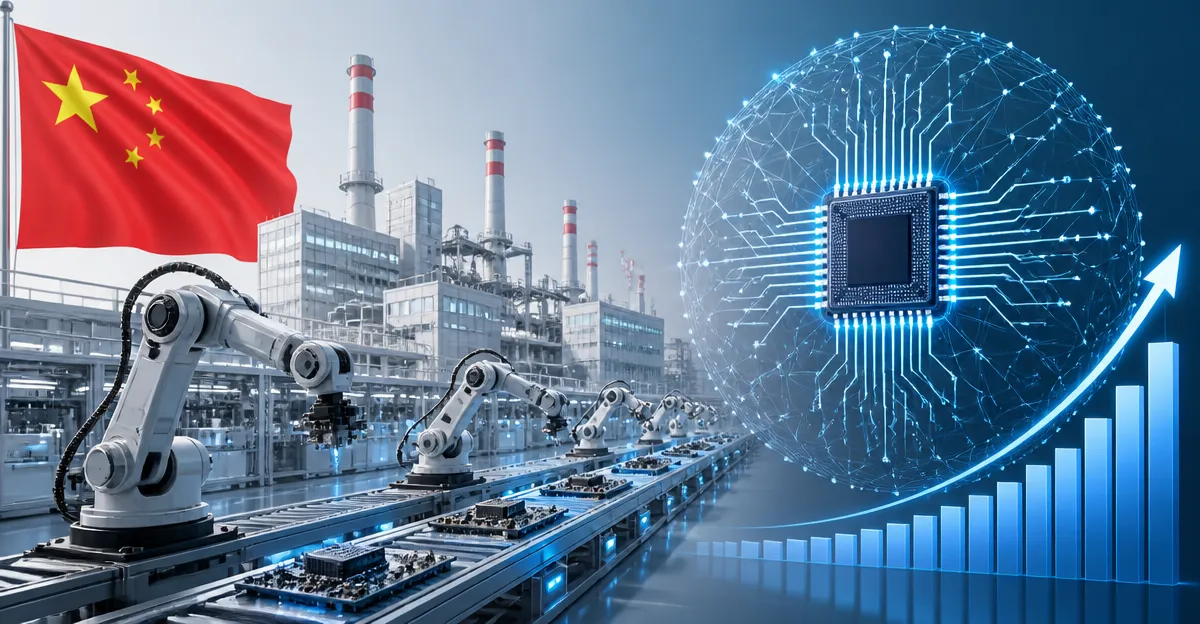
September 30, 2026, (Inside AI) — China's factory activity expanded in September 2026, according to official and private surveys released Wednesday, as easing weather disruptions allowed factories to resume operations and a global artificial intelligence boom supported the industrial sector.
The official manufacturing purchasing managers' index (PMI) rose to 50.2 in September from 49.4 in August, the National Bureau of Statistics said. The 50-point mark separates expansion from contraction. The private Caixin manufacturing PMI, which focuses more on smaller, export-oriented firms, also increased to 51.2 from 50.6 in August. The simultaneous expansion in both gauges suggests a broad-based improvement, though the recovery remains uneven as weak consumption and a prolonged property downturn continue to weigh on domestic demand.
The AI boom has emerged as a key driver of China's industrial output. Global demand for AI servers, data center components, and advanced semiconductors has boosted production in electronics and high-tech manufacturing. China's exports of automatic data processing equipment, including servers, rose 12.4% year-on-year in August, according to customs data. That followed a 15.2% jump in July. The surge reflects rising global investment in AI infrastructure, much of it led by U.S. technology companies building large-scale data centers.
"The AI-related demand is providing a significant lift to China's manufacturing sector, particularly in the electronics and equipment segments," said Zhang Li, a senior economist at a Beijing-based research institute. "But we should not overstate the strength of the overall recovery. Consumer-facing industries remain sluggish, and the property sector is still a drag."
Read: NVIDIA Boosts Share Buyback by $150 Billion, Betting Big on AI Future
Factory output of computers, communication equipment, and other electronic devices grew 9.8% year-on-year in August, the fastest pace since March 2025. Semiconductor production rose 11.3% over the same period. These gains stand in contrast to weaker performance in traditional sectors such as textiles, furniture, and basic materials, where output growth has stalled or turned negative.
The September PMI reading also benefited from a normalization of weather conditions. Typhoons and heavy rains in August disrupted production in southern China, particularly in Guangdong and Fujian provinces. With those disruptions easing, factories were able to resume normal operations, adding roughly 0.3 to 0.5 percentage points to the headline index, according to estimates from several economic research firms.
New export orders, a key sub-index, rose to 50.8 in September from 49.5 in August, marking the first expansion in four months. The improvement was driven largely by electronics and machinery exports, while orders for consumer goods remained weak. Imports of semiconductors and integrated circuits increased 8.7% year-on-year in August, signaling continued demand for components used in AI hardware.
Despite the positive headline numbers, the recovery's uneven nature poses challenges for policymakers. Retail sales grew just 2.1% year-on-year in August, well below pre-pandemic trends. The property sector, which accounts for about 25% of China's GDP when including related industries, continues to contract. New home prices fell in 70 major cities for the 14th consecutive month in August.
"The AI boom is a bright spot, but it cannot single-handedly offset the drag from property and weak consumer spending," said Wang Tao, chief China economist at a major international bank. "We expect more targeted stimulus measures in the coming months, possibly including support for the semiconductor and AI supply chains."
Beijing has already signaled its intention to bolster the tech sector. In August, the State Council announced a 1 trillion yuan ($140 billion) fund to support advanced manufacturing, with a focus on AI, semiconductors, and robotics. The fund is expected to be deployed over the next three years, according to an official who spoke on condition of anonymity.
Global demand for AI hardware shows little sign of slowing. Major cloud providers, including Amazon Web Services, Microsoft Azure, and Google Cloud, have all raised their capital expenditure forecasts for 2026, citing AI infrastructure needs. That spending translates directly into orders for Chinese manufacturers of servers, power supplies, and cooling systems, as well as for Taiwanese and South Korean firms that supply advanced chips.
However, the AI-driven expansion is not without risks. The U.S. has imposed export controls on advanced semiconductors and chipmaking equipment to China since 2022, and those restrictions have tightened over time. Chinese firms have responded by developing domestic alternatives, but they still rely on foreign technology for the most advanced AI chips. The long-term impact of these controls on China's manufacturing sector remains uncertain.
Looking ahead, economists expect the manufacturing PMI to stay near the 50 mark in the fourth quarter. The AI boom will likely continue to support output, but weak domestic demand and property sector woes will cap the upside. A sustained recovery would require stronger consumer spending and a stabilization of the housing market, neither of which appears imminent.
"We are seeing a two-speed economy," said Li Wei, an independent economist in Shanghai. "The AI and high-tech sectors are booming, while traditional industries and consumption lag. This divergence will shape China's economic policy for the rest of the year."