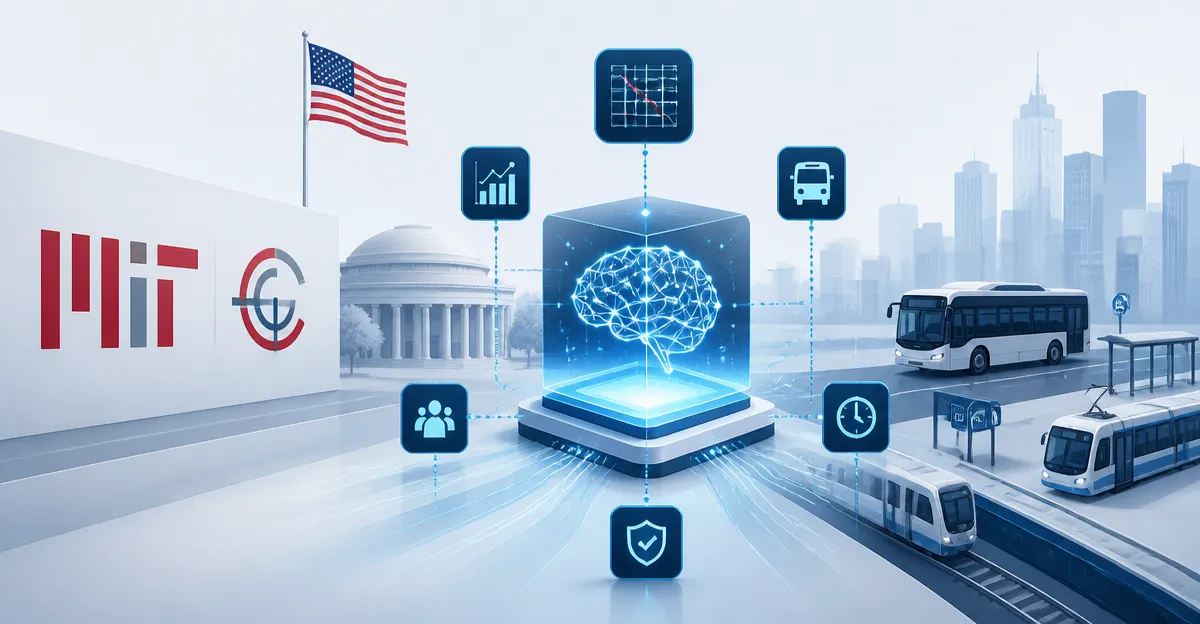
September 30, 2026, (Inside AI) — The MIT Transit Lab has secured $2.1 million from Google.org to build the Public Transit Intelligence Hub (PTIQ), a centralized AI platform designed to unify fragmented data streams inside public transportation control centers. The grant, announced on September 15, is part of Google.org's Impact Challenge: AI for Government Innovation, which selected only 15 projects worldwide from a competitive pool of applicants.
PTIQ aims to solve a persistent operational problem: transit control centers currently rely on dozens of disconnected systems for radio feeds, camera data, vehicle locations, and rider communications. This fragmentation forces staff to manually synthesize information under intense time pressure. The platform will integrate predictive models, optimization engines, and large language model-based contextual reasoning into a single interface. Crucially, the system will not automate decisions. It will instead provide better information to human operators.
The three-year project is led by co-principal investigators Awad Abdelhalim, associate director of the Transit Lab, and Jinhua Zhao, the MIT Class of 1941 Professor of City and Transportation and head of the Department of Urban Studies and Planning. Jim Aloisi, a former Massachusetts secretary of transportation and current MIT lecturer, serves as program manager. The Transit Research Consortium, which includes researchers from MIT and Northeastern University, will also contribute.
Google.org will supplement the funding with pro bono engineering and AI product support from its own staff. The philanthropic arm of Google has increasingly focused on bridging the gap between AI research and public sector adoption. This grant reflects that strategy.
Read: India's Bharat-VISTAAR AI Platform Targets Farm Advisory for Smallholders
"Public transportation agencies are required to make decisions around the clock regarding real-time operations, control, and passenger communication," says Awad Abdelhalim, associate director of the Transit Lab, and PTIQ co-principal investigator, project director, and technical lead. "Our goal isn't to automate those decisions, but to make sure the people making them have the best information possible. By unifying and streamlining data and information flow from fragmented and siloed internal systems, PTIQ will improve the experience of both riders and the transit workforce."
The technical architecture will combine predictive analytics for vehicle arrival times and crowding, optimization algorithms for service adjustments, and LLM-based reasoning to help staff interpret complex situations. But the project's leaders emphasize that institutional trust matters more than raw model performance.
"The hard part of integrating AI in transit is not the technology; it's the institution," Zhao says. "AI is evaluated on benchmarks. Public transit is assessed in the control center and on the streets. Over decades of work with transit agencies in Washington, D.C., Chicago, London, Boston, Tokyo, and Hong Kong, we have learned to ask a different question. Not whether AI can do this, but whether it can work in the organization and whether the staff trust it. PTIQ is designed to ground AI in the institutional reality and behavioral nuances of a transit agency, and bring machine intelligence and human judgment into one place."
That focus on institutional fit distinguishes PTIQ from many AI-for-government efforts. Most public sector AI deployments fail not because the models are inaccurate, but because they do not account for existing workflows, union agreements, or the cognitive load on frontline staff. The Transit Lab's decades of applied research with agencies in major metropolitan areas provide a foundation that pure technology vendors often lack.
"Currently the evaluation of AI models relies heavily on deterministic, objective tasks, such as solving mathematical equations or generating code," Abdelhalim explains. "However, the vast majority of real-world operational tasks -- like delivering public transit services -- are highly dynamic, multi-stakeholder, and lack a single correct objective answer. These complex spatiotemporal environments are the ultimate testbed for evaluating what AI systems can add to society."
Google.org's global head, Maggie Johnson, framed the initiative as a way to move beyond pilot projects. "AI holds incredible potential to transform public services, but there is often a gap between promise and practice," Johnson says. "By equipping the 15 selected organizations with funding and pro bono support from Google's own AI experts, we are empowering the people closest to the problem to show what is truly possible. Together, we can ensure that AI makes a profound, positive difference in the everyday lives of communities worldwide."
PTIQ's success will depend on adoption by transit agencies, not just technical validation. The project team plans to work with existing partners to test the platform in live control center environments. If successful, it could offer a replicable model for how AI integrates into other high-stakes public operations, such as emergency response or air traffic control.
Read: Why Employees Override AI Systems That Work: The Authority Gap
"We expect that PTIQ will take what is largely a siloed environment and connect it in ways that provide powerful benefits for the agency workforce and its riders," says Aloisi, who is also a former secretary of transportation for the Commonwealth of Massachusetts. "[Doing this by] improving response time, reducing platform and bus stop crowding, providing riders with higher quality and timely information, and supporting agency staff -- from dispatchers to vehicle operators and communications staff -- with high-quality, reliable, real-time information and solution sets."
The grant arrives as transit agencies worldwide face rising ridership demands and aging infrastructure. AI-driven operational tools represent one of the few levers available to improve service without massive capital investment. But the project's human-centered design philosophy may prove to be its most important contribution. By refusing to remove humans from the loop, MIT and Google.org are betting that trust, not automation, is the real bottleneck for AI in government.