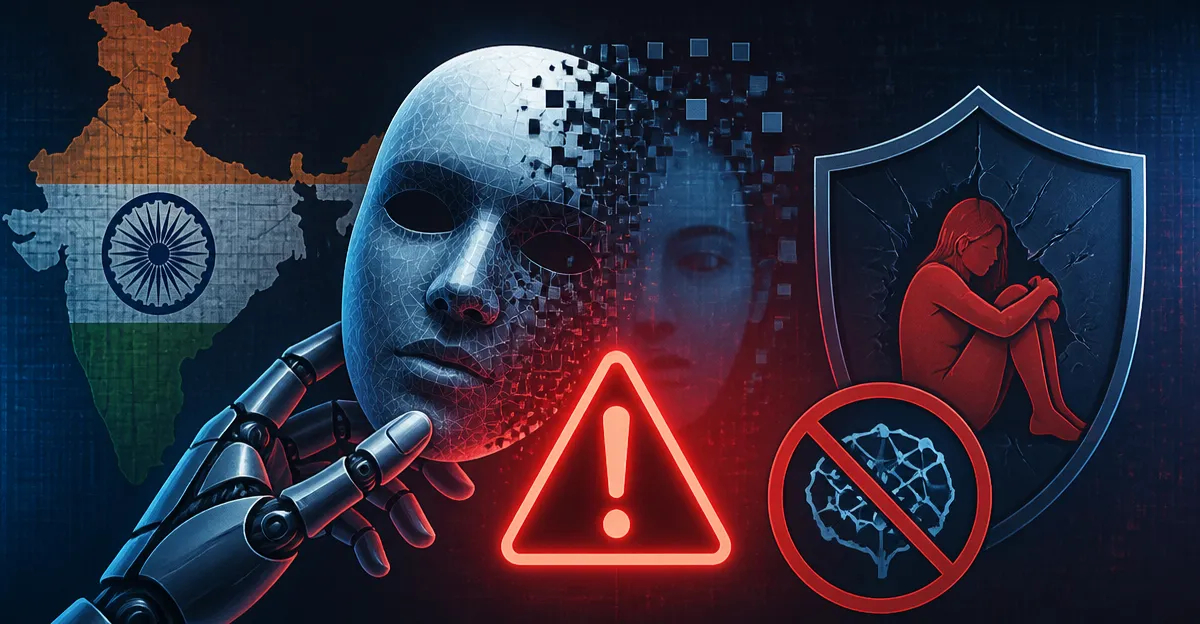
October 4, 2026, (Inside AI) — A sexually explicit deepfake video featuring actor Janhvi Kapoor has ignited a fierce debate across India's Telugu film industry, raising urgent questions about artificial intelligence misuse, victim privacy, and the responsibility of public figures. The clip, which manipulates footage from the song "Chuttamalle" in the film Devara: Part 1, surfaced online in late September and quickly went viral. The incident has drawn condemnation from major stars, calls for legal reform, and a rare public dispute over how to combat such abuse without amplifying it.
The video's existence was first flagged by Kapoor's co-star Jr NTR, who vowed legal action. Within days, a wave of celebrities including Chiranjeevi, Khushbu Sundar, Vijay Deverakonda, and Ram Gopal Varma weighed in, each offering a distinct perspective on the crisis. The case highlights a growing global problem: the weaponization of generative AI to create non-consensual intimate imagery, a practice that remains poorly regulated in many jurisdictions.
Chiranjeevi, a megastar in Telugu cinema, issued a lengthy statement on X calling for institutional action. He did not mince words.
"I am deeply disturbed by the use of AI to create degrading and morphed videos of a woman. Such acts are cruel, shameful and completely unacceptable. I strongly condemn them. This is not an issue concerning just one individual or one film. Today, it has happened to someone else. Tomorrow, it could happen to you, me or anyone we know. We cannot remain silent simply because it has not affected us personally. Every one of us has a responsibility to stand against this abuse." (Chiranjeevi, actor, on X)
He further demanded that cyber crime authorities act swiftly and proposed forming a dedicated committee within the Telugu Film Chamber and Producers' Council to support victims and pursue legal action. "Those who create such content and those who deliberately spread or amplify it must be held accountable under the law," he added, urging the public to report the video rather than share it.
Vijay Deverakonda, known for his outspoken nature, described the deepfake as a new low for society. In a post on X, he wrote,
"We have stooped to the levels of absolute lowlife. Whoever is responsible for this should not be spared. They must face the harshest possible legal consequences and be made an example of. We must not let this go. when did we became so insensitive to each other. What kind of parenting is going on? what kind of society are we living in? Where we find joy in degrading each other?" (Vijay Deverakonda, actor, on X)
He went on to frame the incident as a broader indictment of AI's darker potentials. "At a time when the world is debating and fearing how AI disrupt livelihoods and take away jobs, these idiots are using that very technology to do utter nonsense. This is the digital equivalent of sexual assault. The law must treat such acts with utmost seriousness. And to the team standing up against this, you have my full support."
Khushbu Sundar, actor and politician, echoed the outrage, focusing on the gendered nature of the attack. "As a woman, I refuse to stay silent when another woman is digitally violated, degraded and humiliated," she wrote on X. "What has been done through AI is not a joke, not entertainment and not something we should ever normalise. It is cruel, abusive and deeply shameful. It is tearing off her dignity."
She warned that the technology could target anyone. "Today, it is her. Tomorrow, it could be me, you, our daughter, our sister, our mother, or any woman we love. We cannot remain silent simply because we are not the victim today. When one woman's dignity is attacked, every woman has a reason to stand up and speak out."
Yet not all responses aligned. Director Ram Gopal Varma offered a contrarian view, arguing that the celebrity condemnations had inadvertently amplified the video's reach. In a post on X, he wrote,
"The only thing all the celebrities succeeded in , is to publicise and thereby make crores and crores of people see the objectionable link ..The smart thing would have been to concentrate on catching the perpetrator and publicise that ..Instead what they did is to tweet and bring enormous attention to the victim's identity and the offensive content which is also a crime." (Ram Gopal Varma, director, on X)
His comment underscores a thorny dilemma in the fight against deepfakes: public condemnation can raise awareness, but it may also drive traffic to the illicit material. This tension has played out globally, from South Korea to the United States, where laws often lag behind the technology.
Amid the uproar, actor Yami Gautam raised a related concern about AI's casual misuse in media. She urged outlets to stop using AI to alter her photographs without consent. "A sincere request to the media. Please refrain from using AI to alter or enhance my photographs from public appearances. Kindly use images in original form. Altering or manipulating an individual's image or likeness using AI should not be done without their knowledge and consent," she posted on X.
Her request highlights how AI manipulation extends beyond explicit deepfakes into everyday image editing, often without malicious intent but still violating personal autonomy. The incident also follows recent comments from Kareena Kapoor, who expressed unease about AI's negative online uses, calling it "very disturbing."
The Janhvi Kapoor deepfake has become a flashpoint for India's entertainment industry, which now faces pressure to protect its members. While no arrests have been announced, the case has intensified calls for stronger cyber laws and platform accountability. As AI tools become more accessible, the line between virtual and real continues to blur, leaving victims and lawmakers scrambling to keep pace.