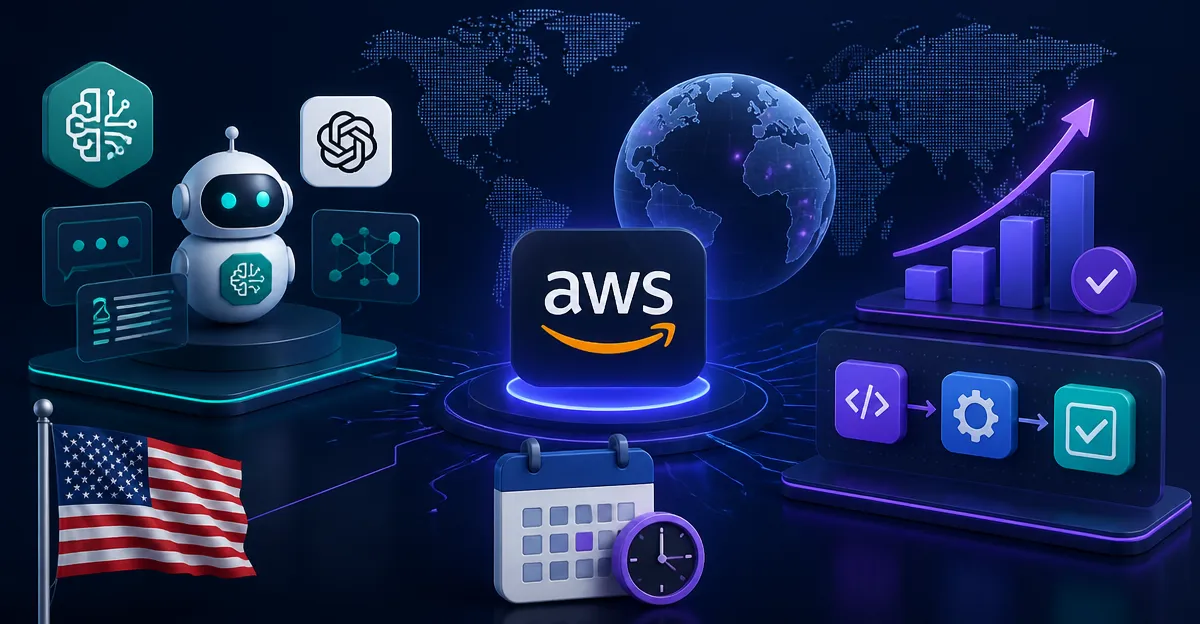
October 5, 2026, (Inside AI) — Amazon Web Services has launched a public preview of Amazon Bedrock Managed Agents powered by OpenAI, a service that lets enterprises build and run AI agents using OpenAI models entirely within their own AWS environments. The announcement, made last week, marks a significant expansion of AWS's agentic AI offerings and deepens its partnership with OpenAI, a competitor to AWS's own model partner Anthropic.
The new service is built on a customized version of OpenAI's Agents API, engineered to be AWS-native and integrated with AWS resources. Customers can choose between self-hosted compute or Amazon Bedrock AgentCore Runtime for managed runtime sessions. This allows organizations to use their existing AWS identities, permissions, and governance controls, a critical factor for regulated industries.
"You can now build agents optimized for OpenAI models that run entirely inside AWS with the identities, permissions, and governance controls you already use," according to AWS's announcement.
The move comes as competition in the enterprise AI agent market intensifies. AWS now offers managed agents from two of the leading foundation model providers, OpenAI and Anthropic, giving customers more choice but also raising questions about how AWS balances these partnerships. The service is available in public preview, with general availability expected in the coming months.
New Frontier Models Expand Bedrock's Arsenal
Alongside the managed agents, AWS is adding four new frontier models to Amazon Bedrock:
- OpenAI GPT-6.1 Sol: An upgrade to GPT-6 Sol, this model delivers strong performance on agentic coding, computer use, and professional work. According to OpenAI, it approaches GPT-6 Astra across demanding evaluations at roughly one-fifth of the cost.
- OpenAI GPT-6 Astra UltraFast mode: A premium speed tier for GPT-6 Astra, delivering up to 6x faster inference with up to 300 tokens per second.
- Anthropic Claude Sonnet 5.5: A smarter, more efficient Sonnet model, stronger for coding and completing well-scoped tasks.
- SpaceXAI Grok 4.7: Builds on Grok 4.6 with better mixed-document handling, more dependable repo-scale coding, and enhanced browser-use agents.
The addition of GPT-6.1 Sol at one-fifth the cost of GPT-6 Astra could pressure other model providers on pricing. Enterprises running large-scale agent workloads are highly cost-sensitive, and a cheaper model that approaches flagship performance could shift buying decisions.
"According to OpenAI, it approaches GPT-6 Astra across demanding evaluations at roughly one-fifth of the cost, giving developers more room to build and run capable agents at scale," AWS stated.
The UltraFast mode for GPT-6 Astra targets latency-sensitive applications. At 300 tokens per second, it could enable real-time conversational agents and high-frequency trading analysis, though the premium pricing may limit adoption to specialized use cases.
Read: OpenAI Launches Dots: Always-On AI Agents Powered by GPT-6 Astra
Anthropic's Claude Sonnet 5.5 and SpaceXAI's Grok 4.7 round out the offerings, ensuring Bedrock remains a multi-model platform. AWS has positioned Bedrock as a neutral ground where enterprises can access models from competing providers without vendor lock-in.
Service Retirements Signal Strategic Shift
AWS also announced several service lifecycle changes, effective September 29, 2026. Amazon Managed Blockchain and Amazon DevOps Guru will enter sunset, with end of support on September 29, 2027, and September 30, 2027, respectively. AWS Backint Agent for SAP ASE and AWS Infrastructure Composer will also sunset. Amazon Mechanical Turk has reached end of support as of September 29, 2026.
These retirements suggest AWS is reallocating resources toward higher-growth areas like AI agents and foundation models. Managed Blockchain, once a flagship for enterprise blockchain adoption, has seen declining demand as blockchain hype faded. DevOps Guru, an AIOps tool, may be superseded by more advanced AI-driven operations agents like the new AWS Well-Architected Agent, also announced last week.
The Well-Architected Agent, in preview, analyzes AWS environments to deliver targeted recommendations for cost, security, performance, and resilience. It represents AWS's push to embed AI into its own management tools.
Other notable launches include Amazon Aurora PostgreSQL support for direct querying of Apache Iceberg and Parquet data, eliminating ETL pipelines, and Amazon S3 Tables support for all Apache Iceberg V3 data types, including geospatial and nanosecond timestamps.
For developers, AWS introduced Kiro workflows, enabling complex tasks with multiple agents and less supervision. The company also launched Strands Decider 2B, a small open-source decision model for fast experimentation. Additionally, AWS expanded its Forward Deployed Engineering organization with new Partner FDE pathways, backed by a $1 billion investment, to help partners deliver production agentic AI.
As AWS continues to build out its agentic AI stack, the balance between supporting OpenAI and Anthropic models while developing its own tools will be closely watched. The public preview of Bedrock Managed Agents is available now, with broader availability expected at AWS re:Invent later this year.