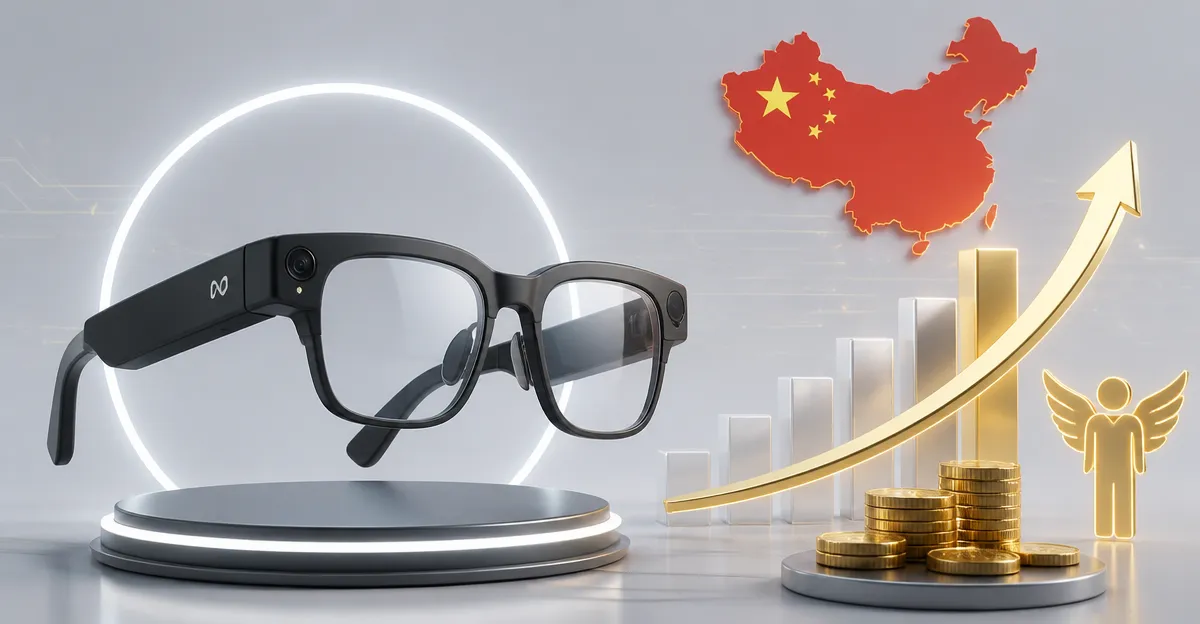
October 10, 2026, (Inside AI) — The Chinese startup behind AI glasses brand NIMO has raised several hundred million yuan in an angel round, valuing the company at RMB 1.5 billion, according to an October 8 report. Gobi Partners led the round, with participation from other Chinese venture capital firms. The exact amount was not disclosed, but sources familiar with the deal say it was in the hundreds of millions of yuan.
The funding comes as competition in the AI eyewear market intensifies. NIMO focuses on smart glasses for everyday use, a segment that has attracted major tech companies and startups alike. The company has already established offline sales channels in China and plans to use the new capital to develop new products and core technologies, expand its domestic retail network, and enter overseas markets.
The investment reflects growing investor confidence in Chinese hardware startups, particularly those integrating AI into consumer devices. While the global smart glasses market has seen mixed results, with some high-profile flops, the promise of AI-driven features like real-time translation, navigation, and augmented reality has kept interest alive.
NIMO's valuation of RMB 1.5 billion places it among the more valuable early-stage hardware startups in China. For context, that is roughly $205 million at current exchange rates. The angel round is unusually large for a Chinese hardware startup, signaling strong belief in the team and the product direction.
Gobi Partners, a venture capital firm with a focus on Asia, has a history of backing innovative technology companies. Its involvement lends credibility to NIMO's ambitions. Other investors in the round were not named, but sources indicate they include both institutional and strategic backers.
The company's decision to prioritize offline retail is notable. While many tech startups focus on online sales, NIMO appears to be betting that physical stores will help consumers experience the product firsthand. This approach could be key to overcoming skepticism about smart glasses, which have struggled to gain mainstream adoption.
Overseas expansion is also on the agenda. Chinese hardware companies have increasingly looked abroad for growth, especially in markets like Southeast Asia and Europe. However, they face challenges including regulatory hurdles and competition from established players like Meta and Apple.
Meta's Ray-Ban smart glasses have gained traction, but they are primarily camera and audio devices with limited AI features. Apple's Vision Pro is a mixed-reality headset, not lightweight glasses. NIMO's focus on everyday use suggests it aims to fill a gap between basic smart glasses and bulky headsets.
The AI glasses market is still nascent. According to industry analysts, global shipments of smart glasses are projected to reach 10 million units by 2027, up from about 2 million in 2025. Much of that growth is expected to come from China, where consumers are quick to adopt new gadgets.
NIMO has not disclosed technical specifications or pricing for its products. However, its website shows a sleek design that resembles traditional eyewear, with subtle cameras and sensors. The glasses likely connect to a smartphone for processing, a common approach to keep weight down.
The startup's success will depend on execution. Building hardware is difficult, and scaling production requires significant capital. The angel round provides a cushion, but NIMO will need to demonstrate traction to raise further funding.
Investors are watching closely. The smart glasses space has seen its share of failures, including Google Glass, which was discontinued for consumers in 2015. But advancements in AI and miniaturization have renewed hope.
NIMO's funding round is one of several recent investments in Chinese AI hardware. In September, another startup, Xreal, raised $60 million for its AR glasses. That company focuses on entertainment and gaming, while NIMO targets everyday utility.
The competition extends beyond China. Facebook parent Meta has partnered with Ray-Ban for its smart glasses, and Amazon recently launched its own Echo Frames. These tech giants have vast resources, but startups can move faster and innovate.
Read: Meta Unveils Muse Charm AI Device at Connect 2026
NIMO's offline strategy may give it an edge in China, where e-commerce is dominant but physical retail still matters for electronics. The company plans to open flagship stores in major cities, according to sources.
Expanding overseas will be more challenging. Different markets have different regulations for cameras and data privacy. NIMO will need to navigate these carefully.
The company has not announced a timeline for its overseas launch. It is currently focused on product development and domestic expansion.
For now, the angel round gives NIMO breathing room. It can invest in research and development, hire talent, and build inventory. The valuation sets a high bar for future fundraising.
Industry observers note that AI glasses could become the next major computing platform, but that is years away. In the near term, they are likely to remain accessories to smartphones.
NIMO's backers are betting that the company can carve out a niche. With Gobi Partners' support, it has a network to tap for expertise and connections.
The startup's founders have not spoken publicly about their vision. However, job postings suggest they are hiring for roles in computer vision, machine learning, and hardware engineering.
The funding round closed earlier this month. NIMO will likely use the proceeds to ramp up production and marketing.
As the AI glasses market evolves, NIMO's progress will be a test case for Chinese hardware innovation. Success could inspire more investment in the sector.
For now, the company remains private and its products are not yet widely available. Those interested can sign up for updates on its website.