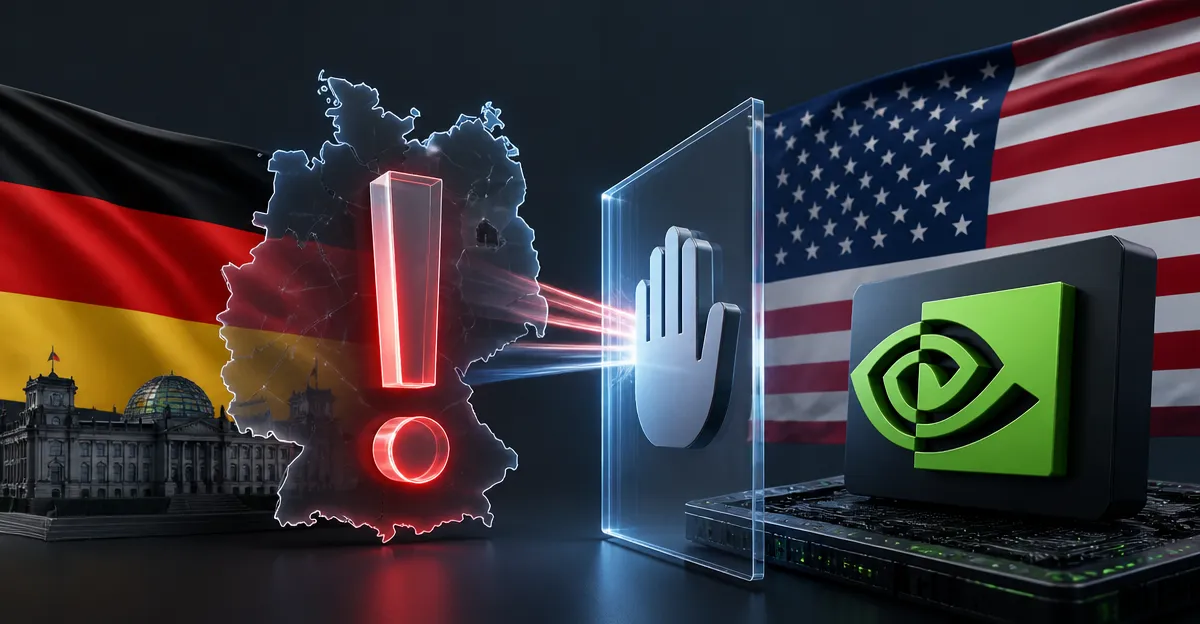
November 24, 2026, (Inside AI) — Germany's Foreign Minister Johann Wadephul said on Tuesday he was shocked by US President Donald Trump's intervention to pressure Nvidia to reinstate CEO Jensen Huang, questioning whether this was a good model for governance.
Wadephul made the remarks at a Berlin forum, according to sources. His comments mark a rare public rebuke from a senior European official over the intersection of political power and corporate leadership at the world's most valuable chipmaker.
Nvidia has reinstated Huang following his resignation over revelations of extramarital affairs. The reversal drew approval from Wall Street and opposition from US lawmakers.
The episode has thrust corporate governance at Nvidia into the center of a transatlantic debate over the boundaries between political authority and private enterprise. Germany's top diplomat used the moment to question whether democratic governments should intervene in corporate decisions at all.
"It shocked me, to be honest, because as far as I know, if I'm personally looking back, I never saw and recognised such an intervention from the political side to a special company. And I do have some doubts whether this is a very good model for the future," Wadephul said at the Berlin forum.
"So we have enough reason to really defend the rules-based international order, which also means that in free, democratic, and rules-based countries, political power should refrain from interfering in the economic engagement of companies," he added.
Washington's Intervention Draws Scrutiny
The White House has not publicly detailed the nature of Trump's intervention. Inside AI could not independently verify the specific mechanisms used to pressure Nvidia's board. The company has not issued a statement on Wadephul's remarks.
The reinstatement of Huang, who co-founded Nvidia in 1993, represents an unusual sequence of events for a company of its scale. Nvidia's market capitalization has surged past $3 trillion on the back of demand for its AI accelerators, making leadership stability a matter of global economic consequence.
Huang's resignation had briefly raised questions about succession planning at a firm whose chips underpin most large-scale AI training and inference workloads. His return restores continuity but leaves unresolved the governance questions that prompted his departure.
Wall Street's positive reaction reflects investor preference for Huang's continued stewardship. US lawmakers, by contrast, have raised concerns about the precedent of political intervention in corporate affairs.
The German foreign minister's remarks add a European dimension to the debate. Berlin has been navigating its own complex relationship with Washington over trade, technology, and regulatory standards for AI. Wadephul's comments signal that European capitals are watching US corporate governance developments with unease.
The incident also raises questions about the limits of political influence over semiconductor supply chains. Nvidia's products are subject to export controls that already involve close coordination between Washington and allied governments. Adding leadership decisions to that list of political considerations would mark a significant expansion of state involvement.
Wadephul's phrase "rules-based international order" carries particular weight in Berlin, where the government has consistently emphasized multilateral frameworks over unilateral action. His remarks suggest Germany views the Nvidia episode as a test case for how democratic societies manage the relationship between political authority and private enterprise.
For now, Huang remains at Nvidia's helm. The company continues to supply the chips powering AI systems across the world. But the political scrutiny surrounding his return may not fade quickly.
Wadephul's intervention ensures the episode will be discussed beyond Washington and Wall Street. European officials have signaled they will watch closely how the precedent develops.
Nvidia's next earnings report, expected in the coming weeks, will offer the first financial signal of how investors and customers have processed the leadership turmoil. The company has not indicated any change to its operational outlook.

Shamil has a low tolerance for AI that only works in controlled demos. He covers agentic systems and generative AI with the skepticism of someone who has seen too many “revolutionary” tools quietly disappear six months after launch.