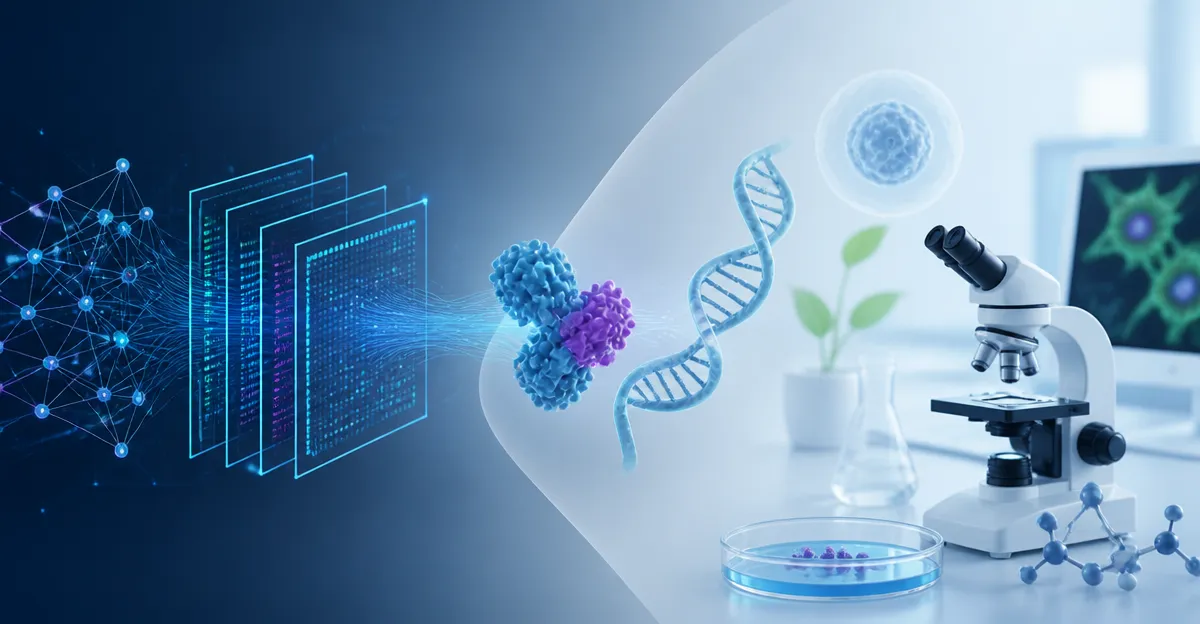
October 16, 2026, (Inside AI) — Google's AI Co-Scientist, a multi-agent system built on Gemini, is now generating hypotheses, clustering ideas, and even conducting peer review for biomedical researchers. The tool marks a shift from AI as a computational assistant to an autonomous collaborator in scientific discovery. Meanwhile, Anthropic has established a wet lab in the San Francisco Bay area and plans to deploy Claude to direct robots in automated experiments. These developments signal that agentic AI is moving from digital workflows into physical laboratories, potentially reshaping how biological research is conducted.
The integration of AI into biological research has accelerated beyond simple data analysis. Agentic AI systems can now autonomously execute tasks, make decisions with limited human intervention, and adapt workflows. In biomedical research, these systems use external tools like browsers and software to perform specific functions. Google's AI Co-Scientist exemplifies this evolution by acting as a research collaborator that intervenes at multiple stages of the scientific method. It generates hypotheses based on literature and data, identifies similar ideas, conducts peer review, prioritizes hypotheses, and continuously refines research concepts.
This shift matters because it addresses a longstanding bottleneck in biological research: the gap between computational predictions and physical experiments. Automated labs, cloud computing, and autonomous systems are beginning to bridge this divide. Anthropic's wet lab initiative, reported by Reuters, represents a significant step toward automating physical experiments. The company plans to expand to an automated setup where Claude directs robots to carry out pre-defined, workflow-specific experiments designed by humans. Researchers could access such infrastructure remotely through cloud labs, conducting experiments without being physically present.
The implications extend beyond convenience. Autonomous labs could dramatically accelerate the pace of discovery by enabling round-the-clock experimentation and reducing human error. However, the technology faces inherent limitations. A study found that an autonomous lab system successfully determined optimal growth conditions for a specific E. coli strain but failed to identify conditions suitable for glutamic acid production, a more complex task involving multiple metabolic pathways. This suggests that while AI can handle simpler processes, biological complexity remains a formidable challenge.
Read: AI Companies Run Virtual Drug Trials to Predict Clinical Failures
OpenAI and Ginkgo Bioworks published preprint research demonstrating an autonomous lab where GPT-5 connected to a cloud lab to optimize cell-free protein synthesis. This system not only executed predefined tasks but also made decisions, though its capabilities may be limited to simpler processes. Such advancements highlight both the promise and the current boundaries of AI-driven experimentation.
Despite these strides, human scientific expertise remains indispensable. AI-generated claims require verification because models can hallucinate, misinterpret literature or data, and produce scientifically inaccurate findings. Researchers need critical thinking skills and practical expertise to troubleshoot experiments, relying on wet-lab experience and understanding of underlying biology, data, laboratory infrastructure, reagents, and materials. Scientific inquiry also depends on contestability, the ability to challenge, reproduce, and re-examine findings. Transparency about AI's contribution is crucial, requiring disclosure of when and how AI has been used.
Data quality further constrains AI's effectiveness. Biological databases must be carefully curated, standardized, biologically relevant, and reproducible to support reliable predictions. AlphaFold, for instance, relies on the Protein Data Bank, a repository of experimentally determined 3D structures accumulated over 50 years. Scientific inferences also stem from failed experiments, unpublished findings, intuition from lab experience, and peer discussions. Breakthroughs often occur fortuitously or by connecting ideas from seemingly unconnected fields. It remains unclear whether AI can perform this kind of conceptual reframing.
From an Indian perspective, efforts to foster AI and biology convergence are taking shape. GenomeIndia was launched to build a comprehensive database of India's genetic diversity for biomedical research. The Indian Biological Data Centre (IDBC) serves as the first national repository for life science data, storing information and bioinformatics infrastructure under the Biotechnology Information System Network (BTISNet). The BioE3 policy supports AI-Bio hubs, integrating India's computational research ecosystem with biotechnology. Additionally, a national AI-enabled medical imaging resource for precision oncology was established, enabling personalized cancer diagnosis and treatment. The Anusandhan National Research Framework (ANRF) fosters translational development and commercialization of AI-driven healthcare technologies.
These initiatives position India to leverage AI for affordable healthcare and indigenous biomedical innovation. However, challenges persist, including data standardization, infrastructure gaps, and the need for skilled personnel. The convergence of AI and biotechnology could revolutionize precision oncology and drug discovery, but realizing this potential requires sustained investment and policy support.
As AI becomes more embedded in scientific inquiry, it will likely assume a collaborative role in routine research through automation and pattern identification in large biological datasets. Yet scientific discovery also involves asking the right questions, which depends on creativity, critical inquiry, mentorship, and rigorous experimentation. Human researchers must ensure AI supports and enhances this process transparently and accountably, complementing human ingenuity.