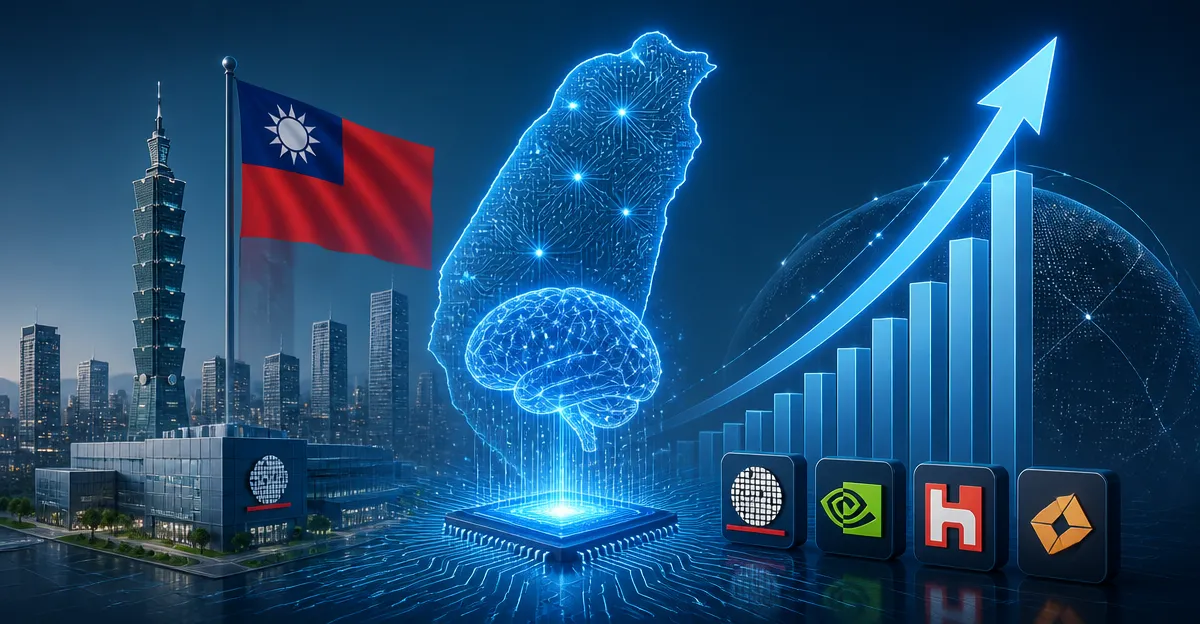
November 1, 2026, (Inside AI) — Taiwan has overtaken India as the world's fastest-growing large economy, posting a 14.36% year-on-year GDP expansion in the third quarter of 2026, according to data released Friday by the Directorate General of Budget, Accounting and Statistics. The surge follows 15.43% growth in the first quarter and 12.93% in the second, putting the island on track for full-year growth of 11.05%, a sharp acceleration from 8.76% in 2025.
The driving force is artificial intelligence, specifically the global buildout of data centers and the semiconductors that power them. Taiwan Semiconductor Manufacturing Company (TSMC), the world's largest contract chipmaker and primary supplier to Nvidia, sits at the center of this boom. TSMC's net revenue in 2026 is projected at $175 billion, up 43% from last year, according to industry estimates.
The scale of Taiwan's expansion becomes clearer when set against India, which held the fastest-growing large economy title for years. India's GDP grew 8.6% in the first quarter and 7.8% in the second, robust figures by most standards but far below Taiwan's pace. Taiwan's economy is roughly one-ninetieth the size of India's, with a GDP of about $1 trillion versus India's nearly $4 trillion. Yet the gap in growth rates is stark.
Investment And Exports Fuel Nearly 80% Of Growth
Taiwan's third-quarter performance was not driven by consumer spending or government outlays. Investments rose 26.36% year-on-year and accounted for nearly half of the headline growth rate. Exports climbed 21.12%, with net exports explaining roughly one-third of the expansion. In September, Taiwan recorded a trade surplus of $23.63 billion after exports jumped 61% to $87.22 billion, a record high.
"The composition suggests that the AI upcycle is increasingly spilling over from exports into local equipment spending, capacity expansion and broader economic activity," Herbert Wong, an economist at OCBC Bank, noted.
That spillover matters. Early AI-driven growth in Taiwan was concentrated in chip exports. Now, TSMC and its suppliers are investing heavily in domestic fabrication plants, advanced packaging facilities, and research infrastructure. This capital expenditure creates jobs, boosts construction activity, and stimulates local supply chains, broadening the economic impact beyond the export sector.
The European Centre for International Political Economy estimated in January that TSMC alone contributes 8.9% to Taiwan's GDP. With revenue up sharply this year, that share has likely grown. The company's market capitalization hovers around $5 trillion, placing it among the world's most valuable firms alongside Nvidia and Apple.
Taiwan is not alone in riding the AI investment wave. South Korea, home to Samsung and SK Hynix, grew 3.4% in the third quarter, following 3.8% and 3.7% in the first two quarters. While smaller in percentage terms, South Korea's GDP is twice Taiwan's size, and its 2025 growth was just 1.1%. Investments rose 4.3% and exports 8.6%, with facility investment up 9.4% on semiconductor manufacturing equipment.
The United States also posted 3.4% third-quarter growth, impressive given that developed economies rarely sustain such rates. Oxford Economics estimates the AI buildout contributed about 0.7 percentage points to U.S. GDP growth over the past year, or roughly 30% of the total.
"We estimate the AI buildout, through capex and wealth effects, contributed about 0.7 percentage points to GDP growth over the past year, or roughly 30% of the total," Nancy Vanden Houten, Lead US Economist for Oxford Economics, said.
The concentration of AI-related growth in a handful of economies raises questions about sustainability. Taiwan's dependence on TSMC and semiconductor exports exposes it to cyclical downturns in the chip industry, which has historically been volatile. The current boom is unprecedented in scale, but memory of the 2001 dot-com bust and subsequent semiconductor slumps lingers.
Economists surveyed by various outlets expect Taiwan's 2026 growth to reach close to 13%, higher than the official forecast of 11.05%, and to exceed 6.5% in 2027. Those projections assume continued AI capital expenditure by hyperscalers and enterprises, which has shown few signs of slowing.
Read: Foxconn Chief Downplays AI Bubble Concerns, Sees Strong 2027 Growth
For now, Taiwan's economy is firing on all cylinders. The question is whether the AI investment cycle can sustain this pace, or whether the island's fortunes will follow the semiconductor industry's familiar pattern of boom and bust. For a global economy increasingly reliant on AI infrastructure, Taiwan's performance offers both a template and a warning.