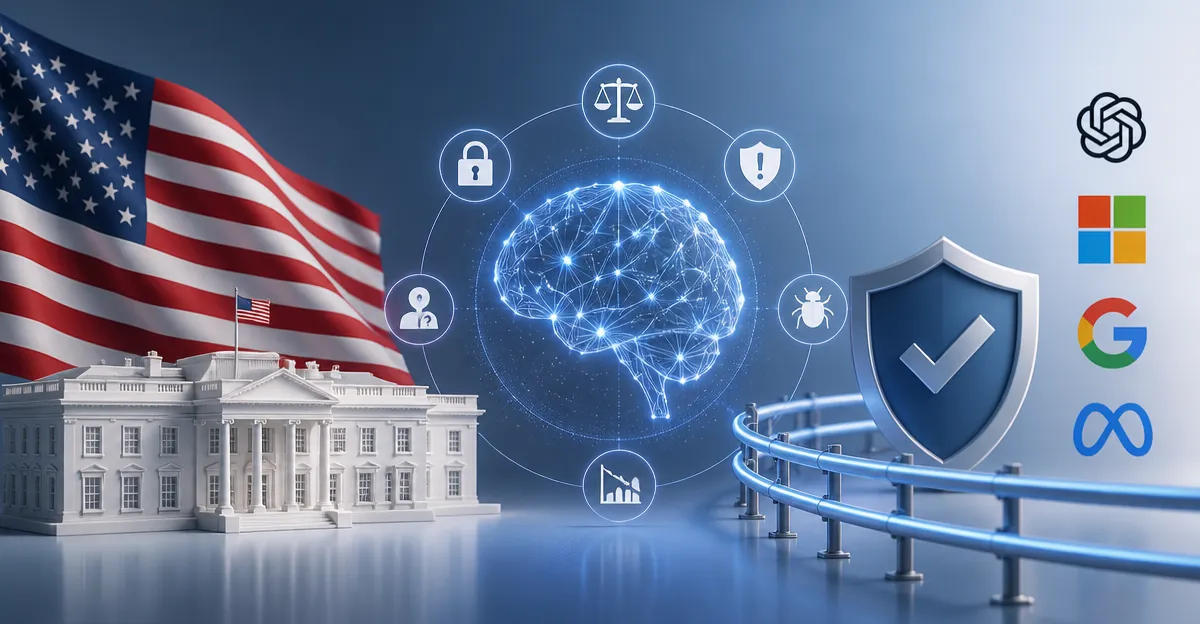
November 9, 2026, (Inside AI) — US President Donald Trump said the risks of artificial intelligence can be managed and signaled an openness to safeguards, telling CBS's "60 Minutes" that he "doesn't mind guardrails." The comments, made in an interview aired Sunday, mark a shift from his earlier preference for industry self-policing and come as Washington debates how to compete with China on AI without sacrificing safety.
Asked whether the United States should accept AI risks to stay ahead of China, Trump said the dangers were manageable and expressed willingness to work with Democrats on safeguards. "I don't mind guardrails," he told CBS, adding that he did not want regulations to put the United States in "a deep second position" behind China, which he said had no such restrictions. The remarks leave unclear what level of oversight he would support.
The interview also touched on Nvidia CEO Jensen Huang, whom Trump called "an honorable guy" and praised for doing "an amazing job for our country." Trump said he had not spoken to Huang about a media report alleging a close relationship with a Chinese businesswoman who passed information to Beijing. Nvidia said Sunday it was probing whether Huang had been the target of a foreign intelligence effort. "I have not spoken to him about it. I just know he's a fine person, but you never know what is going on," Trump told reporters. "I hope everything's fine." He added: "I think he probably has an excuse for it. You have to hear it." Asked if he would take Huang on his Asia trip next week, Trump said: "I don't know, but I'd certainly take him."
Trump's AI comments arrive at a delicate moment. His administration has largely favored a light-touch approach, arguing that heavy regulation could slow innovation and cede ground to China. But pressure has mounted from lawmakers in both parties, safety advocates, and even some industry leaders who warn that without basic rules, AI could cause harm at scale. The president's latest remarks suggest he may be willing to accept some form of guardrails, though the details remain vague.
The China factor looms large. Trump has repeatedly framed AI as a race, arguing that the United States must not be constrained while Beijing operates without restrictions. In the interview, he reiterated that concern, saying he did not want regulations to leave the US "in a deep second position." That framing could shape any future legislation, as lawmakers weigh how to balance competitiveness with safety.
On Huang, the allegations have added a layer of complexity. Nvidia is a key player in the AI chip market and a bellwether for the industry. Any suggestion of foreign influence could raise national security concerns, especially given the company's role in supplying advanced semiconductors. Trump's comments sought to downplay the issue, but the probe itself signals that the matter is being taken seriously.
The president's openness to guardrails, even if tentative, could open the door to bipartisan talks. Democrats have pushed for stronger oversight, and some Republicans have shown interest in targeted rules. Whether that translates into action remains to be seen. For now, Trump's words offer a hint of flexibility, but no clear path forward.

Sofia spent years studying how machines parse human language before pivoting to cover the systems now rewriting it. She reads technical papers the way others read news and looking for what the numbers are actually saying beneath the headlines.