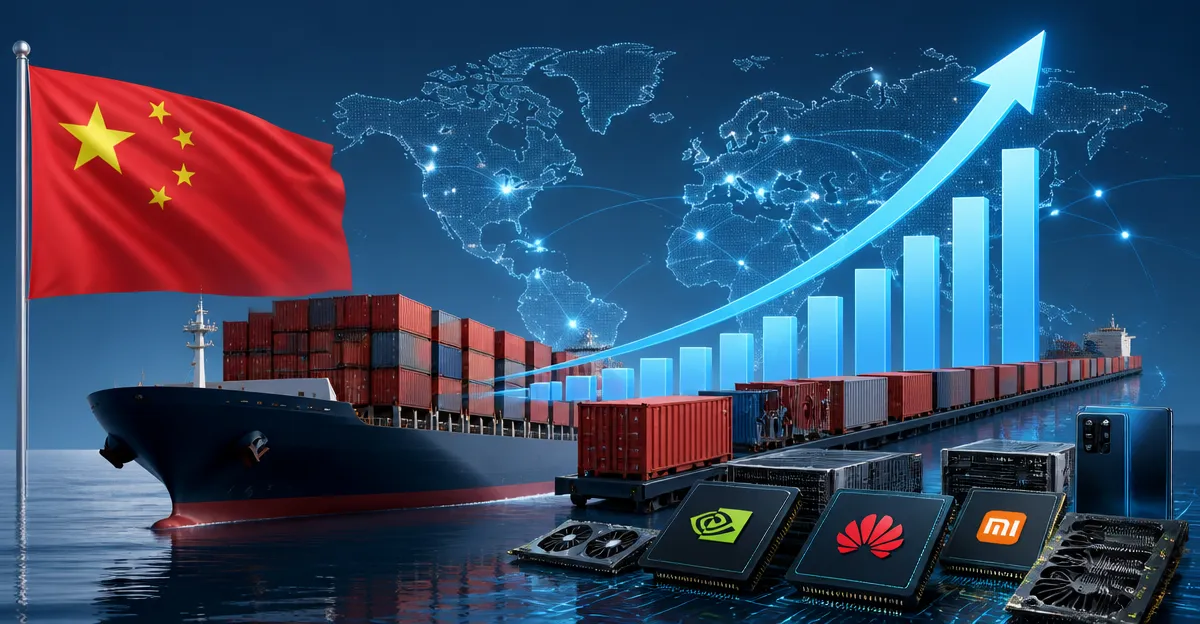
November 10, 2026, (Inside AI) — China's trade surplus crossed the $1 trillion mark in the first ten months of 2026, reaching $1.04 trillion, as a global scramble to build artificial intelligence infrastructure drove demand for Chinese high-tech goods. Customs data released Tuesday showed exports jumped 35.2% year-on-year in October, measured in US dollar terms, slightly below September's 36.3% surge but above the 33.5% median forecast from economists polled by Reuters. Imports rose 41.6%, beating expectations of a 32% increase.
The milestone arrives a month earlier than in 2025 and marks the second consecutive year the surplus has topped $1 trillion. The figure underscores a widening imbalance in the world's second-largest economy: overseas demand for AI-related hardware is propping up growth while domestic consumption remains weak and the property sector continues its prolonged slump. That reliance on exports is now feeding directly into trade tensions with the European Union and the United States.
The export surge is not evenly spread across sectors. Much of the momentum traces to data center buildouts and semiconductor supply chains tied to AI training and inference workloads. Chinese manufacturers of servers, power equipment, and networking components have captured a growing share of global orders as hyperscalers and governments race to expand computing capacity. China's customs administration data shows the surplus widening even as domestic vehicle sales fell for a twelfth consecutive month, according to a separate industry association release.
AI Demand Masks a Fragile Domestic Economy
The AI infrastructure boom has become a critical crutch for Beijing. Consumers remain reluctant to spend, constrained by a property downturn that has eroded household wealth and confidence. Chinese automakers, facing weak home demand, have pushed harder into overseas markets. That strategy works only as long as global demand holds.
Analysts at Macquarie expect exports to accelerate further in the fourth quarter before slowing from the first quarter of 2027. Their warning is blunt: the outlook depends on how long the AI boom lasts. If global capital expenditure on data centers cools, China's export engine could lose its main driver.
"The risk of additional tariffs and other trade barriers will remain elevated in 2027, particularly as Chinese manufacturers continue expanding their presence in overseas markets," said Joe Peissel, lead macroeconomist at Trivium China.
The European Union has already moved to limit Chinese hybrid vehicle exports over the next few years, though those measures have yet to take effect. Factories are expected to front-load shipments before the restrictions bite, temporarily inflating export figures. Beijing also announced Monday an extension of its trade truce with Washington by two months, but linked expanded purchases of US farm goods to the implementation of a reciprocal tariff-reduction arrangement.
The AI-driven export surge carries a structural risk that trade data alone cannot capture. China's growing surplus in high-tech goods may accelerate a decoupling in precisely the sectors that matter most for future growth. If the EU and US respond with targeted restrictions on AI hardware and components, Chinese manufacturers could find themselves locked out of the very markets driving their current boom. That scenario would leave Beijing with excess capacity and fewer buyers, deepening the domestic imbalances the surplus currently masks.
Xi and Trump Set for Third Meeting This Year
Diplomatic attention now turns to the Asia-Pacific Economic Cooperation summit next week in Shenzhen, China's southern tech and innovation hub. President Xi Jinping and US President Donald Trump are expected to meet for the third time this year. The location is symbolic: Shenzhen is home to some of China's largest technology companies and a key node in the AI hardware supply chain.
Trade friction has not slowed the flow of goods. The surplus reached $1.04 trillion despite existing tariffs and the threat of more. The EU has signaled it wants further curbs. Washington continues to review its tariff architecture. Both face a dilemma: restricting Chinese AI hardware could raise costs for their own data center buildouts.
For now, the numbers favor Beijing. But the same AI boom that lifted the surplus past $1 trillion is also concentrating China's economic exposure in a single, volatile demand cycle. The trade truce extension buys time. It does not resolve the underlying imbalance. Whether the surplus keeps climbing into 2027 depends less on Chinese policy than on the durability of the global AI investment wave.

If a research paper dropped this week, Mahesh has already read it. He covers AI tools and vibe coding for builders who need to know what is worth their time and what is not.