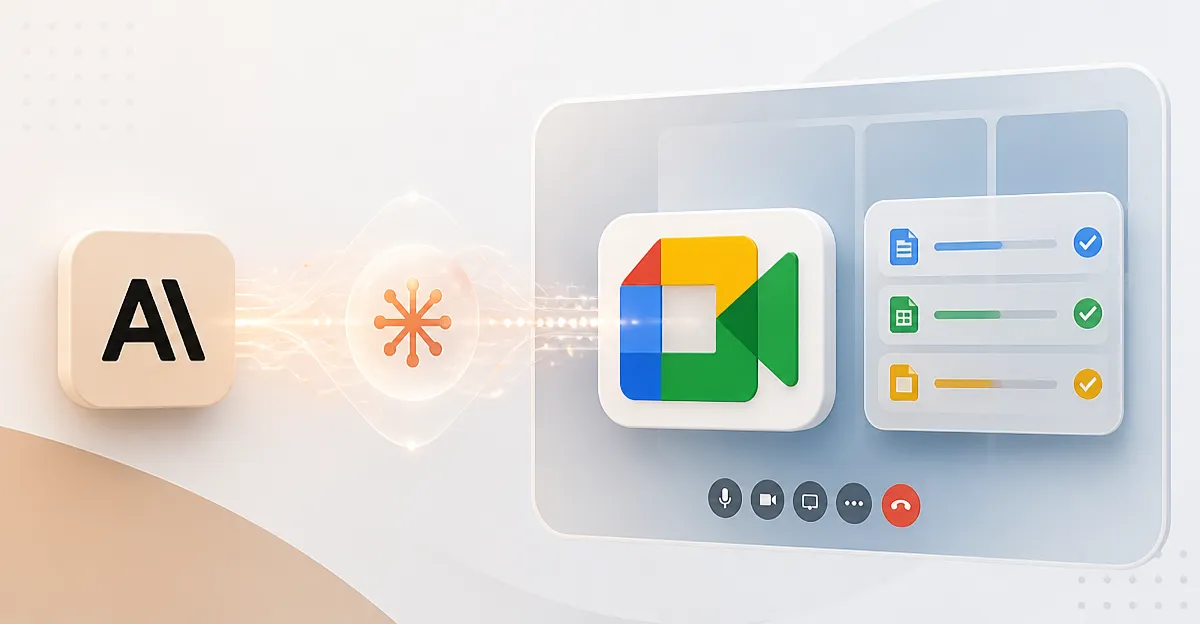
November 11, 2026, (Inside AI) — Anthropic announced on Tuesday that its Claude assistant is now available inside Google Meet, turning the video conferencing platform into a live workspace where AI can draft plans, build timelines, and answer questions during the call itself. The feature, called Claude Meetings, launches in beta for Team and Enterprise customers and marks a shift from passive meeting transcription to active task execution while conversations unfold.
The timing is deliberate. Earlier the same day, Anthropic began a roadshow for its U.S. initial public offering, seeking to raise as much as $64.4 billion at a $1.02 trillion valuation. The IPO will test investor appetite for the AI boom and the company's aggressive spending plans. Claude Meetings gives prospective shareholders a concrete product story: AI that does work, not just talk about it.
Claude appears as a visible participant in the call. It follows the conversation, drafts action plans, creates timelines, and responds to questions in the meeting chat. The company said the goal is to move beyond recording and summarizing toward completing the follow-up work while the discussion is still happening.
"People describe what they have in mind, like an app for their team or a new way to look at the numbers, and Claude builds it with them," the company said.
Anthropic is also rolling out Claude Whiteboards for turning discussions into timelines and action plans, alongside Claude Sheets and Claude Data. The suite signals a broader ambition: embed Claude into the everyday tools where knowledge work actually happens, not just as a chatbot but as a collaborator inside documents, spreadsheets, and meetings.
Google Meet First, Other Platforms Later
The beta launch on Google Meet is a strategic first step, not a final destination. Anthropic said it plans to expand Claude Meetings to other meeting platforms, though it did not name them. Google Meet competes directly with Microsoft Teams and Zoom, both of which have integrated their own AI assistants. Microsoft has pushed Copilot into Teams, while Zoom has its own AI Companion.
The competitive landscape matters. Microsoft's Copilot can summarize meetings and draft follow-ups, but it operates largely after the call or through structured prompts. Anthropic's pitch is different: Claude works live, building artifacts during the conversation. That distinction could resonate with teams that find post-meeting summaries too late to be useful.
Anthropic's move also raises questions about platform dependency. Launching first on Google Meet means Claude runs inside a competitor's ecosystem. Google has its own Gemini assistant and may view third-party AI participants with caution. The beta arrangement suggests Anthropic is testing demand before committing to deeper integrations or building its own meeting layer.
The IPO context sharpens every product decision. A $1.02 trillion valuation would place Anthropic among the most valuable technology companies at listing. Investors will scrutinize whether Claude Meetings drives enterprise adoption and revenue, or remains a feature that is nice to have but hard to monetize. Anthropic has not disclosed pricing for the new capabilities beyond their inclusion in Team and Enterprise plans.
Enterprise customers already use Claude for coding, analysis, and document work. Adding meetings extends the surface area where Claude can prove its value. But it also increases the risk of errors in high-stakes settings. A timeline drafted live during a call could be wrong. A plan generated in real time could miss context. Anthropic has not detailed how it handles accuracy or user verification for live-generated work.
The roadshow and product launch on the same day suggest a coordinated effort to present Anthropic as a company that ships, not just researches. Whether investors see Claude Meetings as a meaningful growth driver or a feature war with Microsoft and Google will shape the IPO's reception. For now, the beta is limited, the platform is singular, and the promise is large.

Shamil has a low tolerance for AI that only works in controlled demos. He covers agentic systems and generative AI with the skepticism of someone who has seen too many “revolutionary” tools quietly disappear six months after launch.