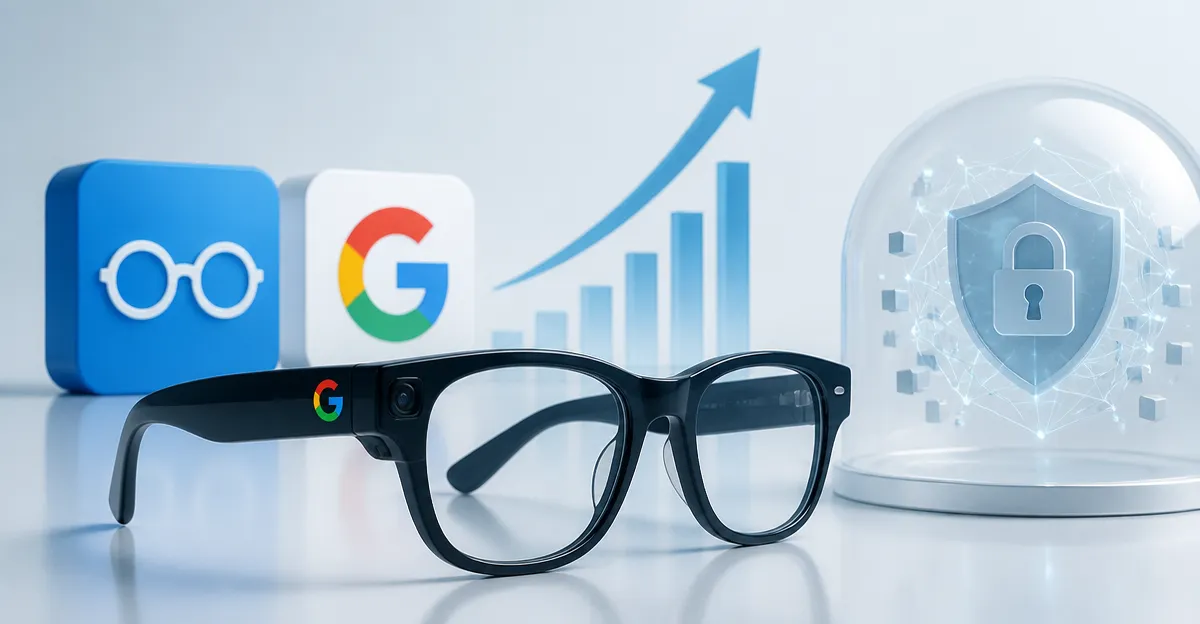
November 12, 2026, (Inside AI) — Warby Parker will begin taking pre-orders on Thursday for its first smart glasses, built in partnership with Google and Samsung, as the affordable eyewear brand tries to turn a niche category into a mainstream business. The New York company is betting that demand for AI wearables will balloon in the coming years, even as regulators in Europe and Australia move to restrict camera-equipped glasses.
The glasses connect to Google's Gemini assistant for directions, translation and other tasks. They are broadly similar to Meta's Ray-Ban and Oakley frames, which accounted for 81.3% of AI glasses shipments in the first half of this year, according to tech research group Omdia. Warby Parker's pitch is different: a privacy framework embedded from the outset, Co-CEO Neil Blumenthal said.
Google will not use visuals captured by the glasses to train its AI. The devices will bar facial recognition of bystanders. And a small white light on the front turns on automatically when a user records video. Shoppers can pre-order from Warby Parker starting Thursday.
The launch lands in a category that is growing fast but unevenly. Global AI glasses shipments more than doubled in the first half of 2026 from a year earlier, Omdia data shows, though growth has slowed since the second half of last year. Meta still dominates. Brands from Warby Parker to luxury group Kering, which is also poised to release glasses with Google, are looking for a foothold.
Read: Nothing to Launch Screenless AI Device in December, CEO Carl Pei Says
Investors have rewarded the plan. Warby Parker shares have rallied nearly 40% this year, outperforming a 10% gain in the S&P 500. Executives said on an earnings call earlier this month that they expect the wearable technology to add several percentage points to fourth-quarter revenue growth.
"As long as the tools provide utility to customers, then we'll be successful," Blumenthal said.
Analysts at TD Cowen wrote in a research note last week that smart glasses are poised to be an "increasingly important driver" of Warby Parker's growth outlook, even as the core optical business remains soft.
Google Aims to Rebuild Trust
Google's involvement carries its own history. The company's earlier Glass experiment became a symbol of surveillance anxiety a decade ago, and public skepticism has not disappeared. Juston Payne, who leads extended reality products at Google, acknowledged the risk.
"This is an area where, understandably, trust was lost," Payne told reporters at a demo for the Warby Parker glasses in New York.
Google says it will embed privacy guardrails to prevent tampering with the recording indicator light, redact people's faces from video before it is sent to Gemini, and ban targeted advertising on the glasses.
Read: Microsoft Says Tech Firms Must 'Prove' AI Data Centers Benefit Locals
"We are going to change this conversation," Payne said. "We are trying to raise the bar."
Privacy advocates remain cautious. Calli Schroeder, who leads the AI and human rights program at the Electronic Privacy Information Center, welcomed the training restriction but said it does not resolve the core concern.
"I'm certainly happy to hear that (video footage is) not automatically fed into AI systems for training," Schroeder said. "But that still leaves open: a stranger has footage of my kid on their phone. That's concerning no matter how you phrase it."
The regulatory backdrop is already tightening. One of Britain's biggest pub chains has restricted use of the frames. Norway's government is planning a temporary ban on AI glasses in certain locations. Australia is considering barring camera-equipped smart glasses in government workplaces. Meta's glasses include a camera notification light on the front, a Meta spokesperson said, adding that input from safety experts helped inform its privacy features.
The strategic logic for Warby Parker is straightforward. Its core eyeglass business faces soft demand, and smart glasses offer a way to lift average selling prices and attract new customers. But the company is entering a market where the dominant player has a multiyear head start, and where the product category itself still triggers public suspicion. Google's guardrails may help, but they also highlight how much of the trust problem remains unresolved.
For now, Warby Parker's bet is that utility will outweigh unease. The pre-order launch will be an early test of whether shoppers agree.

If a research paper dropped this week, Mahesh has already read it. He covers AI tools and vibe coding for builders who need to know what is worth their time and what is not.