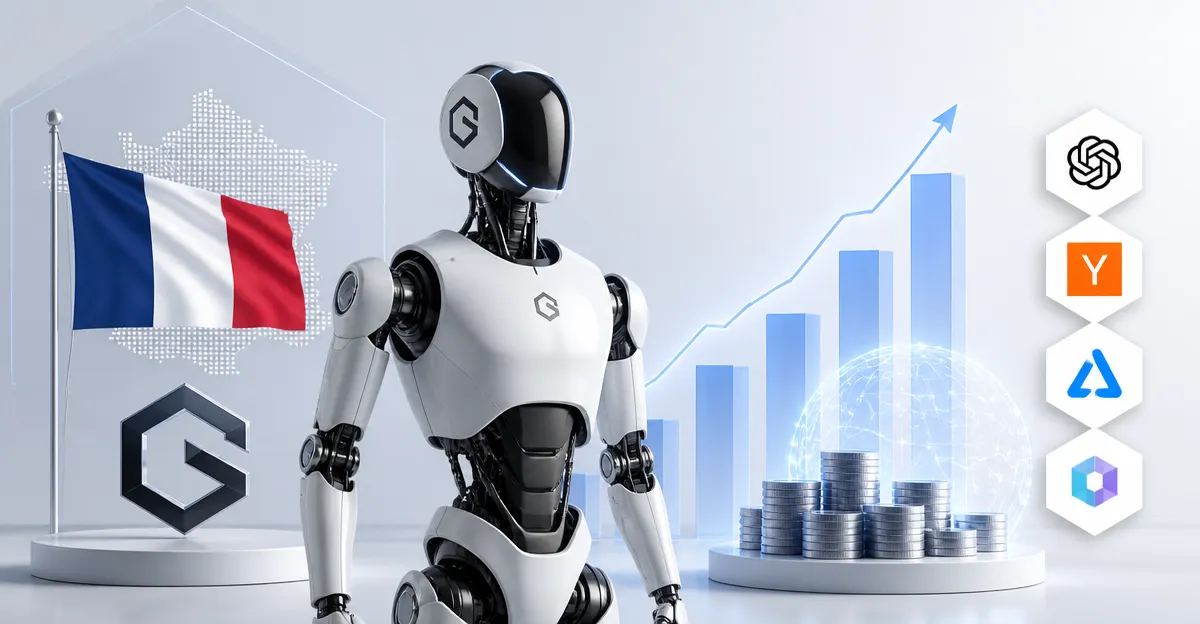
November 17, 2026, (Inside AI) — Genesis AI, a French robotics startup, has raised $500 million in a Series A funding round that values the company at $3.5 billion, it announced Tuesday. The round ranks among the largest ever for a European robotics company and signals intense investor appetite for AI-powered industrial machines.
The funding was co-led by Khosla Ventures, Premji Invest, and Eclipse. Other backers include former Google CEO Eric Schmidt, French telecom billionaire Xavier Niel, chipmaker Nvidia, and French state-backed investor Bpifrance. The company plans to use the capital to scale production of its flagship robot, Eno, expand data collection and AI training, and sharpen the robot's manual dexterity.
Genesis, co-founded by former Mistral AI researcher Théophile Gervet, is betting that vertical integration, designing its own actuators, motors, gearboxes, and hands while developing AI in-house, will shorten test cycles and speed up deployment. The company also has a headquarters in San Carlos, California, and is initially prioritizing the United States market, with plans for a US supply chain and American contract manufacturers before expanding in Europe.
CEO Zhou Xian said the company would use the fresh funds to increase production of Eno, a general-purpose robot designed for factory and logistics work. The robot's unusual form factor, three body segments resembling oversized playing cards mounted on a rotating wheeled base, allows it to fold into a compact space and pop up to roughly human height when operating. Genesis said it placed particular emphasis on developing dexterous hands, one of the hardest technical challenges in robotics.
Read: GenRobot AI Raises $100 Million for Robot Training Data
"I don't understand why robots need a head because ... it doesn't even have a brain living there," Zhou said, explaining why Genesis rejected a more human-like form.
The round lands as Europe's robotics sector gains momentum. Britain's Humanoid and Germany's Neura Robotics, Agile Robots, and RobCo are among a growing group of Europe-based robotics companies valued at more than $1 billion and targeting industrial work. Genesis's valuation places it in that cohort, though it is testing only a small number of robots with customers. It has a partnership with South Korea's LG CNS to test Eno for manufacturing and logistics, and expects a wider customer rollout in 2027.
The involvement of Nvidia is notable. The chipmaker has been actively investing in robotics startups that rely on its computing platforms, and Genesis uses Nvidia chips for its AI training. Nvidia's backing gives Genesis access to hardware and software ecosystems that could accelerate development.
Genesis's decision to design components in-house, including actuators and gearboxes, is unusual for a startup at this stage. Most robotics firms rely on off-the-shelf parts, but Genesis argues that vertical integration allows it to iterate faster and control costs. The strategy carries risks, as manufacturing complex components at scale is capital-intensive and requires specialized expertise.
The company's focus on dexterous hands reflects a broader industry shift. While robots have mastered locomotion and basic manipulation, human-like hand dexterity remains elusive. Advances in AI, particularly reinforcement learning and simulation, have made progress possible, but commercial deployment at scale is still years away.
Genesis's US-first strategy is pragmatic. The US offers a large industrial base, favorable investment climate, and proximity to Nvidia and other tech partners. However, it also puts Genesis in direct competition with American robotics firms, many of which are better funded and further along in commercialization.
Read: XPeng Activates Automated Production Line for IRON Humanoid Robot
The Series A round is unusually large for a European startup at this stage, reflecting both investor enthusiasm and the capital intensity of robotics. Building robots requires significant spending on R&D, manufacturing, and customer acquisition. Genesis's $3.5 billion valuation implies high expectations, and the company will need to demonstrate commercial traction to justify it.
Genesis's partnership with LG CNS provides a foothold in Asian manufacturing and logistics, a key market for industrial robots. The company expects a wider rollout in 2027, but scaling production and deploying robots in customer facilities will test its execution capabilities.
For now, Genesis has the capital and backers to pursue its vision. The challenge will be turning technical promise into reliable, cost-effective products that customers are willing to adopt at scale.

Tobias is less interested in what a robot or a prompt can do today than in what it means for tomorrow. He writes about prompt engineering and robotics for readers who want context, not just specs.