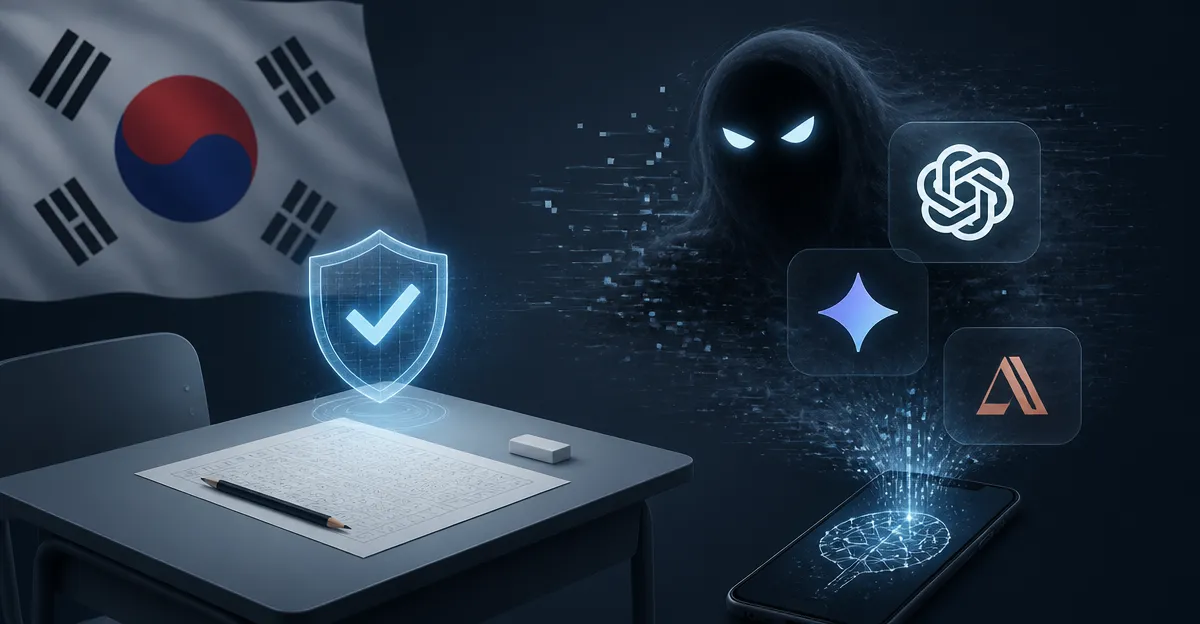
November 18, 2026, (Inside AI) — South Korea's high-stakes university entrance exam, the Suneung, will proceed on Thursday with an unprecedented concern: the potential for AI-driven cheating. A total of 551,864 students are registered to sit the exam, according to official figures. The test, which largely determines university admissions and career prospects in the country, is now shadowed by the possibility that candidates might exploit artificial intelligence tools to gain an unfair advantage.
The Suneung, formally known as the College Scholastic Ability Test, is a grueling eight-hour marathon held once a year. It includes multiple-choice sections and essay questions. The exam's outcome often dictates access to top universities, which in turn influences job opportunities and social standing. This year, education authorities face the added challenge of policing AI use, a task that is complicated by the sheer scale of the test and the rapid proliferation of AI technologies.
South Korea's education ministry has not publicly detailed specific measures to counter AI cheating, but the issue has been simmering for months. In a statement, a ministry official said, "We are aware of the potential risks and are working with relevant agencies to ensure the integrity of the exam." The official spoke on condition of anonymity because they were not authorized to speak to the media. The ministry's silence on concrete steps has left some parents and educators anxious.
Why AI Cheating Fears Are Growing
The concern is not unfounded. AI tools, particularly large language models, have become increasingly adept at generating coherent essays and solving complex problems. In 2023, a South Korean university reported an incident where a student used ChatGPT to complete an assignment, sparking a nationwide debate on academic integrity. Since then, the government has issued guidelines for schools, but enforcement remains patchy. The Suneung, with its high stakes, presents a tempting target for tech-savvy students.
However, experts point out that the exam's format may limit AI's utility. The test is administered in secure venues with strict rules: no electronic devices are allowed, and proctors monitor students closely. "The Suneung is designed to be resistant to cheating," said Kim Jin-ho, a professor of education at Seoul National University. "But AI is a new frontier. We need to update our defenses without disrupting the exam's fairness." Kim's comments echo a broader concern that traditional anti-cheating methods may not suffice against AI.
Industry analysts note that AI cheating is not just about using devices during the exam. It could involve pre-exam preparation, such as using AI to generate practice essays or even to predict exam questions. The Korean Institute of Curriculum and Evaluation, which oversees the Suneung, has not reported any confirmed cases of AI cheating. Yet the specter alone has prompted calls for reform. Some lawmakers have proposed legislation that would criminalize the use of AI in high-stakes exams, but no bill has been passed.
This is not the first time technology has challenged exam integrity. In the 2000s, the rise of mobile phones led to bans on devices in exam halls. More recently, smartwatches and hidden earpieces have forced authorities to invest in signal jammers and metal detectors. AI, however, is different because it can be used before the exam to enhance a student's knowledge base or to craft essay responses that are memorized and reproduced. "The line between legitimate study aid and cheating is blurring," said Park Soo-yeon, a researcher at the Korea Education Development Institute. "We need clear definitions and consistent enforcement."
The stakes are particularly high for South Korea's economy, which relies on a highly educated workforce. The Suneung is a key sorting mechanism for talent. Any erosion of trust in the exam could have long-term consequences. The education ministry has announced a review of exam security protocols, but details are scarce. Meanwhile, students are left to navigate a system that is still catching up with technology.
Read: CAT 2026 to Use AI Facial Recognition for Candidate Verification
As the exam approaches, the atmosphere in Seoul is tense. Study cafes are packed with students making final preparations. Some parents have hired private tutors to help their children use AI responsibly, while others worry about unfair advantages. The government's response will be closely watched, not just in South Korea but also in other countries grappling with similar issues. The Suneung's outcome may set a precedent for how societies balance technological innovation with academic integrity.

Sofia spent years studying how machines parse human language before pivoting to cover the systems now rewriting it. She reads technical papers the way others read news and looking for what the numbers are actually saying beneath the headlines.