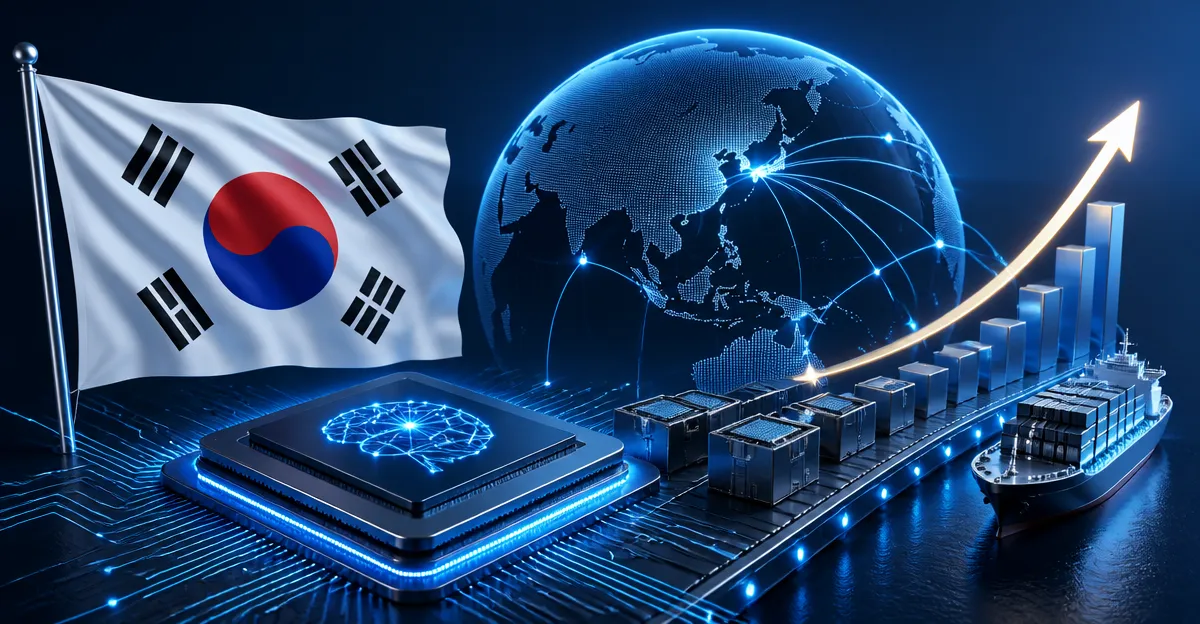
November 19, 2026, (Inside AI) — South Korea has become the fourth country in the world to surpass $1 trillion in annual exports, a milestone reached on Thursday as global demand for artificial intelligence chips propelled the nation past its previous record of $709 billion. The trade ministry confirmed the threshold was crossed at 0509 GMT, placing South Korea alongside Germany, the United States, and China in an exclusive economic club.
The achievement arrives less than a year after South Korea's economy grew just 1% in 2025, underscoring how completely the AI infrastructure buildout has reshaped the country's trade profile. Samsung Electronics and SK Hynix, the two memory chip giants headquartered in the country, have become linchpins of the global supply chain for high-bandwidth memory used in AI accelerators.
Yet the export figures mask a stark domestic reality. Consumer sentiment remains depressed by elevated interest rates and persistent inflation. The benchmark Kospi index has experienced unusual volatility, and the benefits of the chip boom have yet to reach ordinary households. This disconnect between macro-level triumph and micro-level strain defines the political challenge facing President Lee Jae Myung.
Can an Export Boom Fix Household Finances?
The Lee administration has proposed a 162.3 trillion won ($121.94 billion) Future Response Fund designed to channel excess tax revenue from semiconductor exports into growth industries, youth programs, regional development, and education. The fund represents an explicit acknowledgment that export-led growth alone does not automatically translate into broad prosperity.
Read: Nvidia's 260,000 GPU Pledge
"Now, we need to turn this achievement into sustainable growth. We will enhance the competitiveness of major industries and grow future growth engines, such as AI and bio," Lee said in a post on X.
"Most of all, the achievement in exports should improve the lives of the people. We will create 'growth for all', sharing the opportunities and fruits of growth with big and small companies as well as the capital area and regional areas," Lee said.
The president's framing reflects a broader anxiety in Seoul. South Korea's economic model has long depended on a handful of conglomerates dominating exports while smaller firms and regional economies lag. The chip boom has intensified that concentration rather than diluted it. Samsung and SK Hynix account for a substantial share of the export surge, and their supply chains remain heavily weighted toward the Seoul metropolitan area.
Finance ministry officials project economic growth will accelerate to the mid-3% range this year, a sharp rebound from 2025. The finance minister attributed that forecast directly to record chip exports during a briefing last month.
The global AI investment cycle shows few signs of cooling. Hyperscale data center operators continue to place large orders for advanced memory, and South Korean manufacturers have invested heavily in capacity expansion. That positions the country well for the near term, but it also exposes the economy to any correction in AI capital expenditure.
The Future Response Fund, if enacted, would represent one of the more direct attempts by any government to capture windfall gains from the AI boom and redistribute them toward longer-term priorities. Whether it can meaningfully address the domestic demand weakness remains uncertain. Consumer confidence surveys have shown little improvement despite headline export numbers.
South Korea's achievement places it in rare company. Germany, the United States, and China each crossed the $1 trillion export threshold in prior years, but South Korea's path has been uniquely concentrated in a single technology sector. That distinction carries both advantages and risks as the AI investment cycle matures.

If a research paper dropped this week, Mahesh has already read it. He covers AI tools and vibe coding for builders who need to know what is worth their time and what is not.