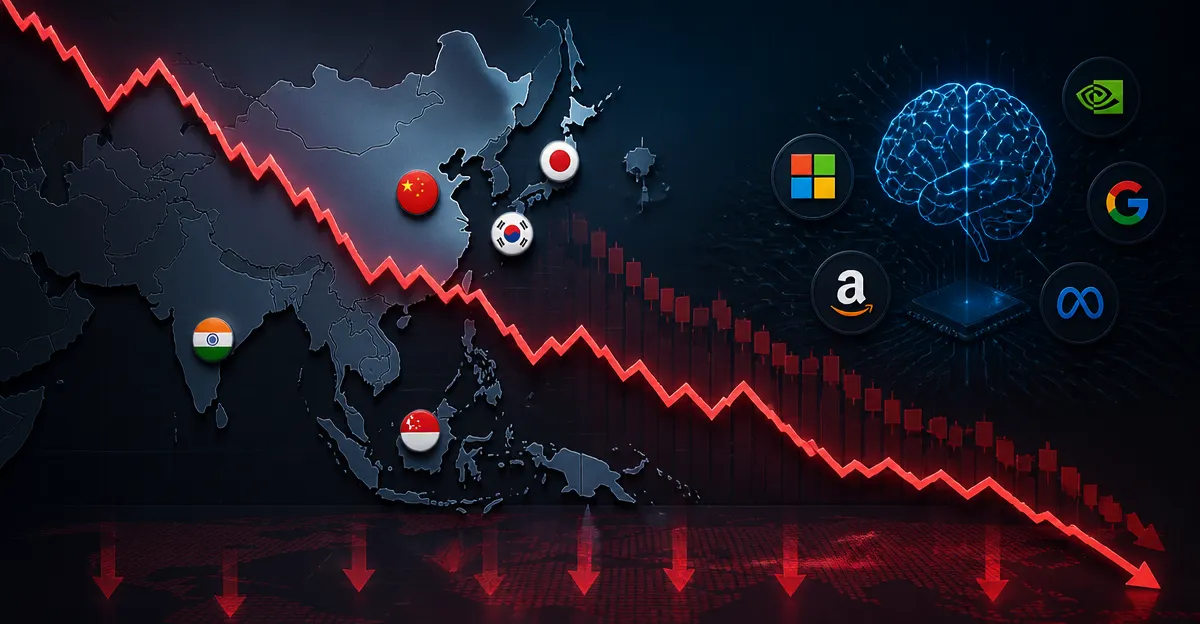
November 20, 2026, (Inside AI) — Anthropic became the first frontier AI company to trade publicly this week, and the market's verdict was swift and unkind. The debut, billed as a coming-of-age moment for the sector, instead coincided with a broad retreat in AI-linked equities across Asia, Europe, and the United States. By early European trade, pan-region Euro Stoxx 50 futures had fallen 1.6%, while S&P 500 e-minis pointed to a further 0.6% decline. The MSCI broadest index of Asia-Pacific shares outside Japan headed for its worst week since the height of the COVID-19 pandemic in 2020.
The timing matters. Anthropic's listing was supposed to validate the commercial case for frontier AI labs. Instead, it landed in a week when Nvidia's blowout earnings failed to rally the sector, when AMD faced fresh questions about its China ties, and when investors began openly asking whether the boom has peaked. The result is a market that treats good AI news as a selling opportunity, a pattern that historically signals crowded-trade unwinding rather than company-specific weakness.
Nvidia's Beat Couldn't Hold The Line
The clearest warning sign came from Nvidia. The chipmaker delivered what analysts described as blowout quarterly results, the kind of print that in prior cycles would have lifted the entire AI supply chain. This time, the numbers were overshadowed by uncertainty following the exit of CEO Jensen Huang. Investors read the departure as a governance risk at the very company that anchors the sector's valuation story.
That reaction reveals how fragile sentiment has become. When the bellwether beats and the stock still struggles, the market is no longer pricing growth. It is pricing the probability that the growth is already reflected in prices, and that the next catalyst has to be exceptional to move the needle.
"Are we nearing the end of the AI boom?"
The question, posed by Jiaxing Li in a market note, captures the mood better than any data point. It is not a prediction. It is a confession that the list of positive catalysts is thinning.
Anthropic's own trading debut did little to answer it. A turbulent first session for the world's first publicly traded frontier AI company suggests investors are unsure how to value a business whose revenue is growing fast but whose path to durable profit remains unproven. Public markets demand quarterly visibility. Frontier AI labs operate on research timelines measured in years.
The deeper issue is that AI valuations have been built on a chain of assumptions: that enterprise adoption accelerates, that compute costs fall, and that regulation stays predictable. Each assumption now faces a stress test. Anthropic's IPO was supposed to be the proof point for the first. Instead it became a referendum on all three.
AMD's China Exposure Draws A Short Report
Regulatory risk moved to the foreground as well. AMD now appears next in line for greater US scrutiny after a short report raised concerns about the chipmaker's ties to Chinese entities, some of which have links to firms on US blacklists. The report has not been independently verified by Inside AI, but the market reaction was immediate. For chipmakers, China exposure is no longer just a revenue line. It is a compliance liability that can reprice a stock in hours.
This is the second front in the sector's pressure campaign. The first is demand uncertainty. The second is the growing cost of operating across geopolitical fault lines. Companies that spent years building dual-market supply chains now face the prospect that those chains become evidence in a regulatory inquiry.
Meanwhile, capital is rotating toward safety. The US dollar stood near a 19-month peak, supported by risk aversion and by growing conviction that the Federal Reserve will raise its key interest rate at its final policy meeting of the year. Treasury yields eased as investors bought government debt. When cash and bonds look attractive again, high-multiple AI stocks face a simple arithmetic problem: the discount rate goes up, and future earnings are worth less today.
None of this means the AI buildout is over. Data center construction continues. Enterprise pilots are converting to production contracts. But public markets price expectations, not infrastructure. And the expectation trade is unwinding.
What happens next depends on whether the sector can produce a catalyst that is not a beat-and-raise from the same handful of companies. Anthropic's listing was meant to broaden the base. Its first day suggests the base is narrower than the bulls believed.

Shamil has a low tolerance for AI that only works in controlled demos. He covers agentic systems and generative AI with the skepticism of someone who has seen too many “revolutionary” tools quietly disappear six months after launch.