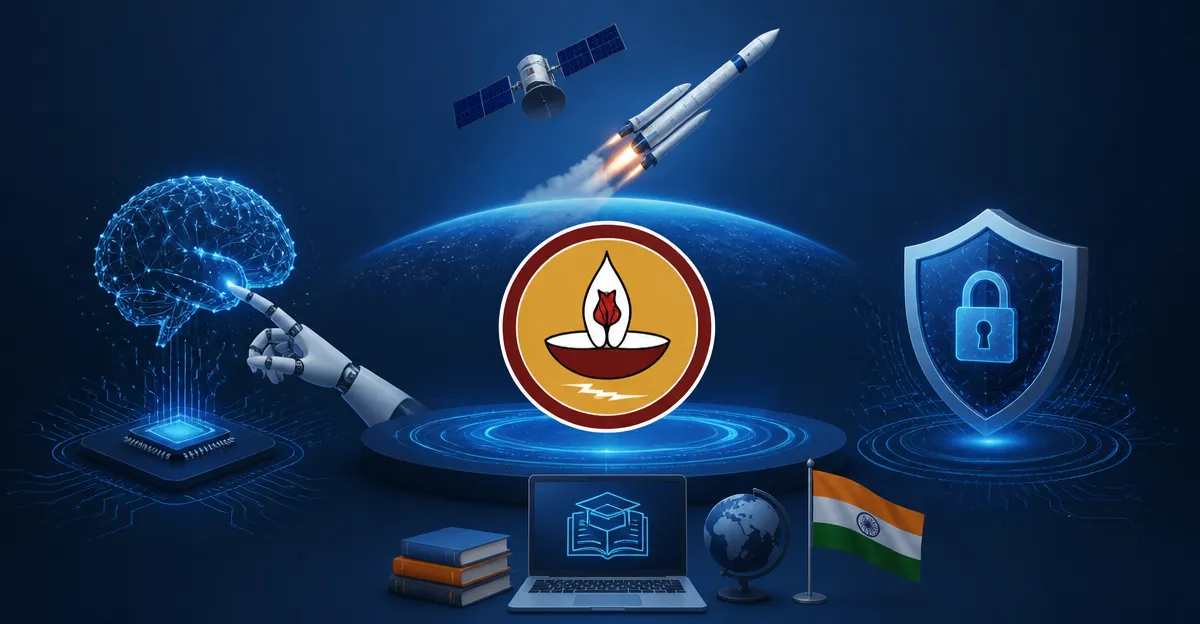
November 20, 2026, (Inside AI) — The Indian Institute of Technology Madras (IIT Madras) has opened registrations for the January 2027 batch of its School Connect Programme, offering 20 online certificate courses to students in Classes 9 through 12. The eight-week courses, which begin on 11 January 2027, cost Rs 500 per course and cover subjects from artificial intelligence and cybersecurity to aerospace engineering and forensic sciences.
The programme, run by IIT Madras's Centre for Outreach and Digital Education (CODE), aims to give school students early exposure to emerging technologies and interdisciplinary fields that fall outside their standard curriculum. It also seeks to help them make informed decisions about future academic and professional pathways. Schools across India can participate at no cost, but they must nominate a teacher as a Single Point of Contact and submit an online Expression of Interest.
This initiative arrives as India's National Education Policy 2020 pushes for early vocational and technical exposure, and as demand for AI-literate graduates surges. By targeting students as young as 14, IIT Madras is betting that early familiarity with fields like data science and cybersecurity will widen the talent pipeline for a country racing to build domestic AI capacity.
Why A Premier Institute Is Courting Schools
The programme's structure reflects a broader shift in how elite technical institutions engage with secondary education. Rather than waiting for students to arrive on campus, IIT Madras is embedding itself in schools through a low-cost, high-reach model. The Rs 500 fee per course is nominal compared to typical online certifications, and the zero-cost partnership for schools removes a key barrier to entry.
Read: Robin Li's AI Bubble Warning
Prof Andrew Thangaraj, Chair of CODE at IIT Madras, framed the programme as a collaborative effort. "IIT Madras is encouraging schools across India offering Classes 9 to 12 to become partners. There is no partnership or registration fee for schools. Interested schools are required to nominate a teacher as a Single Point of Contact (SPOC) and submit an online Expression of Interest. Partner schools will facilitate student enrolments and coordinate programme-related activities," he said.
The 20 courses span an unusually wide range for a school-level programme: Data Science and Artificial Intelligence, Electronic Systems, Aerospace Engineering, Cybersecurity, Architecture and Product Design, Forensic Sciences, Game Technology, Digital Humanities, Ecology, Mathematics, and Economics. Courses are taught by faculty from IIT Madras and other premier academic and research institutions.
The breadth is deliberate. By offering subjects like Digital Humanities alongside Aerospace Engineering, IIT Madras signals that it is not just chasing tech hype but exposing students to the full spectrum of interdisciplinary work that modern engineering and research demand. This approach could help students discover aptitudes they might never encounter in a standard science or commerce stream.
The programme also gives schools a way to supplement classroom learning with structured content developed by experts. For many schools, especially those outside major cities, access to IIT-caliber instruction is rare. The online format and low fee could democratize that access, though questions remain about digital infrastructure and whether the most underserved students can reliably participate.
A Pipeline Play With Unclear Returns
IIT Madras is not the first institution to try school-level outreach, but the scale and specificity of this effort stand out. The programme's success will depend on how many schools sign up and whether students complete the eight-week courses. Completion data, not enrollment numbers, will be the real measure of impact. For now, the institute is casting a wide net, and the January 2027 batch will be an early test of whether early exposure translates into lasting interest.
Read: Anthropic IPO and Asian Startups
Registrations are open now, and schools have until the batch start date to submit their Expression of Interest. Students can enroll through their partner schools. The programme represents a modest but concrete step toward integrating emerging technology education into India's school system, one course at a time.

Shamil has a low tolerance for AI that only works in controlled demos. He covers agentic systems and generative AI with the skepticism of someone who has seen too many “revolutionary” tools quietly disappear six months after launch.