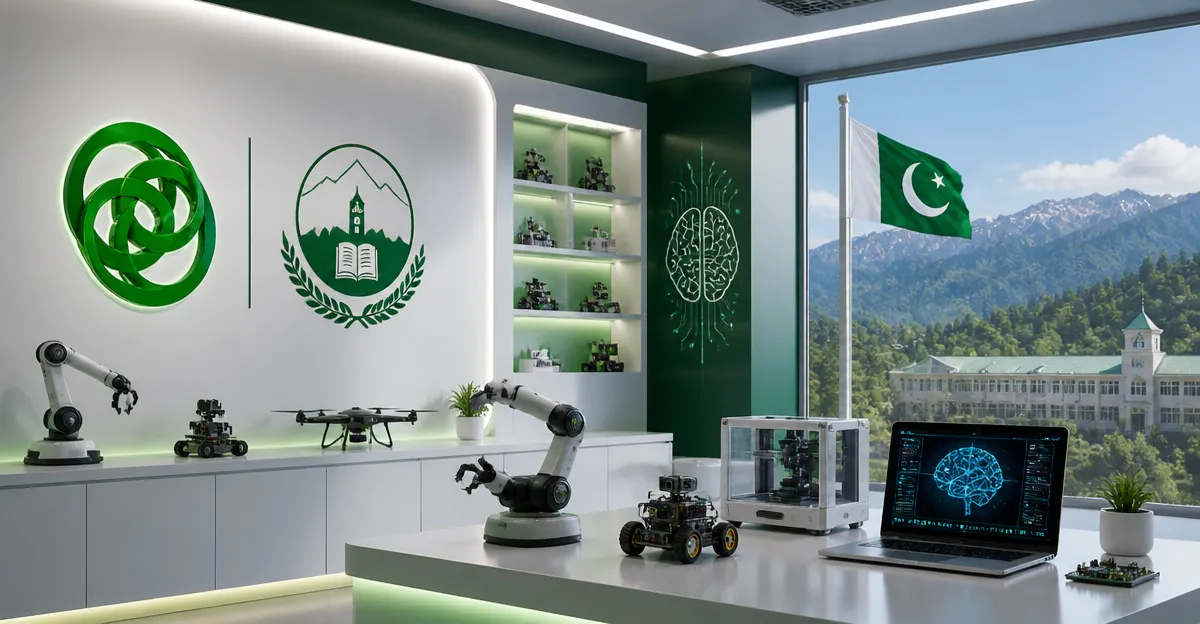
November 21, 2026, (Inside AI) — The National Bank of Pakistan (NBP) has opened an artificial intelligence, robotics, and STEM laboratory at Abbottabad Public School (APS), giving students in the northern Pakistani city hands-on access to emerging technologies. The lab was inaugurated during the school's Annual Parents' Day ceremony, with Federal Minister for Education Wajiha Qamar, APS Principal Akhtar Ali Qureshi, and other guests in attendance.
The initiative was led by Farhan J. Durrani, Divisional Head of NBP's Digital Banking Group. According to NBP, the facility will support practical learning in artificial intelligence, robotics, and related fields. The bank's Chief Digital Officer, Adnan Nasir, said the project reflects NBP's commitment to innovation and digital education while preparing students for a technology-driven future.
"This initiative reflects our commitment to promoting innovation and digital education while preparing students for a technology-driven future," Nasir said in a statement.
The lab's opening comes as Pakistan's banking sector increasingly funds education technology projects, though critics question whether such corporate-backed facilities can scale beyond elite urban schools. Abbottabad, best known as the garrison city where Osama bin Laden was killed in 2011, hosts a growing number of private schools seeking to modernize curricula.
Read: Google grants $5 million to IIT Kharagpur for AI research and education
NBP has not disclosed the lab's cost, equipment specifications, or the number of students it will serve. The bank also did not say whether it plans to replicate the model at other schools. Inside AI could not independently verify these details.
Corporate Funding Meets Public Education
The Abbottabad lab joins a small but expanding set of similar projects in Pakistan. Telecom operator Jazz has funded digital labs in Lahore and Karachi, and the British Council has supported STEM programs in Punjab province. However, most of these facilities remain concentrated in major cities, leaving schools in smaller towns like Abbottabad with limited access to such resources.
Federal education minister Wajiha Qamar's presence at the inauguration signals government interest in private-sector partnerships. Pakistan's national AI policy, approved in 2024, calls for expanding AI education at the secondary level, but implementation has lagged due to budget constraints. Corporate-funded labs could fill part of that gap, though they raise questions about long-term sustainability and curriculum alignment.
NBP's digital banking division has expanded its technology investments in recent years. The bank launched a digital wallet and upgraded its mobile app in 2025. The Abbottabad lab represents a shift toward community-facing technology spending, a strategy some banks use to build goodwill and future customer pipelines.
Whether a single lab in one school can meaningfully change technology education in Pakistan's Khyber Pakhtunkhwa province remains uncertain. The facility's impact will depend on teacher training, equipment maintenance, and whether NBP commits to ongoing support beyond the initial launch.
Read: IIT Madras Opens 20 AI, Aerospace, Cybersecurity Courses for School Students
For now, students at APS have access to tools that most of their peers in the region lack. The bank has not said if it will publish usage data or outcomes from the lab.

Shamil has a low tolerance for AI that only works in controlled demos. He covers agentic systems and generative AI with the skepticism of someone who has seen too many “revolutionary” tools quietly disappear six months after launch.