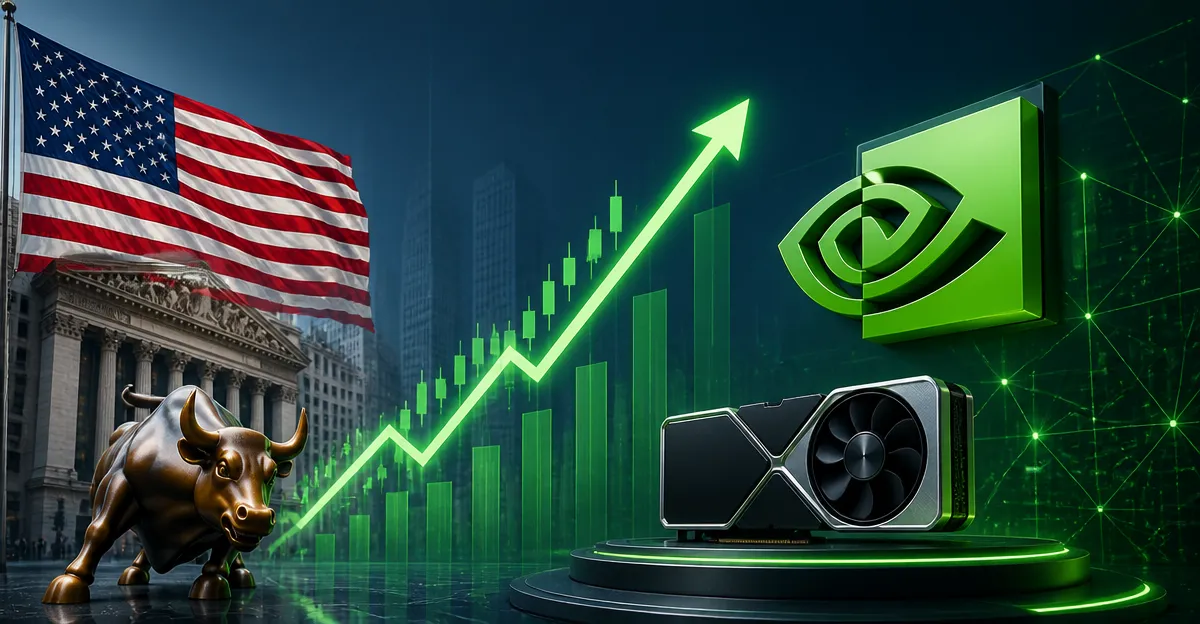
November 24, 2026, (Inside AI) — US stocks staged a sharp rebound on Monday after Nvidia announced the reinstatement of Jensen Huang as chief executive, reversing his abrupt departure and pulling investors back into artificial intelligence shares. The tech-heavy Nasdaq jumped 6.5%, adding more than $2 trillion in market value. The Dow gained 3%, and the S&P 500 climbed about 4.75%. Nvidia shares closed more than 31% higher, their biggest daily percentage gain since May 9, 2003.
The rally follows last week's rout, which was triggered by Huang's exit. His return restored confidence in the AI trade, but the episode exposed how much of the market's value rests on a single executive. The speed of the rebound has not erased concerns about structural fragility in the AI sector.
One Person Cannot Hold Up A Market
Alexander Morris, CEO of F/m Investments, warned that the market's dependence on Huang is a danger sign, not a comfort.
"It's clear that there was one person propping up a very large chunk of the financial economy, and animal spirits are running wild in the market. So if one person can do this today and reinstating them can more or less undo it, You should be just as worried about there being some other structural pillar that you just haven't seen yet that could be removed just as quickly." Alexander Morris, CEO, F/m Investments.
The broader market joined the surge. Amazon, Meta, and Alphabet all gained ground. Neocloud and data center companies, which had plummeted after Huang's exit, also jumped. CoreWeave climbed more than 22%.
One notable exception was Anthropic, which closed lower just days after its super-sized market debut. The divergence suggests investors are not simply buying every AI name. They are distinguishing between companies with direct ties to Huang's leadership and those without.
The scale of Nvidia's move is unusual. A 31% single-day gain for a company of its size is rare. The last time Nvidia rose that much in a day was in 2003, when it was a much smaller graphics chip maker. Monday's move added tens of billions in market value in a single session.
The reinstatement itself was extraordinary. Huang had left the company abruptly, though the circumstances of his departure remain unclear. His return was announced before markets opened on Monday, and investors responded immediately. The decision to bring back a founder-CEO is not unprecedented in corporate history, but it is unusual for a company of Nvidia's current scale and strategic importance.
For the AI sector, the message is mixed. On one hand, Huang's return reassures investors who see him as the architect of Nvidia's AI strategy. On the other hand, the episode shows how quickly confidence can evaporate when a key figure leaves. The market's reaction suggests that Nvidia's valuation is tied not just to its products but to its leader.
The rebound also raises questions about the depth of the AI trade. If a single personnel change can trigger a rout and a single reinstatement can reverse it, the market may be more fragile than it appears. Morris's warning about unseen structural pillars is a reminder that the AI boom has concentrated risk in a few names and a few people.
Anthropic's decline is a case in point. The company went public just days ago, and its shares fell even as the broader market rallied. Investors may be rotating out of newly public AI firms and back into established leaders like Nvidia. Or they may be skeptical of Anthropic's valuation after its debut.
For now, the rebound has calmed nerves. But the underlying jitters remain. The AI trade is still concentrated, and the market's dependence on a handful of leaders has not changed. Monday's rally may have bought time, but it has not solved the structural issues that Huang's departure exposed.

Shamil has a low tolerance for AI that only works in controlled demos. He covers agentic systems and generative AI with the skepticism of someone who has seen too many “revolutionary” tools quietly disappear six months after launch.