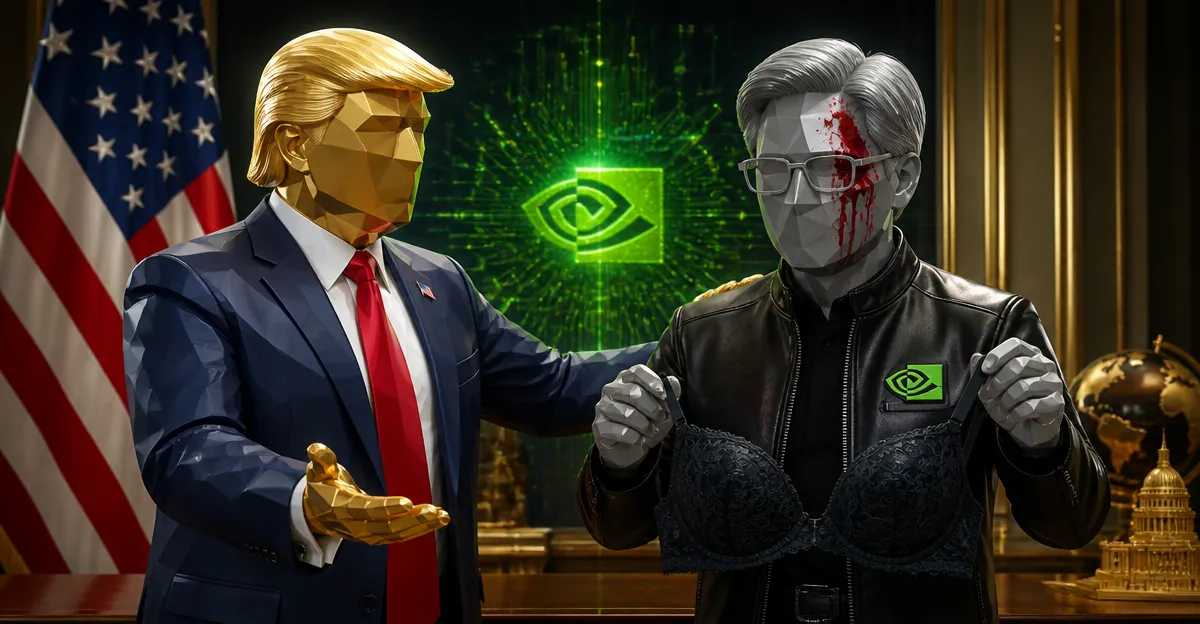
November 24, 2026, (Inside AI) — US President Donald Trump on Monday shared an AI-edited version of the July 2024 Pennsylvania rally photograph in which he survived an assassination attempt, replacing his own face with that of Nvidia chief Jensen Huang. The image shows Huang with blood streaked across his face, one fist raised, and a red bra held aloft, set against a backdrop banner carrying the Nvidia logo.
The post landed hours after Nvidia's board voted unanimously to reinstate Huang as president, CEO and director, reversing a decision made just 11 days earlier. Trump had publicly pressed the board to act, and the White House now says it sees no national security concern in the reinstatement.
The sequence matters beyond the meme. Huang's brief removal followed reports about his alleged relationships with Alice Huang, described in some accounts as a suspected Chinese spy, and two other subordinates. Those reports raised questions about exposure at the world's most valuable chipmaker, a company whose processors underpin most frontier AI training. Trump's intervention, and the board's swift reversal, put the episode at the intersection of corporate governance, national security and presidential politics.
Why The Board Reversed Itself In Eleven Days
Huang stepped down on November 12. Six days later, the board's chairman reportedly told associates there were no plans to bring him back. By November 23, the board had voted unanimously to restore him. The company has not published a detailed rationale for the reversal, and Inside AI could not independently verify the internal deliberations.
Trump's public backing began before the board moved. In posts on Truth Social, he described Huang as a national asset and argued the country needs his leadership at Nvidia for the good of the company and the US economy. He also said the government has no reason to believe Huang's return endangers national security.
"The board made the right call," Trump wrote in one post, according to a readout of the statement. In a separate post he congratulated Nvidia and called the decision a great one. He later told CNBC that he had personally urged board members to bring back the company's founder.
The edited photograph borrows from one of the most recognizable images of the 2024 campaign. In the original, Secret Service agents surround Trump after the attempt on his life, blood running down his face as he raises his fist. In Trump's version, the US flag behind him becomes an Nvidia banner, and the raised fist now belongs to Huang.
Nvidia declined to comment on the image. The White House did not respond to questions about why the president chose that particular photograph as the vehicle for his endorsement.
The affair carries a governance cost that will outlast the news cycle. A board that removes a founder-CEO over security-linked allegations, then restores him within eleven days under public pressure, invites scrutiny of how independent its oversight really is. Nvidia sits at the center of US export controls on advanced chips, and any perceived political influence over its leadership decisions complicates the company's standing with regulators and foreign customers alike.
An Image That Blurs Endorsement And Leverage
Trump's use of the rally photograph is unusual even by his standards. The original image became shorthand for defiance after the shooting in Butler, Pennsylvania. Repurposing it to boost a semiconductor executive fuses two unrelated narratives: the president's personal survival and the fate of a company central to the AI buildout.
The bra in Huang's raised hand has no explained origin. Neither the White House nor Nvidia has addressed it. The detail has circulated widely online, and it risks distracting from the substantive questions about Huang's reinstatement and the security review that preceded his exit.
Huang's return also revives the underlying allegations. Reports about Alice Huang and the two other subordinates have not been resolved publicly. No charges have been announced against Jensen Huang, and he has not commented on the claims. Nvidia's board has not said whether it conducted a new review before reinstating him.
For the AI industry, the practical effect is a chipmaker led again by its most visible figure at a moment of intense demand. Nvidia's customers, including the largest cloud providers and AI labs, depend on continuity at the top. The eleven-day gap introduced uncertainty into supply commitments and partnership talks, according to two people familiar with the matter who spoke on condition of anonymity.
Trump's posts framed the decision as economic patriotism. "We need his leadership," he wrote, describing Huang as an asset to the country. The White House statement added that the government has no indication the return poses a security risk, a claim that stops short of a formal clearance.
The episode now moves to Washington, where lawmakers have already questioned how closely the executive branch should involve itself in the leadership of chip companies subject to export controls. Nvidia's board has not scheduled a public briefing. Huang is expected to address employees this week, though the company has not confirmed a date.

Shamil has a low tolerance for AI that only works in controlled demos. He covers agentic systems and generative AI with the skepticism of someone who has seen too many “revolutionary” tools quietly disappear six months after launch.