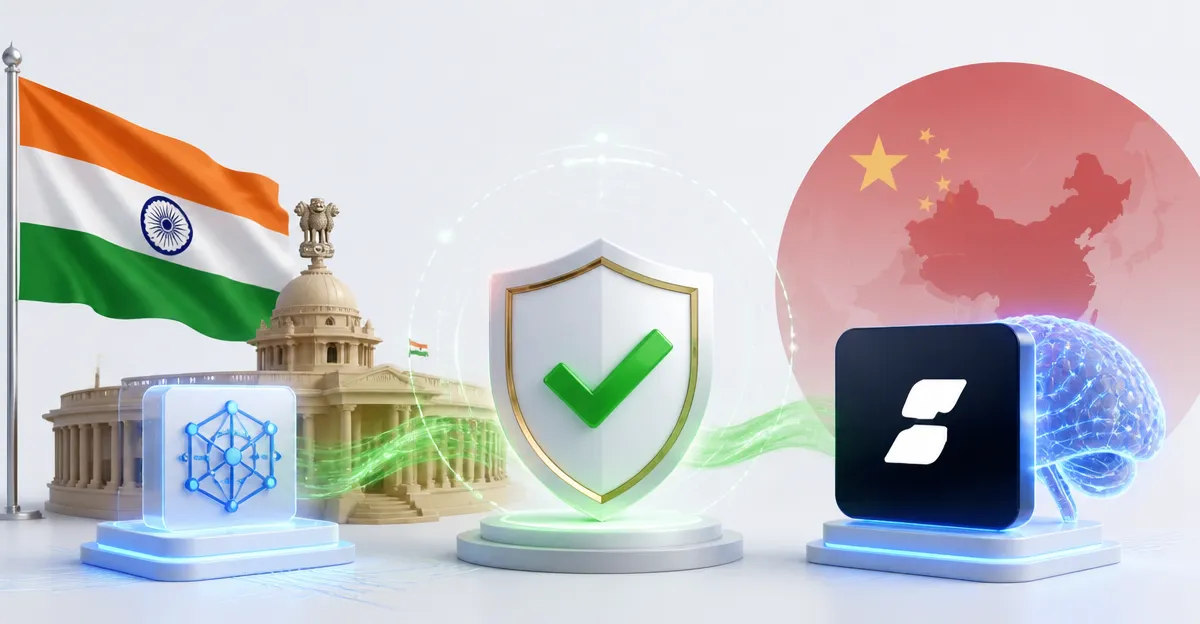
November 25, 2026, (Inside AI) — The Indian government has publicly defended homegrown AI startup Sarvam against accusations that its new Token Factory platform, which offers Chinese-developed AI models, misuses support from the Rs 10,370 crore IndiaAI Mission. S Krishnan, Secretary of the Ministry of Electronics and Information Technology, told reporters on Wednesday that the government sees no contradiction between Sarvam's commercial offerings and its mandate to build indigenous foundation models.
"Based on what Sarvam has told us, based on the experience that people have, we do not see any misuse of the support, which the IndiaAI Mission has provided to Sarvam in the service that they are now offering," Krishnan said.
The endorsement arrives at a critical moment for India's AI ambitions. Sarvam, one of the most prominent beneficiaries of the government's flagship AI funding program, launched Token Factory last week as an inference platform that hosts foreign open-weight models, including those from Chinese developers like DeepSeek, Moonshot AI, Alibaba, and Z.ai, alongside its own proprietary models. The move sparked debate over whether commercial pragmatism undermines the pursuit of technological sovereignty.
Token Factory allows businesses and developers to run AI models on computing infrastructure located in India, addressing data residency and latency concerns without requiring them to invest in expensive GPUs. The platform competes with global services such as Together AI, Fireworks AI, and DeepInfra, which offer similar model-hosting services.
Read: Cursor Weighs Phasing Out Chinese AI Models Amid Congressional Probe
The government's stance highlights a broader question: should sovereign AI mean developing foundation models domestically, or ensuring that the infrastructure and data remain under Indian control regardless of model origin? Krishnan's remarks suggest New Delhi favors the latter interpretation.
"I don't think there is any contradiction between what they are doing for the IndiaAI Mission and working towards the frontier model which will come in due course... After all, AI companies also require a revenue model," Krishnan added.
Sarvam co-founder Pratyush Kumar has previously clarified that Token Factory operates entirely on privately procured GPUs without government support. He explained that the IndiaAI Mission's subsidy, which provided a 40% discount on computing costs to around 20 startups, went directly to GPU cloud providers, not to Sarvam. The company used that subsidized access to train its proprietary Sarvam 105B model from scratch.
"The government did not pay Sarvam directly, instead like with every supported startup, the subsidy went to GPU cloud providers, helping seed AI infra in the country," Kumar said in a post on X.
Kumar also rejected the notion that offering foreign models conflicts with Sarvam's indigenous mission. "Building inference capability does not conflict with our core mission: training our own models," he said.
The company recently released an improved version of Sarvam 105B, claiming better reasoning, tool-calling, and Indian-language capabilities. It has also announced plans for models targeting vision, speech, and edge AI, and is working with partners to bring more advanced computing infrastructure into India for training larger foundation models.
Read: House Republicans Urge Trump to Back Open-Weight AI After China Trip
India's Sovereign AI Dilemma
Sarvam's situation mirrors challenges faced by other nations pursuing AI sovereignty. France's Mistral AI, for instance, offers both proprietary and open-source models while relying on foreign cloud providers. India's approach appears to prioritize building a domestic inference ecosystem and data control over strict model origin purity. The government's support for Sarvam's commercial strategy may signal that revenue generation is essential for sustaining AI research, even if it involves foreign models. This pragmatic stance could influence how other state-backed AI initiatives balance innovation with market realities.
As global AI competition intensifies, India's willingness to let its champion startup commercially host Chinese models while training its own suggests a nuanced understanding of sovereignty. The government's public backing may also ease investor concerns about Sarvam's dual strategy, which some critics viewed as contradictory. With Sarvam planning larger models and infrastructure expansion, the Token Factory controversy may ultimately be remembered as a test case for how developing nations navigate the fine line between self-reliance and global integration.

Sofia spent years studying how machines parse human language before pivoting to cover the systems now rewriting it. She reads technical papers the way others read news and looking for what the numbers are actually saying beneath the headlines.