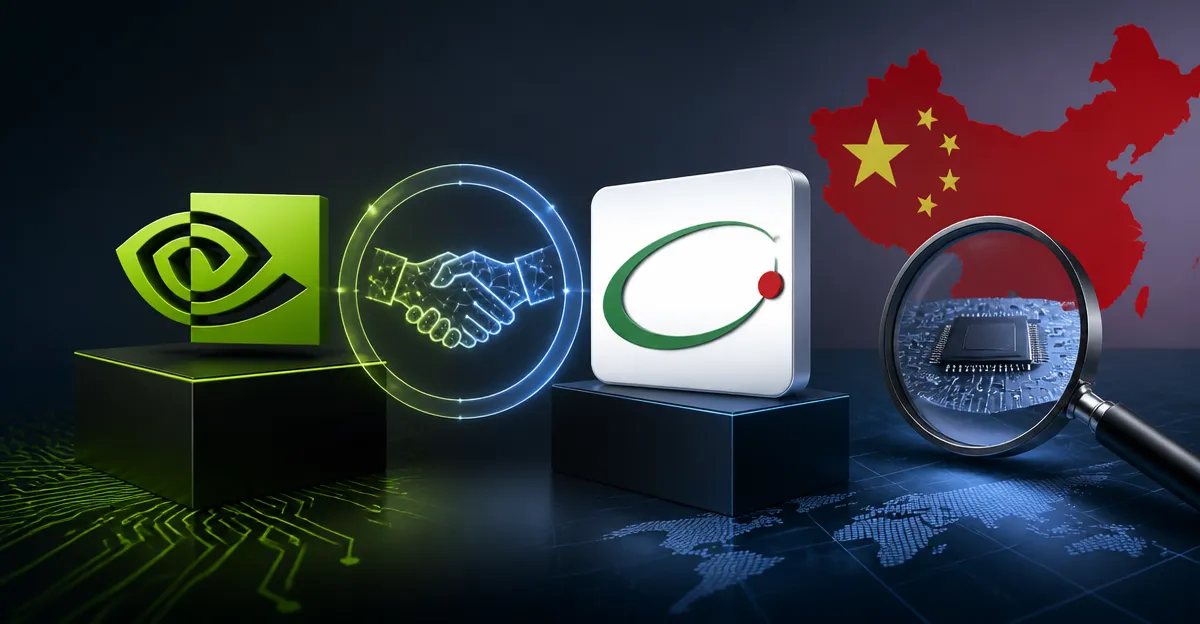
November 26, 2026, (Inside AI) — Jay Puri, who until recently led Nvidia's global sales operations, married a senior Super Micro executive in March, a relationship that has drawn scrutiny amid a federal probe into the alleged diversion of more than $500 million worth of Nvidia-powered servers to China. The connection between Puri and Cenly Chen, formerly Super Micro's chief growth officer, raises conflict-of-interest questions because Puri helped decide how Nvidia allocated its scarce AI chips to customers, including Super Micro, while Chen was a key point of contact for the server maker.
The relationship, first reported by The Wall Street Journal, comes as the U.S. investigates an alleged smuggling scheme involving Super Micro co-founder Yih-Shyan "Wally" Liaw. The timing is notable: Puri and Chen wed on March 7 in Big Sur, California, less than two weeks before federal prosecutors unsealed charges against Liaw and two others on March 19. The case has put a spotlight on the personal networks that underpin Nvidia's sprawling ecosystem of partners and customers.
Puri, 72, joined Nvidia in 2005 after stints at Sun Microsystems and other tech firms. He stepped back from leading global sales in July and was succeeded by Nicholas Parker, a former Microsoft executive, in August. Chen, 50, spent nearly two decades at Super Micro after joining in 2008, rising through sales ranks to oversee teams handling some of the company's largest customers. She left Super Micro weeks after attending Nvidia's annual conference in March, where she spoke about the partnership between the two companies. She is now CEO of ChronoScale, a cloud services company spun out of Applied Digital, another Nvidia partner.
During her tenure at Super Micro, Chen frequently dealt with Puri, according to employees at both companies cited by the Journal. She accompanied Super Micro CEO Charles Liang on visits to Nvidia's offices, where he pressed for chip supplies. In internal sales meetings, she encouraged colleagues to approach her with Nvidia-related questions, presenting herself as their point of contact. At the time, Puri's team decided how Nvidia distributed its latest chips among customers.
Chen denied that her relationship with Puri helped her professionally. "I never had to rely on personal relationships for professional gain," she said in an email to the Journal. She added that she did not select or procure Nvidia chips, noting that customers decided which chips they purchased.
Super Micro said Chen "did not manage Supermicro's overall relationship with Nvidia or our procurement of Nvidia graphics processing units (GPUs)". The company said a process involving several departments determined how it allocated Nvidia chips to its customers.
Allocation Power Meets Personal Ties
The scrutiny of Puri and Chen's relationship highlights a structural tension in the AI chip boom: Nvidia's allocation decisions can make or break a server maker's business. When supply is tight, as it has been for Nvidia's most advanced GPUs, the sales chief wields enormous influence. Any personal connection to a customer executive, even one that is disclosed, can create the appearance of favoritism. Applied Digital CEO Wes Cummins acknowledged that Chen's relationship with Puri created the appearance of a conflict of interest. He told the Journal that the relationship had prevented ChronoScale and Applied Digital from accessing some of Nvidia's customer assistance because of the disclosed conflict. Cummins also said he was unaware of Super Micro receiving any preferential treatment from Nvidia.
The federal investigation into Super Micro centers on allegations that Liaw and two others conspired to divert servers to China. Prosecutors claim they directed an unidentified Southeast Asian company to order around $2.5 billion worth of Super Micro servers in 2024 and 2025, then routed some equipment to China. Liaw has pleaded not guilty and resigned from Super Micro's board in March. The outside broker has pleaded guilty, while a Super Micro sales manager based in Taiwan has not appeared in court.
Super Micro was not named as a defendant and has said it was a victim of the alleged scheme. In August, the company said an independent review found no evidence that any current senior management member knew about the alleged diversion. It has cut ties with the individuals charged and is cooperating with authorities. Chen said she had not been contacted by federal law enforcement and was not named in the indictment.
The Puri-Chen relationship is not the only personal connection drawing attention. Nvidia CEO Jensen Huang faced scrutiny over an extramarital relationship with Alice Huang, an executive at Megaspeed International, another Nvidia customer. On November 17, Nvidia's board chair told investors that Jensen Huang would not be returning as CEO. Six days later, the board voted to bring him back. President Donald Trump welcomed the reinstatement, calling it "the correct decision" and saying it poses no risk to U.S. national security. Nvidia shares rose by about a third on November 23, according to Reuters, 11 days after Huang resigned over reports of alleged relationships with three people, including Alice Huang, whom U.S. officials reportedly see as a Chinese intelligence asset.
For Nvidia, the episodes underscore the difficulty of managing relationships in a sector where personal networks and business interests are deeply intertwined. The company has not commented publicly on the Puri-Chen matter. As the AI chip market continues to boom, the line between professional courtesy and conflict of interest will remain under close watch.

Sofia spent years studying how machines parse human language before pivoting to cover the systems now rewriting it. She reads technical papers the way others read news and looking for what the numbers are actually saying beneath the headlines.